
Mortgage Rates Just Hit a Four-Week High Thanks to Iran. Are Homebuilder Stocks a Buy on the Dip?
Key Points
Mortgage rates have risen over the last month as investors bet that the extended closure of the Strait of Hormuz could lead to inflation and higher interest rates.
Homebuilders have reported declining sales in the first quarter.
The housing market seems unlikely to recover as long as mortgage rates remain elevated.
The housing market has been nearly frozen since the pandemic.
A combination of high mortgage rates and the "lock-in effect" from low rates during the pandemic has kept existing home sales at unusually low levels and has pushed up home prices as there's not enough inventory for prospective buyers.
Will AI create the world's first trillionaire? Our team just released a report on the one little-known company, called an "Indispensable Monopoly" providing the critical technology Nvidia and Intel both need. Continue »
As the chart below shows, existing home sales have been hovering around an average annual rate of 4 million, well below the 5.5 million they were at before the pandemic.
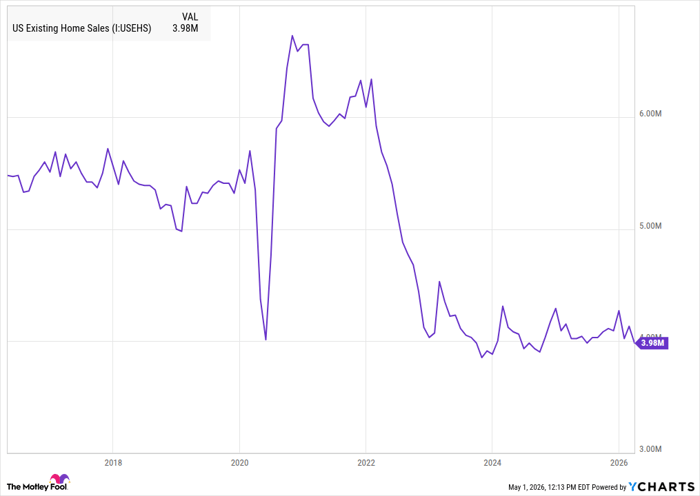
US Existing Home Sales data by YCharts
The lack of available homes for sale has created an opportunity for homebuilders, and for a while, they were taking advantage of that, but homebuilder stocks have slumped since peaking in late 2024 as expectations for interest rate cuts only modestly materialized, and a weakening labor market has pressured demand.
Now, homebuilder stocks are falling again as mortgage rates move higher due to the war in Iran.

Image source: Getty Images.
Mortgage rates are going up
Mortgage rates hit their highest level since April 3, with rates on the 30-year fixed mortgage rising to 6.45%, according to Mortgage News Daily.
As the blockade of the Strait of Hormuz continues, investors seem to be betting that interest rates are more likely to go up as inflation makes rate cuts less likely from the Fed, and could even persuade the central bank to raise rates.
Mortgage applications jumped 21% from a year ago last week, according to the Mortgage Bankers Association, showing increasing interest in home-buying as the spring season enters its peak.
Are homebuilder stocks a buy?
Homebuilder stocks have mostly slipped this week and have had mixed results over the last year.
If you're looking to get exposure to the sector, an easy way to do it is with an ETF like State Street SPDR S&P Homebuilders ETF (NYSEMKT: XHB), which holds homebuilders like D.R. Horton (NYSE: DHI) and Lennar, as well as building materials companies like Owens-Corning and home furnishing companies like Williams-Sonoma, which tend to be exposed to similar forces as homebuilders. The ETF currently trades at a price-to-earnings ratio of 17.5.
Homebuilders that have reported earnings this quarter have mostly delivered middling results. At D.R. Horton, the country's largest homebuilder, revenue fell 2.3% to $7.56 billion, and earnings per share declined as well, even as the company aggressively bought back stock over the last year.
NVR's (NYSE: NVR) revenue declined 22% to $1.88 billion, and Pulte Group (NYSE: PHM) reported a 12% decline in revenue to $3.41 billion.
Considering those results, it's clear that the weakness in the housing market remains, and a surge in homebuilding seems unlikely without lower interest rates, especially with the labor market weak.
Outgoing Fed Chair Jerome Powell was careful to not promise any moves by the Fed, and noted the uncertainty from the war, but some oil executives have said that high prices and disruptions could persist through 2027.
Against that backdrop, homebuilder stocks look set to remain stuck in neutral for the foreseeable future. While there remains a housing shortage in the country, and we could see a surge in home sales and homebuilding if rates come down, that could still be years away.
Jeremy Bowman has positions in SPDR Series Trust-State Street SPDR S&P Homebuilders ETF. The Motley Fool has no position in any of the stocks mentioned. The Motley Fool has a disclosure policy.