
This Boring Industrial Stock Is Helping Power AI Data Centers
Key Points
Management confidently raised its 2030 targets for revenue and margins at its recent Analyst Day.
Strong demand for backup power generators is allowing Cummins to diversify away from the truck market.
The power systems and distribution segments are bringing in high-margin revenue from rising demand.
For decades, investors have viewed Cummins (NYSE: CMI) as a bellwether for the heavy-duty truck market and the broader economy. While that connection to the traditional engine business will always exist, Cummins is undergoing a fundamental shift, fueled by a source of demand that is far less cyclical than truck sales.
The company's power systems segment, which manufactures large diesel and natural gas generators, has become the company's primary growth driver. This was evident in the first quarter, when Cummins beat earnings estimates and raised its full-year guidance despite a slowdown in its legacy engine business.
Will AI create the world's first trillionaire? Our team just released a report on the one little-known company, called an "Indispensable Monopoly" providing the critical technology Nvidia and Intel both need. Continue »
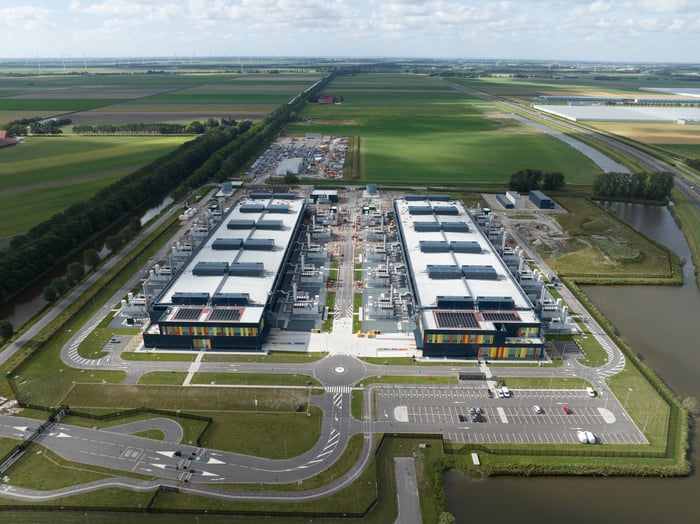
Image source: Getty Images.
Powering the AI boom
Growth for this segment and its distribution segment is being driven by the need for many more data centers in this artificial intelligence (AI) era. To ensure continuous uptime and meet regulatory requirements, these facilities require reliable backup power. A typical 100-megawatt data center needs between 120 and 200 megawatts of backup generation, creating plenty of demand for Cummins.
In the first quarter, power systems revenue grew 19% year over year to $2 billion. More importantly, the segment's earnings before interest, taxes, depreciation, and amortization (EBITDA) margin reached a record 29.5%, and contributed 39% of the company's total EBITDA. Management expects margins to settle between 25% and 26% for the full year, well above historical levels.
The strength of this business and its distribution segment is supported by a durable advantage. In a supply-constrained market, Cummins' ability to manufacture and distribute its own engines and generators gives it a key edge over competitors. With an order backlog that now extends into 2028, the company has gained significant earnings visibility.
A more balanced business
The growth in power generation has offset the cyclical weakness in the North American truck market. In the first quarter, unit sales of heavy-duty trucks fell 16% year over year, resulting in a 4% decline in engine segment revenue. Yet, thanks to the strength in power systems, the company raised its 2026 revenue guidance to 8% to 11% growth.
Management also increased its long-term targets at its Analyst Day last week. The company now expects annual revenue growth of 6% to 9%, reaching $45 billion to $50 billion by 2030, with EBITDA margin above 20%. To meet this demand, Cummins announced a $450 million investment to expand its high-horsepower engine and generator capacity by 20 gigawatts.
The diversified revenue streams make Cummins more resilient than it's been in past truck cycles. Currently, the company is winding down from a heavy investment period as it prepares to launch its new truck engines before EPA27 regulations take effect. Meanwhile, its growing aftermarket business provides stable recurring revenue from parts and service.
The stock currently trades for around 22 times forward earnings, which is a bit rich for Cummins. The stock's price-to-earnings multiple has averaged around 14 over the past five years, but there's no denying the business has improved. Long-term investors should be in for a nice ride if data center demand holds up until the North American truck market takes a turn for the better.
Bryan White has no position in any of the stocks mentioned. The Motley Fool has positions in and recommends Cummins. The Motley Fool has a disclosure policy.