
Alphabet Is Raising $80 Billion for AI Infrastructure. These 4 Semiconductor Stocks Win the Most.
Key Points
Nvidia and Broadcom have long-term relationships to provide chips to Alphabet.
TSMC has about 70% of the foundry chip market.
Alphabet and Marvell are reportedly discussing a deal to supply Google with two new chips.
One of the biggest investment themes in recent years has been the build-out of artificial intelligence (AI). The overall AI market is expected to grow from $390.9 billion in 2025 to nearly $3.5 trillion by 2033, which is a compound annual growth rate (CAGR) of 30.6%.
Drilling down a little further, spending on AI infrastructure -- chips, storage capacity, data centers, and assorted equipment -- is projected to have an equally robust growth curve, jumping from $35.4 billion in 2023 to $223.4 billion by 2030, with a CAGR of 30.4%.
Will AI create the world's first trillionaire? Our team just released a report on the one little-known company, called an "Indispensable Monopoly" providing the critical technology Nvidia and Intel both need. Continue »
This kind of explosive growth is why companies like Alphabet (NASDAQ: GOOG) (NASDAQ: GOOGL) are digging deep to add computing capacity. And that spending isn't slowing down. Alphabet plans to spend as much as $190 billion this year on capital expenditures, and recently announced it is raising $80 billion through stock sales and a $10 billion investment from Berkshire Hathaway to fund those efforts.
Here are four semiconductor stocks that appear best positioned to benefit from Alphabet's increased AI spending.
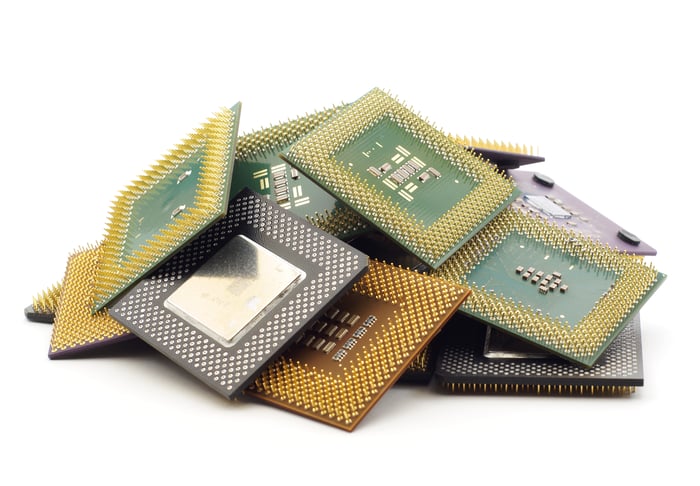
Image source: Getty Images.
1. Nvidia
By its sheer size and dominance, Nvidia (NASDAQ: NVDA) benefits from any major AI build-out, as its chips are the most sought-after for training and running AI programs. Nvidia has a long relationship with Google Cloud, the cloud environment operated by Alphabet, to provide Blackwell and Rubin architectures for full-stack AI platforms.
The companies recently announced plans to expand the Google Cloud AI Hypercomputer to AI factories building agentic and physical AI products.
"By combining Google Cloud's scalable infrastructure and managed AI services with Nvidia's industry‑leading platforms, systems and software, we're giving customers flexibility to train, tune and serve everything from frontier and open models to agentic and physical AI workloads -- while optimizing for performance, cost and sustainability," Google vice president Mark Lohmeyer said in April.
2. Broadcom
Broadcom (NASDAQ: AVGO) appears to be in the catbird's seat when it comes to Alphabet and any expansion of Google Cloud. The semiconductor company designs custom chips, known as application-specific integrated circuits (ASICs), tailored to specific workloads. ASICs are ideal because while they are less powerful than Nvidia's GPUs, which are designed to handle a variety of tasks, Broadcom's chips can be just as good for specific tasks, making them an affordable option.
On top of that, Broadcom has a long-standing relationship with Alphabet to produce its Tensor Processing Units, Google's in-house alternative to GPUs. Alphabet is now selling TPUs to other companies, making them a potential revenue source for Alphabet -- and by extension, giving more business to Broadcom.
3. Taiwan Semiconductor Manufacturing
When there's a demand for more AI chips, one of the biggest beneficiaries is Taiwan Semiconductor Manufacturing (NYSE: TSM). The company operates as the world's largest foundry, meaning it makes the chips that Nvidia, Broadcom, and many others design. TSMC, as the company is known, has an estimated 70% of the chip foundry market.
TSMC produced more than 12,600 products in 2025, spanning more than 300 technologies. Nearly 60% of the company's revenue comes from its high-performance computing segment, although it is also seeing growth in automotive and digital consumer electronics.
4. Marvell Technology
Marvell Technology (NASDAQ: MRVL) is smaller than the megacap names on this list, but it is still impressive with a market cap of $261 billion. The company designs custom AI accelerators and high-speed networking gear, and is perhaps best known for its data center switches that can efficiently route large volumes of traffic.
But what gets my attention is that Marvell is reportedly working with Google on two new chips -- a memory processing unit designed to work alongside the company's TPUs, and a new TPU that is optimized for running AI models.
Notably, Marvell is by far the best-performing stock on this list in 2026, with shares up 250%, compared with 40% for TSMC and less than 15% for Nvidia and Broadcom. In addition, the company was just selected to join the S&P 500 index, which means that index funds that track the benchmark index will be buying Marvell stock.
Patrick Sanders has positions in Nvidia. The Motley Fool has positions in and recommends Alphabet, Berkshire Hathaway, Broadcom, Marvell Technology, Nvidia, and Taiwan Semiconductor Manufacturing. The Motley Fool has a disclosure policy.