
Here's How Stellantis Is in Even Worse Shape Than Its Rival -- but Clear Upside Remains
Key Points
Stellantis reported the second-highest recall volume in the U.S. last year.
Despite Ford surpassing Stellantis in recalls, the former's were far less costly.
Stellantis has roughly twice the warranty costs-to-revenue ratio of the broader industry.
While Detroit automakers Stellantis (NYSE: STLA), General Motors (NYSE: GM), and Ford Motor Company (NYSE: F) have a long list of attributes in common, all three have traded completely differently from one another.
Over the past three years, GM's stock price has soared 124%, Ford's has remained flat with a meager 4% gain, and Stellantis's stock has plunged nearly 60%. Stellantis' decline was sharp and swift, but it has a $70 billion turnaround plan that offers investors upside if it can regain lost market share, deliver a long list of new, compelling products, and reverse staggering warranty costs.
Where to invest $1,000 right now? Our analyst team just revealed what they believe are the 10 best stocks to buy right now, when you join Stock Advisor. See the stocks »
Speaking of warranty costs, it's important for investors to know exactly how much work Stellantis has to do.

Image source: Getty Images.
Recalls add up
Ford has taken a lot of heat for its number of recalls and quality in recent years. In fact, Ford led the U.S. automotive industry in 2025 in recall volume, with a staggering 153. Stellantis found itself with the second-highest total tallying a not-so-great 53 -- still far fewer than its crosstown rival.
However, what's important to note for investors is that not all recalls are created equal. In fact, roughly 80% of Ford's recalls were addressed by over-the-air software updates that don't require traditional dealership visits, repairs, parts, and labor costs. Despite Ford's record-setting number of recalls, the company actually managed to lower its warranty claims costs compared to the prior year.
Further, Stellantis' number of more costly recalls ballooned, pushing the automaker's warranty expenses to a staggering $7.4 billion in 2025. While Ford easily surpassed Stellantis in recalls, those were far less costly for the automaker as it recorded a lesser $5.73 billion in warranty claims last year, an improvement from 2024.
To be fair, since companies have different levels of top-line revenue, we should compare automakers' warranty expenses as a percentage of total revenue. When viewed from that lens, Stellantis' warranty expenses as a percentage of total revenue checked in at about 4.4%, much higher than the industry historical norm of 2% to 3%. Ford's 2025 ratio sits at about 3.1%, but that certainly doesn't absolve the folks at the Blue Oval, as its ratio has trended higher in recent years as the company's focus on quality and customer care has increased its recall count.
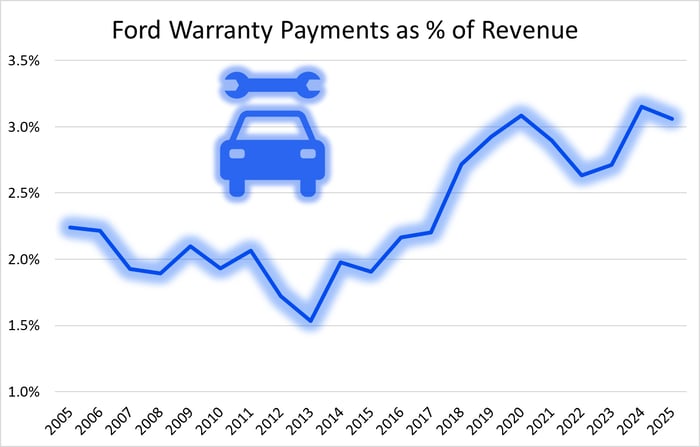
Data source: Ford SEC Filings. Graphic source: Author.
Ford has claimed it's producing some of its best-quality vehicles per internal metrics recently, though it will take time to see the full impact, as many of the recall woes affect older vehicle models.
Upside remains
There is, of course, a flip side for investors: as Stellantis aims to improve the quality of its new vehicle designs and products, upside in the stock remains as its turnaround plan gains traction over the remainder of the decade. Stellantis is checking all the boxes with its massive $70 billion overhaul to its product lineup to improve quality, reclaim lost global market share, and improve margins and profitability.
In fact, at the core of its massive plan is North America, where its quality and warranty costs hit the automaker's earnings. Of the $42 billion that Stellantis is committing to products and brands, roughly 60% will be earmarked for North America.
"Our plan for North America is very simple: Get the product right," said Tim Kuniskis, who heads the company's American brands, according to Automotive News. "Right for the market, right for the brand positioning, right for segment expansion, right for growth, and right to recover our customer loyalty."
Stellantis finds itself at a major pivot point, as its Jeep, Ram, Chrysler, and Dodge brands are poised to introduce 11 all-new vehicles in North America by 2030, aiming to grow sales volume in the region by 35%. If investors want to buy low and potentially sell high on a beaten-down Stellantis stock, one aspect the automaker must deliver on is quality to help bring warranty costs down in the near-to-medium term.
Stellantis has a massive plan for its global turnaround, but what investors might have missed is that it actually has even more work to do on vehicle quality than crosstown rival Ford, which has honestly caught more heat due to the volume of recalls and associated headlines. If Stellantis gets its quality right as it unveils a list of new models, it could be the exact punch it needs to revive not only its market share, but its bottom line.
Daniel Miller has positions in Ford Motor Company and General Motors. The Motley Fool recommends General Motors and Stellantis. The Motley Fool has a disclosure policy.