
Where Will SpaceX Be in 3 Years?
Key Points
SpaceX is rapidly expanding its neocloud business and becoming a key player in this AI market.
The company's Starlink satellite internet service could have 15 million U.S. subscribers by 2030.
SpaceX rocket launches could achieve a high efficiency over the next several years.
Predicting any company's next three years is an impossible task, but doing so for Space Exploration Technologies (NASDAQ: SPCX) is perhaps especially so.
SpaceX's rocket launches, Starlink satellite internet service, and artificial intelligence (AI) data center business are distinct businesses that could define the company in the coming years. And all will take an immense amount of resources to continue growing.
Missed Nvidia in 2009? This Rare Signal Is Flashing Again. In 2009, a "Double Down" signal flashed for a little-known chipmaker called Nvidia. For the first time in years, that same "Total Conviction" signal is flashing for a company 1/100th the size of Nvidia. Continue »
Still, it's worth considering how each might look three years from now. Here's where SpaceX could be.
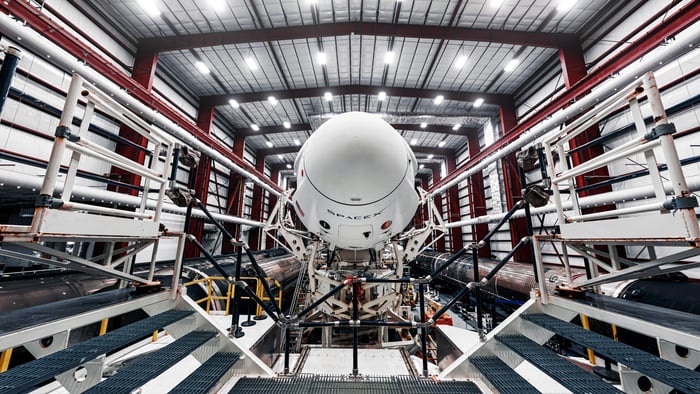
Image source: Getty Images.
Increased emphasis on SpaceX's data center business
SpaceX is quickly morphing into an artificial intelligence company, most recently through its $60 billion acquisition of Anysphere, the parent company of AI software and coding specialist Cursor, to better compete with Anthropic's Claude Code. And it's already inking huge deals as it builds out a growing neocloud business.
Neocloud companies sell their data center capacity to other tech companies, and SpaceX has already made some large deals. For example, Alphabet's Google signed a three-year deal with SpaceX to supply some of its data center capacity for its Gemini AI model, generating about $30 billion for SpaceX by 2029. And Anthropic is already paying SpaceX about $15 billion annually over the next three years to rent out all of its Colossus 1 data center capacity.
What this means for SpaceX is that over the next three years or so, it could become a very important player in AI data centers. Gartner estimates neocloud players could capture 20% of the AI cloud market by 2030. With its current moves, SpaceX is already in a very strong position to take a leading role in space.
Starlink will continue expanding
Starlink is arguably SpaceX's most important business right now, accounting for about 61% of the company's total sales. It's also SpaceX's only profitable business.
Starlink has an impressive 12 million subscribers already, brought in $11.4 billion in sales in 2025, and had $4.4 billion in operating income last year. And SpaceX aims to expand Starlink in the coming years. It's already in the midst of getting ready for a 1,200 satellite launch in mid-2027 using its Starship rocket.
What's more, a handful of analysts believe SpaceX might bid to acquire a mobile carrier in the next few years to expand its internet business. Most recently, a TD Cowen analyst suggested T-Mobile would be a likely acquisition target.
While that's just speculation right now, even conservative estimates for Starlink's global total addressable market (TAM) are large. Morningstar estimates Starlink already has a $129 billion TAM. And some analysts estimate Starlink's U.S.-based subscribers will reach 15 million by 2030 -- up from just 3 million currently.
The Starship rockets reach mass efficiency
Last but not least, SpaceX's rocket business is expected to expand significantly in the coming years. Analysts at Goldman Sachs estimate that SpaceX's core rocket launches could bring in $8.3 billion in revenue by 2030 -- up from $4.1 billion in 2025.
More importantly, SpaceX's Starship rockets are expected to reach an operational efficiency over the next few years that could be unmatched by SpaceX's competitors. If it lowers its marginal cost of launching payloads into orbit by 90%, which it's expected to do with future Starship launches compared to its Falcon rockets, it could achieve a competitive moat that other rocket companies would have a very hard time overcoming.
There's still a lot of uncertainty with SpaceX, and even if the company executes on its goals, there's no guarantee of success in the coming years. Investors are likely better off waiting to see how SpaceX delivers on some of its ambitions over the next year or so before considering buying the stock.
Chris Neiger has no position in any of the stocks mentioned. The Motley Fool has positions in and recommends Alphabet and Goldman Sachs Group. The Motley Fool recommends Gartner and T-Mobile US. The Motley Fool has a disclosure policy.