
Capture the new alpha paradigm! The prototype of an AI fund manager surprised Wall Street! J.P. Morgan AI Smart Beats Classic 60/40 Investments
The Zhitong Finance App learned that as investors increasingly use cutting-edge artificial intelligence application tools to assist in various major investment decisions, from stock selection to risk management, Wall Street financial giant JPMorgan Chase & Co. (JPMorgan Chase & Co.) is testing a more ambitious AI question: whether the AI model can independently allocate funds and reap excess alpha returns that exceed market benchmark returns.
According to a major research report by J.P. Morgan Chase, researchers have established a series of AI-based investment agency workflows (that is, AI agents that focus on independent investment and position adjustment). These AI agent subset systems adjust positions autonomously and change investment themes between stock and bond assets according to changing market conditions. Research reports show that the best-performing system is 0.7 percentage points higher than traditional 60/40 portfolios every year, and has been less volatile in backtesting over the past 20 years, and has also defeated J.P. Morgan's own rules-based market system investment model.
However, the J.P. Morgan strategist team emphasized that these results were based on historical simulations rather than on-site investment assessments. J.P. Morgan warned against viewing them as an important basis for artificial intelligence to continue to outperform the market, and warned against accepting the portfolio answers given by artificial intelligence without criticism.
However, this study also highlights that AI agents are evolving from “auxiliary analysis tools” to intelligent investment infrastructure capable of market status identification (economic growth/inflation cycle), asset rotation, risk control, and portfolio optimization. This also means that the competitive dimension of future alpha returns may shift from simply relying on human experience to a hybrid investment system of “human macrojudgment+continuous computational optimization of AI agents.”
AI is moving from assisted research to autonomous decision-making: smart investment agents are reshaping the trillion-dollar asset management industry
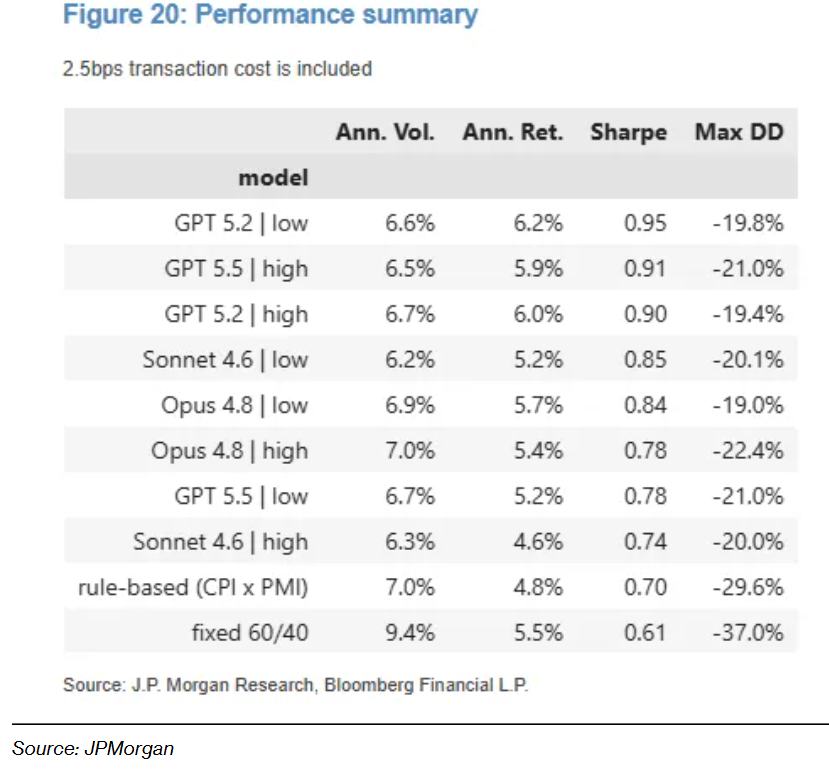
Investors are certainly encouraged by the early results. Researchers at the financial giant have built a series of AI-based investment agents that can dynamically adjust between stocks and bonds in response to changing market conditions. According to a team led by strategist Thomas Salopek (Thomas Salopek), in a historical backtest covering the past 20 years, the best-performing system had an annualized return of 0.7 percentage points over traditional 60/40 portfolios (60% allotted stocks, 40% bonds). At the same time, the volatility was lower, and it also beat J.P. Morgan's own rules-based market system and cycle model.
There is an important limitation to this result. The study was based on historical simulations rather than actual capital investments, and J.P. Morgan also warned that it should not be viewed as proof that artificial intelligence can continue to outperform the market. However, this still indicates the future direction, as the rapid expansion trend in the field of automated trading shows no sign of slowing down.
“AI agents can be set up with a set of processes that enable them to independently make important immediate investment decisions in an uncertain environment and achieve excessive alpha performance against reasonable benchmarks.” The strategists wrote in a report on Thursday, adding that the work was the agency's first attempt to build an artificial intelligence system to identify the state of the market's investment system and cycle.
The best system in J.P. Morgan's AI agent backtesting increased 0.7 percentage points compared to the traditional 60/40 combination, while reducing volatility, and the 8 test AI agent investment workflows all outperformed the 60/40 portfolio in terms of risk adjustment benefits, which means that AI is evolving from an “information processing tool” to an “investment decision infrastructure.”
The so-called “alpha” is defined as the actual return on investment far exceeding the “beta return” — that is, the simultaneous return on investment data that far exceeds that achieved by tracking the benchmark stock index. The simultaneous return achieved by tracking the benchmark index is also known as “beta return” (beta return).
The next generation of Wall Street infrastructure is born: AI agents may become a new engine for asset allocation
For ordinary retail investors, how can they reap alpha profits in the future? AI agents may become one of the strongest automated execution assistants for investors.
J.P. Morgan's research does not prove that AI can steadily beat the market; it is the first time that AI agents have the potential to identify market conditions, dynamic asset allocation, risk control, and capital decision support.
AI agents (AI agents, AI agents) that independently perform various complicated and complicated tasks will most likely be the ultimate trend in AI applications over the next ten years. The emergence of AI agents means that artificial intelligence is beginning to evolve from an information aid tool to a highly intelligent productivity tool. This is why the launch of Claude Cowork's ANTHROPIC valuation can break through $1 trillion and surpass OpenAI.
This experiment shows the next important development direction of Wall Street's adoption of artificial intelligence, or an early glimpse of Wall Street's next stage of artificial intelligence adoption models. Over the past two years, banks have been applying large-scale language models to research and analysis, code development, and internal investment tools. Now, they're further testing whether these systems can go from investing in AI to help employees work, to being personally involved in implementing one of the financial industry's most important decisions — how to allocate capital across different markets.
As these findings were published, more and more academic research began to focus on the question of how the market would change if all investors began to rely on similar artificial intelligence models to make investment decisions.
Although this technology may allow investors to speed up and obtain more complete information, researchers warn that it may also cause transactions to become more crowded, make the market more susceptible to manipulation by the increasingly large number of AI bulls or bears, and amplify the risk of market pressure when a large number of AI intelligent systems arrive at similar investment conclusions.
Notably, J.P. Morgan strategists also acknowledged these risks.
“We strongly warn that the results given by artificial intelligence should not be accepted uncritically, as these may essentially be just overconfident answers based on data within the sample.” they wrote. “Artificial intelligence tools for intelligent AI agents need to be based on a well-considered asset allocation process, without naively believing that intelligent agents themselves can be a source of domain knowledge.”
However, these findings further enrich the growing evidence that artificial intelligence is carrying out increasingly complex investment tasks.
Using intelligent agents driven by OpenAI and Anthropic models, the J.P. Morgan team designed an AI agent operating system. The system can divide the market into the four most classic states according to economic growth and inflationary environments: Goldilocks (Goldilocks), re-inflation, stagflation, and risk aversion.
Subsequently, these artificial intelligence agents are required to decide how to allocate assets according to different market environments — for example, increasing stock allocation during periods of strong economic growth and increasing fixed income asset allocation ratios when economic prospects deteriorate.
All eight tested artificial intelligence agent subsystems surpassed traditional Wall Street 60/40 portfolios in risk-adjusted performance.
They also beat J.P. Morgan's existing rules-based market system and cycle model, which shows that this cutting-edge AI technology can further significantly improve the return on investment based on a classic framework already used to guide asset allocation decisions.
“We are passionate about the development potential of intelligent agent artificial intelligence, although we are still cautious and will not completely hand over asset allocation decisions to the AI intelligent agent operating system.” Salopek and his colleagues wrote.