
The weak yen plus energy shock. Japan's PPI soared 7.1% year on year in June and hit a new high of more than three years. Expectations for interest rate hikes in October continued to heat up
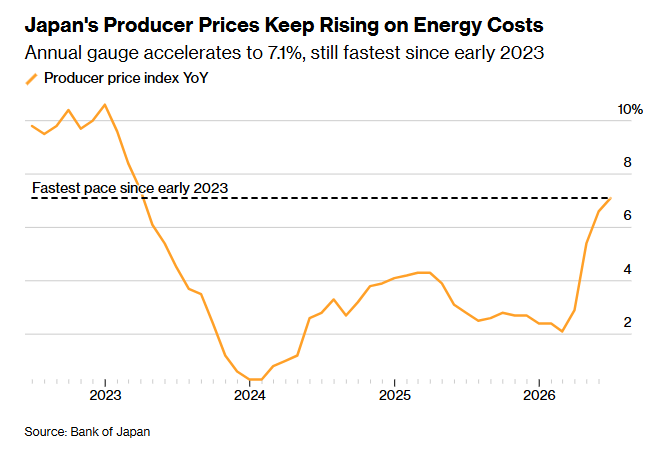
The Zhitong Finance App learned that the Japanese Corporate Commodity Price Index (PPI) accelerated in June, recording the fastest growth rate since March 2023. This data adds key evidence that inflationary pressure continues to accumulate, and further strengthens the market's expectations that the Bank of Japan will continue to raise interest rates.
According to data released by the Bank of Japan on Friday, PPI rose 7.1% year on year in June, higher than the median market forecast of 6.8%, and further accelerated from 6.6% after the May revision. On a month-on-month basis, the June index rose 0.4% from the previous month, and also continued to strengthen on the basis of the revised data for the previous month. This round of gains has not stopped since April's month-on-month increase hit a 12-year high. After the war in Iran broke out, the pressure on corporate costs continued to be released.
Energy and non-ferrous metals lead the way, and import costs soar
This spike in wholesale inflation was mainly driven by energy and material prices. According to disaggregated data, fuel prices soared 22.8% year over year, and non-ferrous metal prices soared 39.2%, highlighting the energy shock caused by the Middle East geopolitical conflict and strong demand for related raw materials in the field of artificial intelligence (AI).
Against the backdrop of the continued weakening of the yen, imported inflationary pressure is becoming more severe. The import price index in yen rose 29.7% year on year in June, which is significantly faster than the 26.1% revised in May. In early trading on Friday, the dollar traded around 162 against the yen in the Tokyo market, still hovering at its lowest level in 40 years, which continued to put pressure on the cost of imported energy and raw materials for Japanese companies.
A wave of wage increases strengthens inflation expectations, but consumer prices are still being suppressed
The continued rise in PPI indicates that Japanese companies are increasingly actively passing on higher investment costs to downstream customers, a clear sign that inflation expectations are taking root. This is also reflected in the just-concluded annual spring wage negotiations: the average wage increase was over 5% for the third year in a row, the first time since 1989 to 1991 that there was such a strong continuous increase.
The Bank of Japan also issued a warning in a report released on Thursday, saying that companies are shifting investment costs faster than before and could drive up consumer inflation later this year. However, in reality, consumer price performance is relatively moderate. Since the government has always relieved the pressure on fuel costs for households through subsidies, the core consumer price index, which excludes fresh food, fell below the central bank's 2% target for the fourth month in a row in May.
To cope with the spending pressure brought about by the Middle East conflict, Japanese Prime Minister Sanae Takaichi has ordered the preparation of an additional budget to continue implementing energy subsidies for households. Minister of Economic Regeneration Minoru Kiuchi, who is regarded as a supporter of loose monetary policy, said at a press conference on Friday that although past increases in oil prices are driving up wholesale prices, thanks to government measures, consumer prices have only risen moderately. He also pointed out that the depreciation of the yen had a lagging effect on the rise in inflation, and that the impact was “not necessarily that big.”
The central bank's policy path is complicated, and the market is betting on an interest rate hike in October
The complicated external environment is making the Bank of Japan's policy path more difficult. The Middle East conflict is increasing inflation by raising oil prices, while squeezing the Japanese economy, which is highly dependent on imported fuel. Last month, the Bank of Japan raised the policy interest rate to 1%, a 31-year high, and warned that inflationary pressure brought about by the war in Iran was continuing to show through a steady rise in wholesale inflation.
After the interest rate hike in June, the central bank is expected to stand still at the next policy meeting, but it will announce the latest quarterly economic growth and price forecasts at that time, which may provide a key clue about the timing of the next rate hike. Currently, traders still generally expect another rate hike during the year, and bets on actions as early as October are increasing.
Masato Koike, senior economist at Sompo Institute Plus, pointed out that wholesale inflation is expected to remain high as the US-Iran negotiations are at an impasse, and supply restrictions and the impact of past energy cost increases will spread to various commodity prices. “If the prices of various commodities rise sharply, the Bank of Japan may be forced to raise interest rates early, including action in October.”