International Air Transport Association: Total global air passenger demand fell 2.2% year on year in May
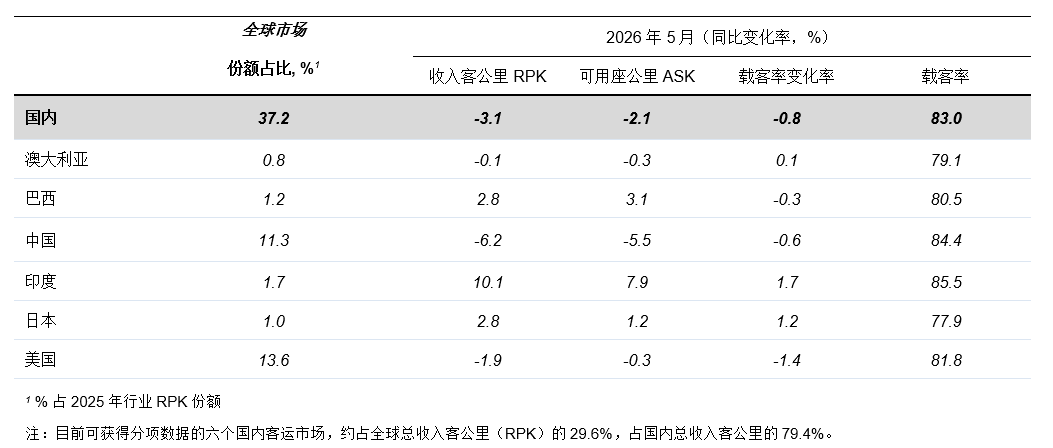
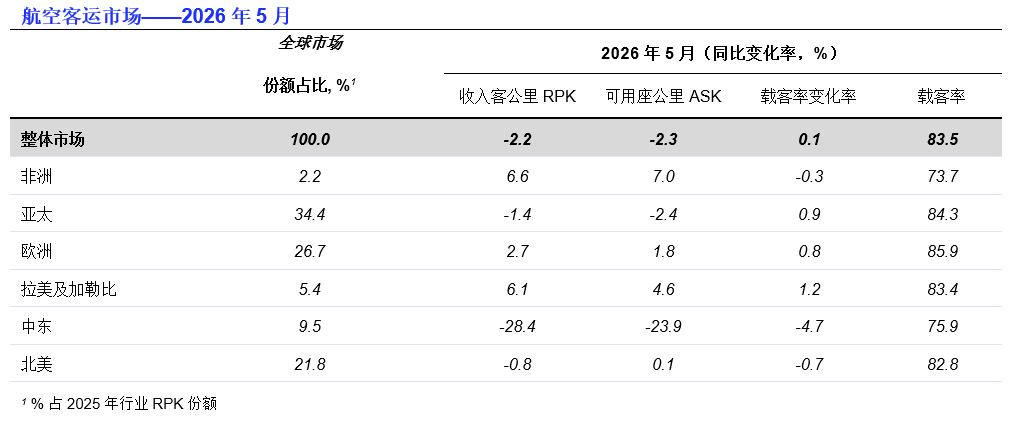
The Zhitong Finance App learned that on July 10, the International Air Transport Association (IATA, “International Air Transport Association” for short) regular data on global air passenger demand for May 2026 is as follows: Total air passenger demand (based on RPK revenue in passenger kilometers) fell 2.2% compared to May 2025. Excluding the Middle East, demand increased by 0.7%. Total capacity (based on ASK's available seat kilometers) decreased by 2.3% year over year. The passenger load rate was 83.5%, an increase of 0.1 percentage points over the previous year, and reached a record high in May. International demand fell 1.6% year-on-year in May 2025. Excluding the Middle East, demand increased by 3.1%. The capacity decreased by 2.4% year on year, and the passenger load rate was 83.7%, up 0.7 percentage points year on year. Domestic demand fell 3.1% year on year in May 2025, and capacity fell 2.1% year on year. The passenger load rate was 83.0%, down 0.8 percentage points from the previous year.
International Air Transport Association Chairman Willie Walsh (Willie Walsh) said, “Due to the war in the Middle East, demand for air passenger transportation fell 2.2% year on year in May. The decline was mainly concentrated in Middle East Airlines. Passenger demand fell 28.4% year on year, but it was significantly narrower than the 46.6% decline in April, highlighting the region's resilience. It is worth noting that demand in North America and Asia also experienced a year-on-year decline, which is largely related to domestic market conditions in the US and China.
Overall, in the face of high fuel prices and high ticket prices, passenger demand in May still showed strong resilience. Although the recent sharp drop in oil prices is a positive sign, the challenges brought about by the war will continue for some time. The supply of oil through the Strait of Hormuz is still uncertain. The benefits brought by falling oil prices may take some time to be reflected in aviation fuel pricing “under normal conditions.” At the same time, for airlines with profit margins of only 2.0%, there is little choice but to continue testing demand resilience with higher fares to cope with rising fuel costs.”
International passenger transport market
International passenger revenue kilometers (RPK) fell 1.6%, and capacity fell 2.4%. Compared with April, the deceleration rate has slowed down. Many regions hit record highs in May; only the Middle East region saw a drop in passenger load rates.
Demand from Asia Pacific airlines increased 1.3% year over year. The capacity decreased by 1.1% year on year, and the passenger load rate was 85.3%, up 2.0 percentage points from May 2025. Stricter restrictions on Vietnam's aviation fuel imports have led to a drastic reduction in the capacity of short-haul routes, and international passenger traffic within Asia declined this month.
European airline demand increased 3.8% year over year. The capacity increased by 2.3% year on year, and the passenger load rate was 85.4%, up 1.2 percentage points from May 2025. Notably, direct passenger traffic to Asia increased 15%, indicating continued improvement in direct service between these two regions.
Middle East airline demand declined by 28.8% year over year. The capacity decreased by 24.3% year on year, and the passenger load rate was 76.1%, down 4.8 percentage points from May 2025. Affected by the delay in the war in Iran, passenger traffic continues to be impacted, but it is weakening month by month, and the decline is almost half of April.
Demand from North American airlines increased 1.0% year over year. The capacity increased by 0.6% year on year, and the passenger load rate was 84.0%, up 0.4 percentage points from May 2025.
Demand from LATAM airlines increased 10.5% year over year. Capacity increased 9.0% year over year. The passenger load rate was 85.0%, up 1.2% from May 2025.
Demand from African airlines increased 8.9% year over year. Capacity increased 8.3% year over year. The passenger load rate was 73.4%, an increase of 0.4 percentage points over May 2025.
Domestic passenger transport market
Compared with the same period last year, domestic passenger revenue per kilometer (RPK) fell by 3.1% in May 2026. China saw the biggest drop, probably related to rising ticket prices and the delayed effects of the Dragon Boat Festival. The US also experienced a significant decline, while most other markets experienced moderate growth.