
The oil market vision indicates that the risk of US inflation is underestimated! Pioneer Asset Management bucked the trend and placed US debt to preserve inflation
The Zhitong Finance App learned that an unusual change in the oil market indicators is prompting Pioneer Asset Management to buy insurance to prevent US inflation that lasts longer than expected. Since the US and Iran reached a weak cease-fire agreement, crude oil prices have fallen sharply, but the decline in gasoline prices has far failed to keep up, causing the price difference between the two to widen to the highest level since 2022. Alesh Kourtney, head of international interest rates at Pioneer Active Management Fund, said he is closely monitoring the so-called “cracking spread” to look for signs that the price of refined oil products may rise again and drive up inflation.
In an interview, Kourtney said, “We've never paid such close attention to this metric before. Since cracking price differences are usually highly correlated with oil prices, they were often only a secondary indicator in the past, but now the price trends of products such as gasoline, aviation fuel, diesel, and fuel oil are all clearly different from crude oil prices.”
Although cracking spread is a fairly common indicator in oil trading to measure the difference between the price of refined oil products and the price of crude oil, this data usually does not receive much attention from bond investors. The war in the Middle East led to a sharp drop in fuel production at global refineries, and Ukraine's continued attacks on Russian refineries prompted Russia to ban diesel exports, thereby boosting refining profit margins.
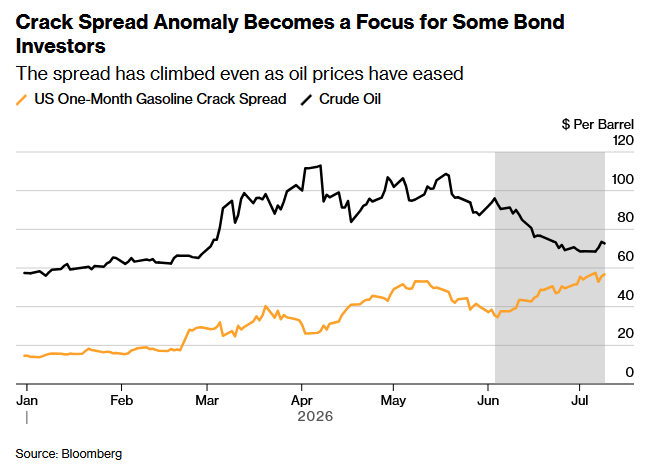
Despite falling oil prices, the cracking spread continued to widen. This anomaly became the focus of attention of some bond investors
Courtney said, “The question is whether this spread will return to normal, or will this low correlation evolve into a more structural characteristic and have an impact on the risk of inflation.” “These deviations may either reinforce the risk of inflation or reduce the risk of inflation. Both situations are likely to occur, and the impact may be quite significant.”
The two-year break-even inflation rate, which measures the gap between the nominal yield on US Treasury bonds and the yield on inflation-protected bonds (TIPS), has continued to fall over the past month, and has now fallen to near its lowest level in nearly two years. This indicates that the market expects the US inflation rate to be only slightly higher than the Federal Reserve's 2% target level after two years.
This trend prompted Kourtney and his team to establish long positions on US short-term inflation-protected treasury bonds (TIPS), while also buying break-even inflation trading positions with a longer-term yield curve. They believe that the market has underestimated the possibility that inflation will continue to be higher than expected. This week, after US President Trump expressed doubts about the cease-fire agreement between the US and Iran, the situation in the Middle East became tense again, driving oil prices to rise sharply.
The Pioneer Group team is also currently working to optimize its model. In addition to crude oil, different types of petroleum distillate products are included as reference indicators when evaluating the risk of inflation. Currently, traders expect that the Federal Reserve, the European Central Bank, and the Bank of England will each raise interest rates by 25 basis points before the end of the year, and expect to further tighten monetary policy this year or next. Compared to the interest rate hike bets that quickly heated up in the market after the outbreak of the US-Iran war in March, the market's expectations for further interest rate hikes have clearly eased.