
NEV industry: valuation falls into a “golden pit”, three growth variables drive valuation reshaping
Since May of last year, the valuation of the Hong Kong stock auto sector has continued to decline. Up to now, the sector has fallen by more than 40%. The decline in some targets has been cut short, but a “golden pit” has already been seen after a sharp decline in valuations.
The core logic of this wave of correction is mainly to reduce valuations. In the past few years, benefiting from the development of new energy sources, individual stocks generally doubled and valuations reached a high point; on the other hand, the penetration rate gradually increased to 50%, and the upper limit space was suppressed, and the growth rate of new energy vehicles slowed down. 2026 confirmed the logic of industry slowdown. Affected by factors such as NEV purchase tax policy changes and declining policy subsidies, NEV sales declined in January-February and began to resume growth in March, but the growth rate was only in units, and industry growth was still slowing down.
However, it is worth mentioning that exports have become the core growth engine of the industry. According to data from the China Automobile Association, in January-June, 2.355 million new energy vehicles were exported, an increase of 1.2 times over the previous year, while the industry remained strong, and all major car companies were striving for a larger share of the export market. At the same time, the layout in fields such as physical AI and robotics, the industry is creating new growth opportunities.
However, in the last two weeks, the NEV sector has risen across the board, and valuations have continued to recover. So, has the NEV industry ushered in an inflection point in valuation?
The leader is Hengqiang, and exports are in full bloom
The Zhitong Finance App learned that according to the June passenger car sales data released by the Passenger Transport Association, the performance of new energy vehicles and fuel vehicles continued to diverge, but the overall trend of the industry was weak. The passenger car market retailed 1.602 million units, down 23.2% year on year, fuel vehicle sales fell nearly 40%, and NEV retail sales fell only 9%, and the penetration rate increased to 62.8%. However, production and wholesale volume of new energy passenger vehicles increased by 21.4% and 19.2% respectively in June.
The top 7 monthly wholesale brands are all independent brands. In order of ranking, they include BYD (01211), Chery (09973), Geely, SAIC Passenger Car, Changan Automobile, Great Wall Motor, and Zero Sports (09863), with a total wholesale volume of 1.294 million vehicles, accounting for 54.9%. Among new energy passenger cars, the top four are all independent brands, including BYD, Geely, Chery, and Zero Run, with a total of 756,400 vehicles, accounting for 51.1%. Obviously, in the field of overall and new energy, independent brands have completely crushed joint venture brands.
Looking at the June sales data released by major car companies, let me summarize: domestic brands have risen, sales of joint venture brands are poor, new forces are strong, and export demand has skyrocketed.
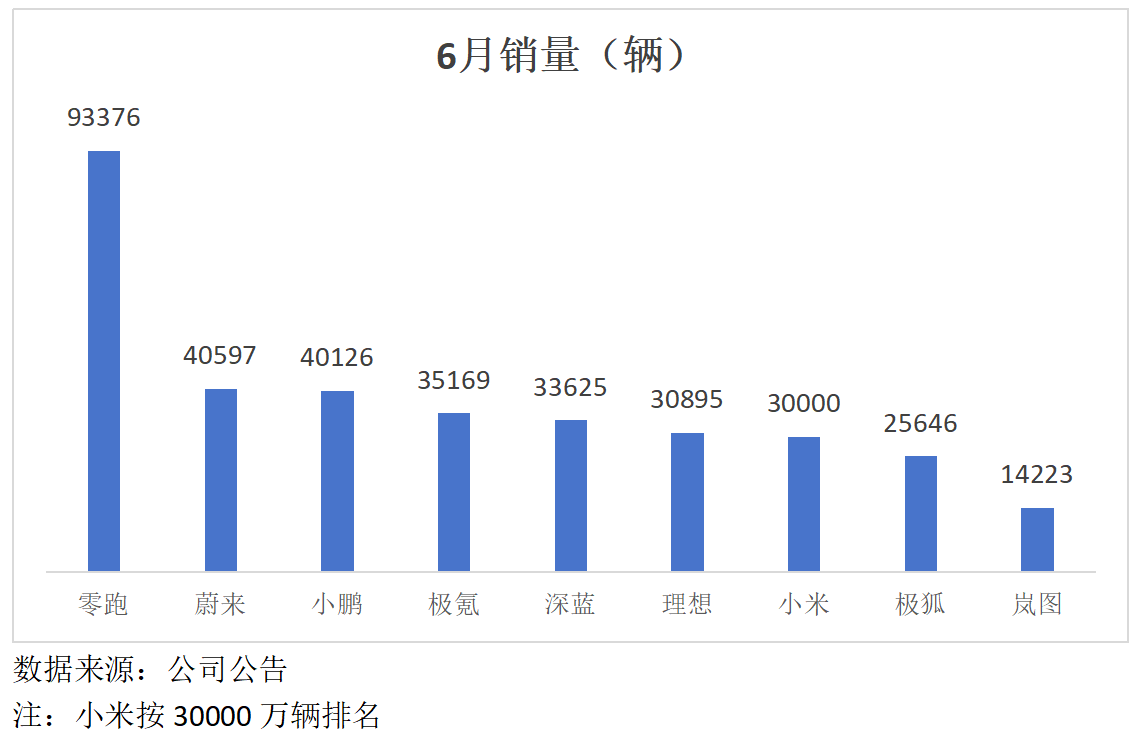
BYD is the industry leader, far ahead of its peers with 403,500 vehicles. Other independent brands also performed well. Among them, Great Wall sales bucked the trend and increased 2.48%. In comparison, joint venture brands, such as Guangqi Honda, saw a 53% drop in sales in June and a 55.82% drop in sales in the first six months. Sales of most of the new power brands have continued to grow. Among them, Zero Run has 93,400 vehicles, which is 1.3 times higher than that of the second-largest new power brand. With a 95% growth rate, it is also at the leading level in the industry. The sales volume of other brands has diverged, and the market share has changed slightly.
Overseas exports of new energy brands are flourishing, and the monthly export sales of most brands have maintained a trend of doubling. Looking at the first half of the year, among traditional brands, Chery was the largest exporter. In the first half of the year, the export volume reached 944,000 vehicles, up 71.5% year on year, followed by BYD, which exported 789,000 vehicles, up 70.5% year on year. Geely grew the most, exporting 474,000 vehicles, up 158% year on year. Among the new power brands, Zero Run continues to lead the way, exporting nearly 100,000 vehicles, topping the list of new forces, and surpassing the export volume for the whole of last year, leading the market share in many countries. Among them, the Italian pure electric market share is more than 1/3, continuously ranking first in the Italian pure electric market in terms of sales.
Three growth variables, the industry presents growth opportunities
In the long run, there are three obvious growth variables in the NEV industry: first, the export market mentioned above; second, intelligent driving and physical AI are changing traffic models, and new business opportunities are emerging; and third, car companies are deploying robots one after another, opening up a second curve of growth in the automotive industry.
Let's look at exports first. The data shows that from January to May 2026, the export sales volume of new energy vehicles was 4.059 million units, an increase of 63% over the previous year, accounting for 33.3% of total sales, an increase of 12.7 percentage points over the previous year. As can also be seen from the above, traditional car companies represented by BYD and Geely, as well as new forces represented by Zero Run, have impressive export performance. Sales are growing rapidly, and other car companies are also using overseas markets as their core growth strategies.
In fact, both domestic and overseas markets have won with their product strength and high cost performance ratio. For example, BYD, the leader in the industry, has two core series, including the Dynasty and Ocean series, from cars to SUVs, covering almost 300,000 yuan of user needs, and high-end brand performance is also very impressive. For example, Fangchengbao Auto's sales growth rate reached 1.9 times in June; and the C-Series and B-series continued to top the price list. It was also a hit as soon as it went on sale, and the idea of a good but not expensive product was consumed The person approves.
Second, intelligent driving technology accelerates iteration. On the one hand, the Ministry of Industry and Information Technology announced the first mandatory national standard for L3/L4 exclusive autonomous driving in China, the “Safety Requirements for Autonomous Driving Systems for Intelligent Connected Vehicles” (approval draft), to be officially implemented on July 1, 2027; on the other hand, technological maturity, with Tesla and Xiaopeng as representatives to gradually promote pure vision solutions into the mainstream of smart driving.
Currently, the price of intelligent assisted driving solutions continues to drop. For example, the price of the Xiaopeng M03 is only around 100,000, and major car companies have followed suit, basically lowering smart driving to 100,000 to 150,000 yuan. Furthermore, with the support of physical AI, application scenarios for intelligent driving have also spawned many opportunities in emerging markets, from the field of private cars to commercial vehicles such as unmanned taxis, unmanned sanitation vehicles, and unmanned logistics vehicles.
Finally, physical intelligence is reshaping the automotive industry chain. Auto companies such as Guangzhou Automobile, Chery, BYD, and Xiaopeng are all involved in the robot business. Robots integrate cutting-edge technologies such as AI, high-end manufacturing, and new materials. They are the best implementation scenario for physical AI, and have huge prospects in manufacturing, home, and medical care. According to the “China Development Report 2025” forecast, the size of China's physical intelligence market is expected to reach 400 billion yuan by 2030. Currently, artificial intelligence has been commercialized, mainly in startups, such as Yushu, but it is still in the prototype stage. Car companies have not yet achieved obvious results in this business, but they will form a new growth curve after the scale explodes.
The industry ushered in an inflection point in valuation, focusing on leading targets
Looking at the capital market, valuations of almost all NEV brands have been simultaneously retreating since the fourth quarter of last year, with a maximum retracement of more than 60%. This wave of negative valuations has bottomed out, and the three major growth variables are leading to inflection points in valuations.
In the last two weeks, valuations in the automotive sector have risen across the board. BYD's H shares have risen by more than 15%, while targets such as Xiaopeng, Geely, and Zero Sport have also risen by more than 10%. The industry has ushered in a revaluation cycle. Among them, BYD is the overall leader in the industry and Zero Run is at the top of the list of new forces, and it is expected that it will be the first to benefit from the valuation reshaping opportunities brought about by the three major increases.
BYD's strongest company, Hengqiang, stands out from its peers in sales. Overseas exports are growing rapidly, and are expected to exceed 1.8 million units throughout the year. Meanwhile, large capital was also the first to bet. Currently, the PE valuation is 25 times. The Huachuang Securities Research Report said that the company's flash charging+intelligent strategy is two-wheel drive, leading technology to consolidate the basic domestic sales market, while relying on iterative technology to build product competitiveness, domestic sales are recovering month by month. The company has gradually broken out of a fundamental low point, and the bottom of the stock price can be expected to recover.
As the leader of new power brands, Zero Run continues to lead in sales volume and performance. At the same time, it is also one of the few new power brands that have achieved comprehensive balance in growth, profit, and cash flow. Although affected during the sector pullback period, it has shown a spiral upward trend in valuation since its launch. The company was also favored by many investment banks. Among them, Huachuang Securities gave it a “strong” rating, with a target price of HK$58.85, which is 56% premium compared to the current price.
Overall, the valuation of the NEV industry has fallen into a golden pit, sales have continued to grow, and three major growth variables have emerged. The export market, emerging racetracks, and robots are jointly driving a new growth curve, and improvements in fundamentals have ushered in a reshaping of valuations. However, the industry has maintained the trend of strong players. BYD has taken the lead, and Zero Run has also stood at the top of the list among new forces, showing the “Double Dragon Dance Together” scene. Although other new energy brands are divided, they have maintained a strong growth trend. The industry has ushered in an inflection point in valuation, and we can focus on leading targets.