
SK Hynix (SKHY.US)'s US stock “debut” is coming tonight! The AI investment boom ushered in a critical stress test
The Zhitong Finance App learned that South Korean memory chip giant SK Hynix (SKHY.US) will officially enter the US market for trading on Friday. This US listing debut will be a key test for whether investors still believe the artificial intelligence (AI) boom can continue, especially after the recent pullback in semiconductor stocks.
SK Hynix set the issue price of its US-listed American Depositary Receipts (ADR) at $149 per copy, which is a 2.7% premium over the average share price of its common stock listed in Seoul, South Korea over the past three trading days. According to a listing issuance document previously submitted to the US Securities and Exchange Commission (SEC), each SK Hynix ADR issue is equivalent to one-tenth of the company's common shares. The ADR issuance scale was finally determined to be 17.79 million common shares (corresponding to 177.9 million ADR shares), and the capital raised was approximately US$26.5 billion. This will be the largest initial public offering (IPO) ever carried out by a foreign company in the US, surpassing Alibaba Group's previous record of 25 billion US dollars in IPOs.
According to reports, SK Hynix's ADR offering has been oversubscribed by more than 7 times. People familiar with the matter said earlier that the offering attracted demand from many institutional investors, including global long-term investment funds, funds focused on the technology industry, sovereign wealth funds, and global investment institutions focusing on the Asian market. SK Hynix has received subscription offers from institutions such as Baillie Gifford, Coatue Management, and Situational Awareness Partners. The total ADR amount these agencies intend to subscribe for can reach up to 7 billion US dollars.
SK Hynix's ADR issuance attracted active subscription from investors, reflecting global capital's consensus on the pricing of the AI storage industry chain. SK Hynix is the second largest DRAM manufacturer in the world and the number one manufacturer in the HBM market. In the first quarter of 2026, HBM's market share reached 56.4%, and NAND flash memory's global share was 18.5%. Net profit increased 398% year-on-year during the same period, and the operating profit margin exceeded 70%, and it was deeply tied to Nvidia to form a joint R&D relationship.
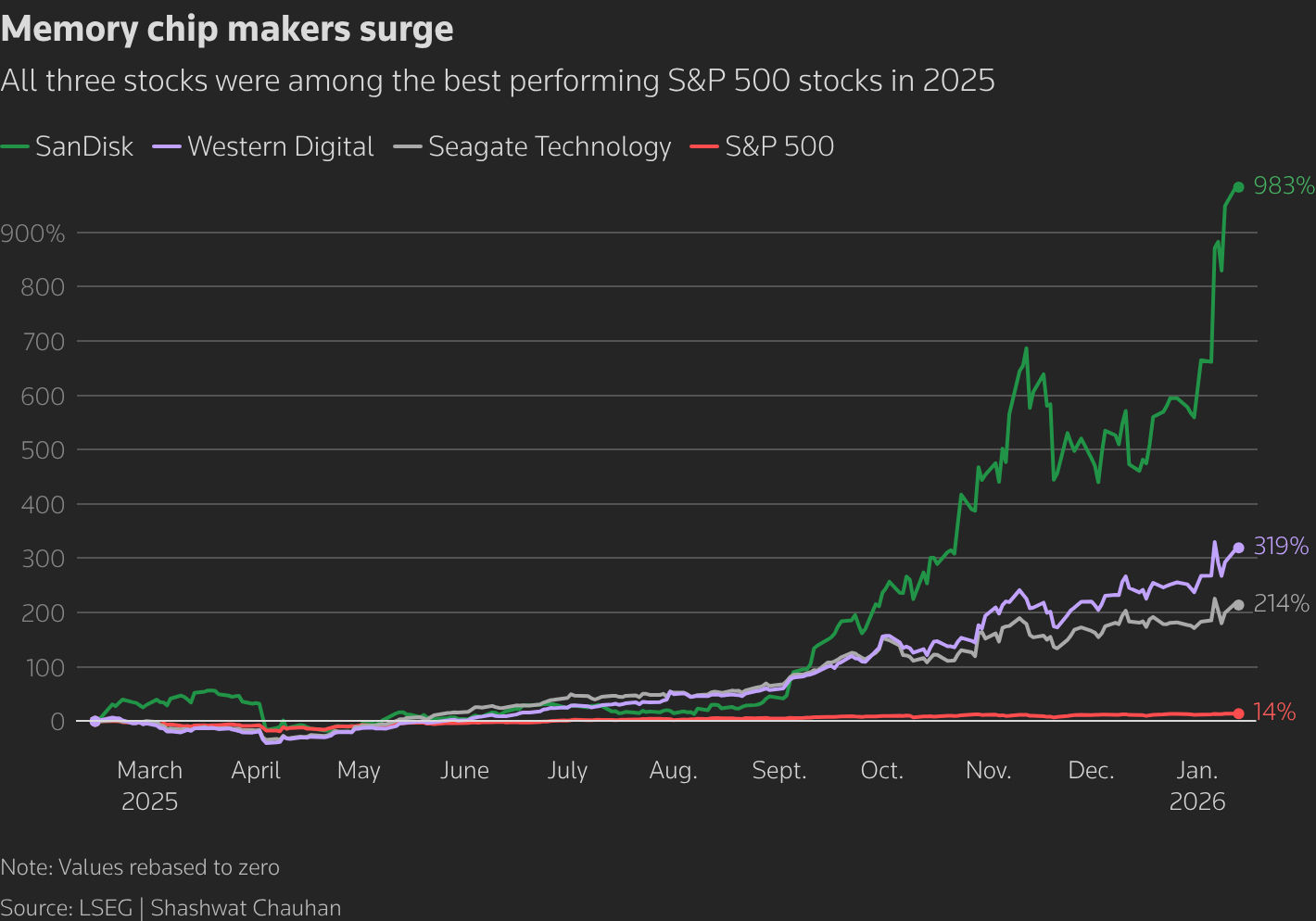
However, after experiencing a round of strong gains, the rise in chip stocks has cooled down in recent weeks, in part because investors are concerned that the growth rate of AI spending may slow down. The stock price of SK Hynix's common stock listed in Seoul, South Korea has fallen by about 25% from its all-time high set two weeks ago. However, even so, the company's stock price is still up about 630% from a year ago.
Thomas Hayes, chairman of Great Hill Capital in New York, said: “The global semiconductor sector is now the most crowded trade in the world. Underwriters and issuers — also known as SK Hynix — finance at a time when market demand is at its peak. They think the current valuation is in a high position, so they want to seize this opportunity.”
SK Hynix's offering is the second-largest stock offering in the US market after SpaceX (SPCX.US)'s record initial public offering (IPO) last month. The financing will fund the construction of a new plant for SK Hynix, while also giving the memory chip manufacturer direct access to the world's largest investor base.
SK Hynix said that the funds raised will focus on the construction of the first fab in the Yongin Semiconductor Cluster, the expansion of advanced packaging facilities at Cheongju P&T7 Park, and the construction of an AI memory packaging plant in Indiana, USA. At the same time, the company will also purchase extreme ultraviolet (EUV) lithography equipment to further enhance advanced process manufacturing capabilities. Overall, the fund-raising investment is highly focused on HBM, advanced packaging and high-end manufacturing capacity expansion, which is in line with SK Hynix's long-term strategy to continue to consolidate the competitive advantage of the AI chip supply chain and meet rapidly growing AI memory demand.
Furthermore, SK Hynix said that the purpose of this listing is to raise the company's popularity in global capital markets and seek more reasonable market valuations. The company believes that although it has established a leading position in the AI memory market, its current valuation is still lower than that of its competitor Micron Technology (MU.US).
According to the data, Micron Technology's stock price also soared 711% in the past 12 months. Although SK Hynix dominates the HBM market, its expected price-earnings ratio for the next 12 months is about 5.8 times, while Micron Technology expects a price-earnings ratio of about 7 times for the next 12 months. Analysts said that SK Hynix's listing in the US will expand the investor base, improve stock investability, and help narrow the valuation gap between it and Micron Technology.
Giuseppe Sette, co-founder of investment analysis platform Reflexivity, said, “For US investors, this is the purest broad-market stock target on the subject of investing in AI memory chips. SK Hynix chose to go public on the NASDAQ to meet this demand and enjoy a higher valuation level of US chip stocks compared to the Seoul market.” “SK Hynix successfully completed this financing based on the AI story, but subsequent companies that go public in the US may face a more difficult and demanding market.”
The listing of SK Hynix will undoubtedly be a major test at a time when the market's fervor for investment in AI infrastructure begins to cool down, leading to obvious shocks in related chip stocks.
In order to compete for a leading position in faster and smarter AI models, tech giants are investing hundreds of billions of dollars to build infrastructure to support AI development, and fund this expensive expansion plan through issuing stocks and financing loans. Analysts expect this type of capital expenditure to continue to grow in the short term. A report released by Bank of America Securities this week predicts that by 2027, global cloud computing and AI infrastructure capital expenditure will be close to US$1.5 trillion, an increase of 40% to 50% over the previous year.
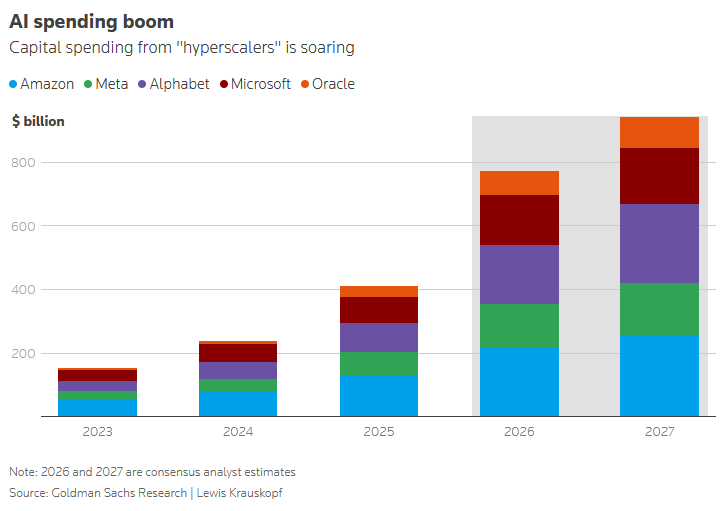
However, the market is increasingly questioning how much these huge investments will ultimately pay off. This has also raised investors' concerns about hyperscale cloud computing service providers (which may eventually have to slow down capital spending.
Matt Kennedy, senior strategist at Renaissance Capital, which focuses on IPO research and ETF products, said, “Investors will weigh the relationship between the strong performance accumulated by the sharp rise in stock prices over the past year and recent market fluctuations. “Oversupply concerns have always been a risk inherent in the semiconductor industry.”