
Meme ETFs surged 35% during the year but still fell into losses, and the alarm for the “valuation trap” under the AI speculation boom sounded again
The Zhitong Finance App learned that investors chasing market themes are re-learning a familiar lesson: popular investments don't necessarily bring profit. Although the Roundhill Meme Stock ETF (MEME), which tracks retail group stocks, has accumulated a cumulative increase of about 35% since 2026, with a single-day increase of 3.5% on Thursday, the closing price of $8.41 as of July 9 is still about 15% lower than the reissue price in October 2025. The fund's assets under management are around $20 million, which is far below the level at the time of issuance.
This performance gap highlights a principle often overlooked during times of market frenzy: short-term returns can be driven by popularity and popularity, but the longer you hold, the more factors such as profitability, competitive position, and purchase price dominate.
MEME ETF: Surging 35% during the year but still “losing money”
Since 2026, the Roundhill Meme Stock ETF (MEME) has accumulated a cumulative increase of about 35%, and rose another 3.5% in a single day on Thursday, mainly driven by the strong performance of constituents such as AST Spacemobile, Terawulf, and Lumentum Holdings. The AI boom has not only spawned a sharp rise in high-profit chip stocks, but also led to the return of speculative trading — the popularity of leveraged ETFs, sharp fluctuations in small-cap stocks, and the return of the “meme stock season.”
The fund commenced trading on October 8, 2025 at an issue price of approximately $9.90. The beginning of its establishment coincided with the peak of the previous retail trading cycle, then the market experienced adjustments, and the MEME ETF once fell to a 52-week low of $5.33. Even if it rebounds 35% in 2026, there is still a gap of about 15% from the issue price. The structural characteristics of the Fund amplify this risk of volatility. Its portfolio changes hands nearly five times a year — one of the funds with the highest turnover rate on Wall Street — while nearly 60% of its assets are concentrated in its top ten positions. The holdings include AST Spacemobile, Terawulf, Lumentum Holdings, Bloom Energy, Applied OptoElectronics, and iREN Limited.
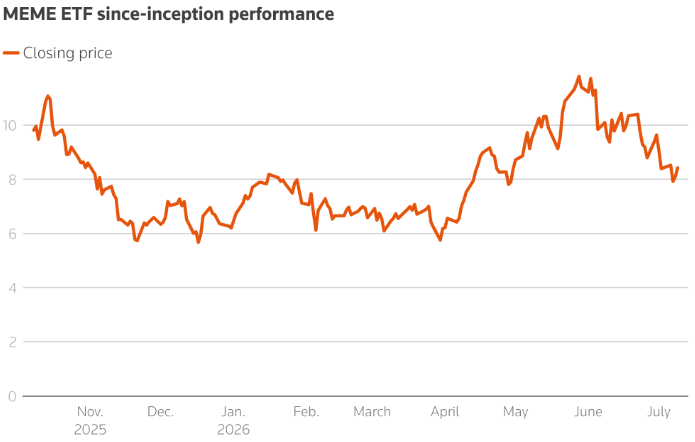
Despite impressive performance in 2026, investors who bought at the beginning of the offering still lost about 15%, and both the S&P 500 and NASDAQ indices rose by about 12% during the same period. Dave Mazza, CEO of Roundhill Investments, said: “The establishment of the fund coincided with the peak of the last retail cycle, which is more a sign of timing than whether these stocks can achieve a strong rise like we saw this year.”
William Blair's chief investment strategist Olga Bitel emphasized: “Just because retail investors are heavily involved in these exciting companies and IPOs doesn't mean you shouldn't do your homework to figure out what this company actually does, where it is in the ecosystem, and whether it can deliver on its promises.”
From Cisco to AI giants: historical lessons of overvaluation, good company ≠ good investment
The poor performance of MEME ETFs reveals a principle often overlooked during times of market frenzy: short-term returns can be driven by popularity and popularity, but the longer they are held, the more dominant factors such as profitability, competitive position, and payment price.
Cisco Systems became the company with the highest market capitalization in the world at the peak of the Internet bubble in 2000, but investors who bought near the peak of the stock price waited more than 25 years until May 2026 to return to the high point of the Internet bubble period. After the bubble burst, Cisco's stock price plummeted by nearly 90%. This lesson also applies to the most interested companies in the market today — including SpaceX and the potential future listings of artificial intelligence startups OpenAI and Anthropic.
Today, AI startups Anthropic and OpenAI are testing investors' patience in similar ways. Anthropic's valuation reached 965 billion US dollars in the H round of financing in May, and the secondary market valuation soared to 1.2 trillion US dollars. Javier Avalos, co-founder of the secondary trading platform Caplight, described Anthropic as “the most sought-after company ever in the secondary venture capital market.” Rainmaker Securities CEO Glen Anderson said, “Anthropic's demand far exceeds supply, so it's difficult to reach a deal because no one is selling.”
However, neither company achieved stable profits. OpenAI's revenue in 2025 was about 13 billion US dollars, but the total expenditure reached 34 billion US dollars, and the net loss was about 39 billion US dollars. Excluding one-off projects, the operating loss was approximately US$21 billion. Although Anthropic is about to achieve its first quarterly operating profit, it is still investing heavily in the development and deployment of AI models. OpenAI still spent more than revenue in the first quarter of 2026.
According to Polymarket data, traders think the probability of Anthropic's IPO before the end of 2026 is 76%. However, it has been revealed that OpenAI's IPO plans may be delayed until 2027.
Speculative frenzy under the AI boom
The boom in artificial intelligence has not only driven a sharp rise in the stocks of high-profit chip companies, but also led to the return of speculative trading. Its characteristics include the popularity of leveraged ETFs, sharp fluctuations in small-cap stocks, and the resurgence of the “meme stock” market.
Regulators have issued a warning. The Bank for International Settlements (BIS) warned in its latest annual report that the world's top five hyperscale cloud service providers are expected to invest more than 1 trillion US dollars in AI-related capital expenses between 2025 and 2026, and may have shown signs of overheating. BIS general manager Pablo Hernández Decos warned: “If the development results of artificial intelligence do not meet expectations, this will make the entire industry more vulnerable and could bring the current investment boom to an abrupt end.”
Morgan Stanley technology analyst Jason Hunter pointed out in a customer report that the current segmentation of AI transactions is beginning to reflect the situation on the eve of the 1999 internet bubble — semiconductor, storage, and AI hardware vendor stocks continued to rise, while cloud giants that actually bear large-scale capital expenses are clearly lagging behind. TS Lombard predicts that global AI capital expenditure will reach about 800 billion US dollars by 2026, and economists warn that “Nvidia may be the new Cisco.”
Outlook: When the fervor recedes, fundamentals will eventually dominate
The market has proven time and again that high expectations can be a burden. Investors who buy when market sentiment is high often find that even if the company's performance is strong, it cannot support high stock prices. Will McGough, Chief Investment Officer of Prime Capital Financial, concluded: “An army of retail traders certainly helps shape trends, but investing clearly doesn't have a free lunch.”
The current AI boom has unsettling similarities to the 2000 internet bubble: also driven by the “this time is different” narrative, there are also a large number of unprofitable companies receiving sky-high valuations, and retail investors are also scrambling to take the lead. Cisco's lesson reminds investors that even if a company eventually becomes an industry leader, excessive purchase prices can take decades to recoup.
As Bitel says, the essence of long-term investing remains the same: understanding the fundamentals of a business, figuring out its place in the ecosystem, and whether it can deliver on its promises. When the tide of AI speculation recedes, nude swimmers will eventually be revealed — and history has proven time and time again, and this one is no exception.