
Fed policy uncertainty heats up, traders are betting on the return of fluctuations in the foreign exchange market
The Zhitong Finance App learned that as banks warned that changes in the Fed's policy expectations and the escalation of geopolitical tension might impact the market, after several months of calm, foreign exchange traders began to buy more hedging tools to prevent exchange rate fluctuations from intensifying.
According to the data, an indicator measuring the expected volatility of major currencies in the coming month has risen slightly in recent weeks, but it is still only slightly above the five-year low hit in June, and far below this year's average. Meanwhile, the one-year EURUSD implied volatility has recovered from its low since 2022, but the one-month EUR/CHF implied volatility is still at its lowest level in more than a decade.
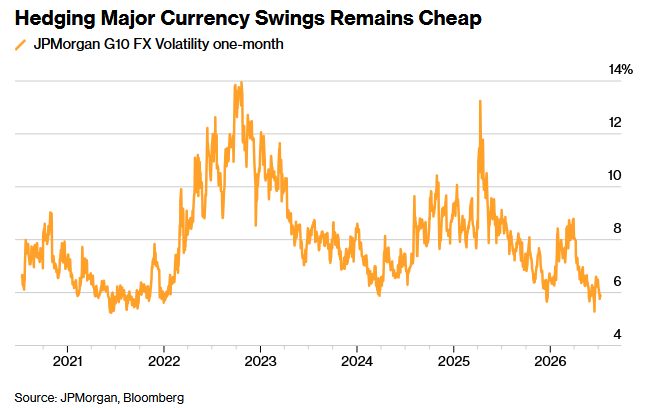
The cost of hedging large swings in major currencies is still low
This low volatility in the foreign exchange market has also made arbitrage trading one of the most profitable foreign exchange trading strategies this year. Arbitrage transactions usually borrow low-yield currencies such as yen or Swiss franc and then buy high-yield currencies, including emerging market currencies, to earn profit from interest spreads.
Since this year, this strategy has yielded returns of around 8%, outperforming global bonds and gold. Goldman Sachs Group strategists said that huge interest rate differences between developed economies and continued sluggish market volatility have together created the most favorable market environment for arbitrage trading for more than 20 years.
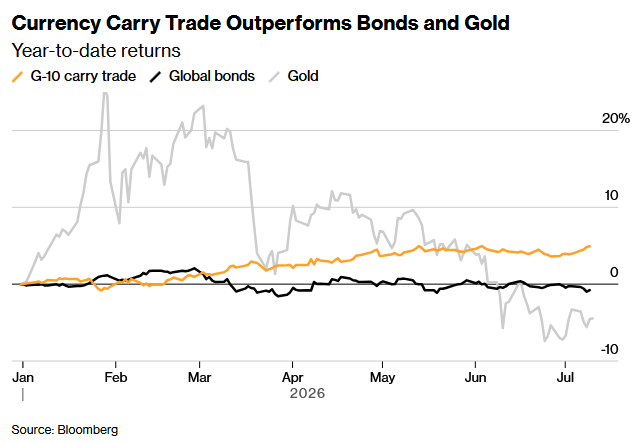
Foreign exchange arbitrage trading has outperformed bonds and gold in terms of returns since the beginning of the year
Goldman Sachs strategist Stuart Jenkins wrote in a report, “It is the stability of interest rates in G10 countries in the current range — actual volatility due to interest rate differences is declining, and the market anticipates that future policy actions are relatively limited — that has enabled G10 foreign exchange arbitrage yields to rise simultaneously while volatility remains sluggish.”
Hedge funds and asset managers usually use arbitrage trading to earn interest rate differences between different markets. As long as the overall exchange rate remains stable, this strategy can continue to be profitable. However, this strategy also comes with risks. The problem is that the second key factor underpinning arbitrage trading — low volatility — may soon disappear. Since arbitrage gains are gradually accrued, losses due to exchange rates can occur rapidly within a few minutes. Therefore, once market fluctuations suddenly increase, it may trigger the rapid liquidation of arbitrage positions and amplify fluctuations in the entire financial market.
At the same time, the market is facing a far from calm environment. Under the leadership of the new Federal Reserve Chairman Kevin Walsh, the Federal Reserve is gradually reducing the provision of clear interest rate path guidelines to the market, making traders increasingly rely on every release of economic data to determine policy trends. Meanwhile, another outbreak of conflict between the US and Iran is threatening the already fragile cease-fire situation in the Middle East.
Barclays Bank strategists believe that this disconnect between market performance and the macro environment is unlikely to last long. The strategy team led by Marek Latzko said that the bank's model shows that the volatility of the foreign exchange market is expected to pick up in the future, and advises investors to buy relevant financial instruments that can profit when the volatility of the euro against the US dollar intensifies later this year. They wrote in a report: “The reason why the current volatility of the foreign exchange market remains low is not because macroeconomic uncertainty has declined, but because the market lacks clear directional judgment.”
Foreign exchange traders familiar with related transactions said that some investors and interbank trading departments seeking short-term gains seem to have reached similar conclusions. Since current hedging costs are still low compared to potential risks, leveraged investors are actively developing trading strategies that can profit once market volatility recovers.
There are already some signs that the market may be changing. As the foreign exchange options market begins to take into account the US inflation data to be released next week, the hedging cost of short-term options in the euro and British pound has rebounded from a low point this week. This also reminds the market that after the Federal Reserve reduced its forward-looking guidance, the influence of individual economic data on the market has reached the highest level in many years.
The upcoming US inflation report may influence the money market's bets on the Fed's interest rate path. Currently, the money market still expects the Federal Reserve to raise interest rates by at least 25 basis points this year.
Currently, the market is still generally betting that the market environment will remain stable in the future. However, if volatility returns, trading strategies that have always benefited from a low volatility environment may quickly experience large-scale liquidation. Moreover, if the volatility of the foreign exchange market continues to rise, the impact will go far beyond the options market.