
“Musk's premium” fights back and forth: SpaceX (SPCX.US) IPO surges and falls in the first month, Tesla (TSLA.US) “defends and fights back”
The Zhitong Finance App learned that the aura of the biggest IPO in global history has not yet faded, and the stock price of SpaceX (SPCX.US) has fallen from the clouds. This giant, which integrates aerospace, telecommunications, AI, and social media, controlled by Elon Musk, has plummeted more than 35% from the closing high of $225.64 set on June 16, and hit an all-time low of $145.20 in the July 9 intraday market. By the close of trading on July 9, SpaceX reported $149.29, lower than the opening price of $150 on the first day of listing for two consecutive days.
In subtle contrast to this, Tesla (TSLA.US) stock has risen slightly since SpaceX went public — it opened at $399.49 on June 12, and is currently trading around $402. The market's repricing of Musk's “faith premium” is unleashing a brutal tug-of-war between these two stocks.
From $225 to $145: the “end of the honeymoon” of the biggest IPOs in history
SpaceX's IPO has set many historical records. On June 11, the company issued 555.6 million shares at a price of 135 US dollars per share, raising 75 billion US dollars; if underwriters exercise green shoe options, the maximum amount raised can reach 86 billion US dollars. It opened at $150 on the first day of listing on June 12, and the stock price then soared. It hit a closing high of $225.64 on June 16, and the market capitalization once approached $3 trillion.
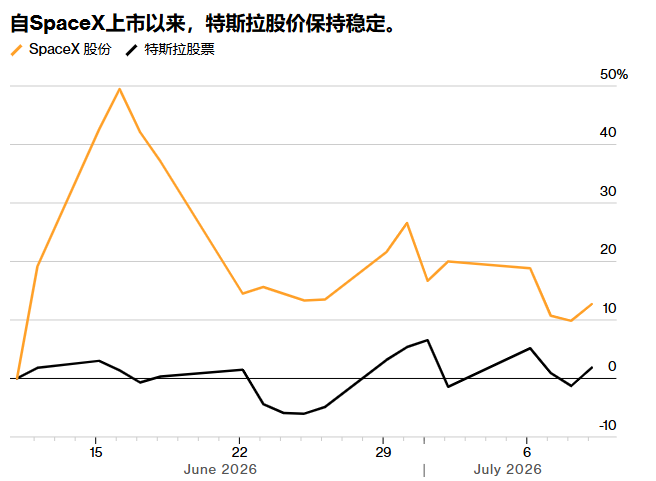
However, the feast was followed by a cruel return of values. On July 7, on the first trading day to be included in the NASDAQ 100 Index — it only took 15 trading days from listing to the index, setting the fastest record since the index was founded — SpaceX's stock price suffered a severe drop. The closing price plummeted 6.83% to $149.47, falling below the opening price of $150. Bloomberg industry research analysts estimate that funds included in the NASDAQ 100 and Russell Index series should have driven the tracking index to generate at least $5.4 billion in buying demand. However, Mike Coe, chief strategist at the options analysis platform Openinterest.pro, pointed out that SpaceX's weight in the NASDAQ 100 is only 1.3%, and the driving effect of passive buying has been greatly weakened.
JJ Kinahan, senior vice president of the Chicago Options Exchange, said in his warning on the eve of inclusion: “We know the volatility is high... can you accept that the stock price may fluctuate $20 over the next 11 days? The stock price can go up $20, but it can also go down $20.”
The gap between beliefs and fundamentals: net loss of 4.276 billion dollars in the first quarter, with a market sales ratio of more than 100 times
Behind the sharp drop in SpaceX's stock price is the market's general concern that AI concept stocks are overvalued. According to SpaceX's prospectus, the company's performance is still in the red. In the first quarter of 2026, SpaceX had revenue of US$4.694 billion and a net loss of US$4.276 billion, almost close to the loss for the full year of last year. According to the FactSet survey, 23 analysts predicted a median earnings per share for SpaceX in 2026 of -$0.42.
Among the three major business segments of the company, only the connected segment with the Starlink satellite Internet as the core can “hematopoiesis”, and the space and AI sectors continue to “burn money”. The Grok model did not have an advantage in market competition. SpaceX expects revenue of about 36 billion US dollars in 2026, and has yet to achieve profit. The market sales ratio based on revenue for the next 12 months is as high as 41 times. More conservative estimates show that with a market capitalization of 2 trillion US dollars and annual revenue of about 19 billion US dollars, the market sales ratio is more than 100 times.
Precisely because of continued losses, SpaceX did not meet the S&P 500 profit entry threshold, which meant that the benchmark index would not include it for at least a year.
Wall Street's “Vote of Faith”: The average target price is $236, and the highest price is $800
Despite the sharp drop in stock prices and worrying fundamentals, Wall Street's major investment banks almost completely gave bullish ratings after the end of the quiet period. According to data compiled by Bloomberg, analysts' average target price is as high as $236.45, and there is room for a 58% premium compared to the current closing price.
Morgan Stanley is the most aggressive, giving it an “overweight” rating, targeting a $300 price target, and setting a pessimistic $75 and optimistic $600 scenario. The bank expects SpaceX's revenue to reach 319 billion US dollars in 2030 and exceed 3.3 trillion US dollars in 2040, but predicts that the company will not achieve positive free cash flow until 2035.
Raymond James gave a “Strong Buy” rating in the initial coverage report, and the target price was as high as $800. Deutsche Bank gave a “buy” rating with a target price of 255 dollars; J.P. Morgan gave an “overrun” rating with a target price of 225 dollars; Bernstein gave a “outperform the market” rating, with a target price of $239; RBC gave a “outperform the market” rating, with a target price of 225 dollars; Goldman Sachs gave a “buy” rating, with a target price of 205 dollars.
There are also skeptical institutions. MoffettNathanson gave a “neutral” rating for the first time, and the CFRA recommended “selling” the stock.
Combined conjecture: Tesla's “Musk Premium” defense battle
SpaceX's post-launch performance had a subtle and profound impact on Tesla. Steve Sosnick, chief strategist at Yingtou Securities, refers to Tesla as a “faith” stock — Musk has earned huge wealth for many loyal believers. Today, however, this belief is being doubly tested.
On the one hand, if SpaceX performs well, it will attract the attention and capital of the two companies' overlapping investor groups; on the other hand, if SpaceX does not perform well, it will hinder the value of future mergers. Ivan Feinseth, chief investment officer at Tigress Financial Partners, pointed out that SpaceX's sensational IPO had already diverted retail and momentum capital focused on Musk from Tesla, but SpaceX's equally high valuation also supported what Tesla thought was the “bottom line of bailouts.”
Merger speculations are becoming the focus of market attention. J.P. Morgan analyst Rajat Gupta said the merger between Tesla and SpaceX was “reasonable on paper” and that the two companies' shared AI ambitions would be a “potential strategic adhesive.” However, Gupta warned that potential obstacles include regulatory approvals in multiple jurisdictions, issues of symmetry in governance and voting rights, and “outsiders believe the merger will be a SpaceX-led acquisition.” J.P. Morgan predicts that if the deal happens, the most likely structure would be for SpaceX to buy Tesla in full stock.
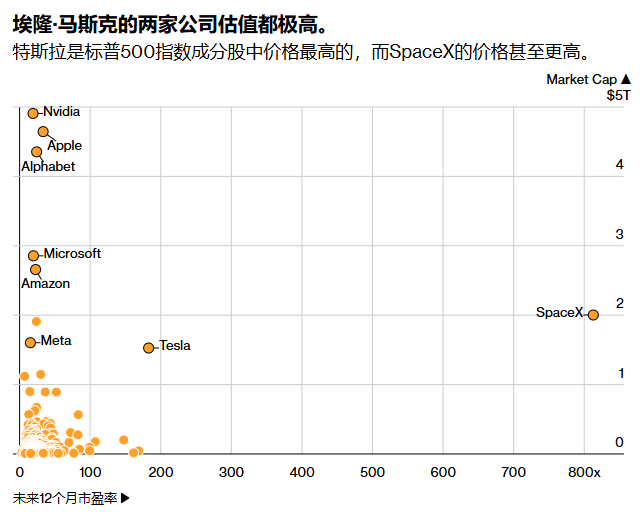
Royal Bank of Canada analyst Tom Narayan believes that the possibility of a merger is increasing, and the main reason SpaceX wants to merge with Tesla is “operational cooperation.” He raised Tesla's price target from $475 to $500, implying a 22% increase. However, BNP Paribas analysts are skeptical, pointing out that the two companies' large cash consumption and significant regulatory risks complicated the merger, maintaining Tesla's “weaker than market” rating and a target price of $280.
Tesla will announce its second-quarter earnings report on July 22. Although the company delivered 480,126 vehicles in the second quarter, the best second-quarter record in history, with a year-on-year increase of 25%, the stock price plummeted 7.49% on the day the delivery data was released. Strong sales failed to boost stock prices, reflecting that the capital market is re-examining Tesla's core narrative: when growth is mainly driven by price cuts and promotions, Tesla's story is sliding from “technological disruption” to the logic of “traditional cars.”
Looking Ahead: Crossroads of Faith
SpaceX's performance in the month since its listing revealed a profound shift in the capital market's pricing logic for the “Musk Concept.” During the IPO frenzy, investors were willing to pay a sky-high premium for Musk's vision; but when the hustle and bustle subsided, fundamentals — continuing to expand losses, uncertain profit schedules, and a market sales ratio of up to 100 times — began to redominate pricing.
Nationwide's chief market strategist Mark Hackett said that the market's concerns about overvaluing AI concept stocks may continue until the earnings report is released. SpaceX needs to fully reuse starships within the next few years, significantly enhance Grok's competitiveness, and successfully develop a cost-effective space solar data center. According to analysts at Morgan Stanley, SpaceX will need to raise an average of 84 billion US dollars a year from 2027 to 2034 to support infrastructure construction.
Tesla is also facing tests. If Robotaxi and robotics fail to develop into meaningful businesses as scheduled, their $1.5 trillion market capitalization base will be questioned. “Tesla doesn't even need SpaceX if it can operate successfully,” Karobaar Capital analysts said.
The test of the earnings season: Can the autonomous driving narrative come true on July 22?
On July 22, Tesla will release its full second-quarter earnings report. This will be a critical time to test the success of “Musk's Premium.”
Investors are no longer focused on car deliveries, but on: Robotaxi's expansion plans and schedule, FSD's subscription growth and safety data, Cybercab and Semi's mass production progress, and the return prospects for AI capital expenses.
Horizon Investments analyst Dmitry Shlyapnikov's summary is quite representative: “The July 22 financial report will be a short-term test to test whether management can transform the autonomous taxi and warehousing business from theory to actual performance.” SpaceX's earnings report is even more remote — as a company still losing huge sums, the market's patience with it is based on a long-term vision of “$3.4 trillion in future revenue.” However, if Tesla's autonomous driving narrative fails to meet market expectations on July 22, the entire “Musk Empire” valuation logic will face re-examination.
Before the IPO, many Wall Streeters feared that SpaceX's listing would pose an “existential threat” to Tesla — draining capital, competing for attention, and diluting “Musk's premium.” However, market responses a month later showed that merger expectations are transforming this potential “zero-sum game” into a kind of “symbiotic narrative”: SpaceX's pullback has not dragged down Tesla; on the contrary, speculations that the two companies will eventually merge into one are providing new support for Tesla's stock price.