
The strongest buyers' confidence in US stocks is shaken! Net purchases from retail investors fell to their lowest level since the pandemic, refusing to “blindly buy large markets” and switched to “story stock selection”
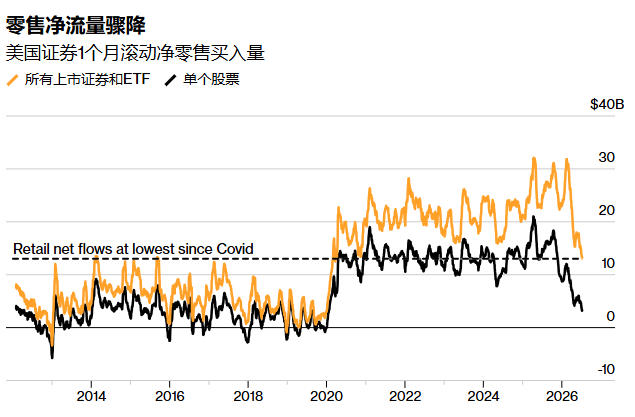
The Zhitong Finance App learned that retail investors — one of the strongest supporters of US stocks this century — are showing signs of weakening confidence. According to the latest data from Vanda Research, the gap between capital inflows into US stocks and outflows over the past four weeks has narrowed to 13 billion US dollars, the lowest level since the outbreak of COVID-19. Although market trading activity remains strong, retail investors are selling almost as fast as buying, causing net positions to return to their low since 2020.
This development shows that the investor community is becoming more picky, and they prefer to chase specific market topics rather than have broad confidence in benchmark indices. With the US stock market diversification close to the highest level in history and intense rotation between winners and losers, 2026 is becoming a real “stock picker year.”
The “Big Seven” were abandoned by retail investors: the share of transactions plummeted to 6%
“Magnificent Seven” (Mag 7), which was once the most sought after by retail investors, is experiencing a large-scale “vote with your feet.” According to Citi data, in the five trading days up to June 26, retail transactions only accounted for 6% of Mag 7's total trading volume, the lowest level in four years.
This ratio is clearly different from the peak of over 20% between 2023 and 2024. This ratio will remain above 15% for most of 2025. Citi strategist Stuart Kaiser pointed out that retail interest in Mag 7 last week was lower than the level of about 85% of trading days since 2022, indicating a decline in systemic enthusiasm rather than short-term fluctuations.
Within Mag 7, Nvidia was hit most clearly by the withdrawal of retail investors — retail transactions fell to 8.1% of the stock's total turnover from 9.6% the previous week. Tesla, on the other hand, has the relatively highest retail interest among the seven constituent stocks, accounting for 10% of the total trading volume, but this figure is also close to its historical low since 2022.
Meanwhile, Mag 7 stock's performance this year has also been disappointing. Bloomberg's index tracking this combination fell 3.1% cumulatively, while the S&P 500 index rose 8.7% during the same period.
Vanda Research: Retail investors “buy stories, not big markets”
Viraj Patel, a global macro strategist at Vanda Research, pointed out that retail investors' net buying activity has declined sharply, but this does not mean they have stopped trading. “Some carefully selected retail investors have joined a very carefully selected group of institutional investors — in the eyes of these people, 2026 is really a world of stock selectors,” Patel said.
The retail behavior pattern in 2026 is very different from the post-pandemic era. Instead of buying AI stocks and the “Big Seven” widely, they quickly rotated between topics: betting on energy stocks and energy ETFs at the beginning of the year; switching to silver ETFs and non-US stock markets in February; chasing the semiconductor sector and locking in chip stocks such as Micron and Mywell; and quickly moving to cryptocurrency ETFs in June.
The launch of SpaceX brought this trend to a climax. According to data from Vanda Research, in the first three trading days of SpaceX's listing, retail net purchases reached US$369.8 million, while Nvidia's net purchases during the same period were only US$88.2 million. Retail interest in SpaceX has overshadowed almost every other stock in the market.
According to Vanda Research, retail investors' speculative capital is being devoured by cryptocurrencies, prediction markets, sports betting, and various private equity and alternative assets. The study said bluntly: “It's not that retail investors are no longer speculating, but rather that the process of finding a 'tenfold share' is scattered across more markets; stocks are just one of them.”
Reversal of sentiment: those who are bearish overwhelm those who are bullish
The cautious attitude of retail investors is fully confirmed in sentiment data. According to the latest survey by the American Association of Individual Investors (AAII), 37.2% of respondents said they were pessimistic (bearish) about the stock market for the next six months, while 36.3% were optimistic (bullish). According to AAII's historical average data, the bullish ratio is 37.5%, and the bearish ratio is 31.0%.
More noteworthy is the continuation of the trend — since mid-February, the number of bearish bearers has surpassed bulls in all but four weeks. Bullish sentiment has been below the historical average for seven consecutive weeks. Just a week ago (July 1), the bearish ratio once reached 42.3%, while the bullish ratio was only 31.4%.
This continued pessimism is particularly abnormal in the context of US stocks approaching historic highs. As one market watcher put it: “History shows that the strongest bulls are often driven by doubt rather than fanaticism” — but 19 weeks of bears have gone beyond a normal “wall of worry.”
Where did the money go? Crypto, prediction markets, and sports betting's “food-grabbing”
Another key factor in the changing behavior of retail investors is that the competitive landscape for speculative capital has completely changed. According to Vanda Research, retail investors' speculative capital is being devoured by cryptocurrencies, prediction markets, sports betting, and various private equity and alternative assets. The same one-dollar “adventure money” is no longer just looking for the next “tenfold share” in the traditional stock market, but is scattered across many different platforms.
ETFs have become an important alternative. According to Citi data, retail capital is shifting from individual stocks to ETFs. While Mag 7's share of retail transactions fell to 6%, the inflow of related ETFs was increasing.
Cryptocurrency and prediction markets divert speculative capital. Vanda Research notes that retail investors' speculative capital now faces more competition — cryptocurrency trading, prediction markets, and sports betting are all vying for “risk money” for the same dollar.
“It's not that retail investors stop speculating, but rather the process of finding the next '10-bagger', spread out to more markets. Stocks are just one of them.” Vanda Research wrote in the report. This kind of fund diversion means that in the past, the traditional analytical framework that relied solely on tracking retail purchases to determine risk and market conditions is becoming ineffective.
Market impact: Light positions do not represent a bearish signal
Vanda Research emphasized that the decline in net retail holdings does not constitute a bearish signal for the stock market. The analysis points out that it is the “crowded area” rather than the “light part” that is really likely to cause drastic correction. When retail investors have yet to enter the market in large numbers, the market is less pressured to be forced out; if retail investors return in the future, it may also become additional purchases that will drive up the index.
Etoro's US investment analyst Bret Kenwell believes that the potential slowdown in retail demand reflects concerns about the overvaluation of the overall market and technology stocks. “Chip stocks are consolidating after a sharp rise in the second quarter, and retail investors may be reluctant to invest new capital into sectors they think have expanded excessively in the short term.”
Citadel's statistics also show that retail investors' desire to “buy on the dips” still exists — since this year, as long as the S&P 500 index falls, the size of retail purchases is close to 3.5 times the average daily level.
According to J.P. Morgan Chase data, retail investors bought a net share of US$8.9 billion this week, which is higher than the average of the past 12 months of US$6.8 billion. However, Vanda's Patel pointed out, “There has never been a clear trend in AI and technology, and even the Big Seven are no longer trading like a single entity.”
The advent of the stock picker era
The shift in retail behavior reflects a profound transformation that the US stock market is undergoing. As the index approaches historic highs, retail investors are shifting from “buying the market indiscriminately” to “chasing themes and stories.”
For professional investors, the key question is no longer “whether retail investors are buying”, but “which story are retail investors chasing now”. In an environment where segmentation within the AI sector intensifies and capital is rapidly rotating between different topics, the winners of the second half of 2026 will be those investors who can accurately capture the transformation of retail narratives.
As Vanda Research said, light positions are not a sign of risk; crowded positions are. However, when retail investors' funds are scattered across multiple battlefields such as cryptocurrencies, forecasting markets, sports betting, etc., the framework for predicting market trends by tracking retail behavior in the traditional sense may also need to be re-examined.