
Is Bayer (XTRA:BAYN) Still Undervalued After An 84% Run?
Bayer stock has delivered a strong 83.8% return over the past year, yet its current valuation checks still suggest the shares lean cheap rather than stretched.
- Over the last 12 months, Bayer is up 83.8%. This puts fresh focus on whether the recent share price strength has already captured the main improvement in expectations.
- Recent news around the consolidation of the U.S. glyphosate business into Ruveon and the clinical research alliance with leading U.S. medical institutions can support long term cash flow expectations. At the same time, ongoing disputes with U.S. farm groups over glyphosate tariffs highlight regulatory and relationship risks that may affect sentiment around the stock.
- Bayer scores highly on valuation checks, with the company screening as undervalued in 5 out of 6 metrics. This points to the broader checks leaning toward the shares still being priced below what those fundamentals imply.
The issue now is whether Bayer's recent rerating has already done the heavy lifting, or if the current price still leaves room relative to what the valuation checks suggest.
Is Bayer Still Cheap on Sales?
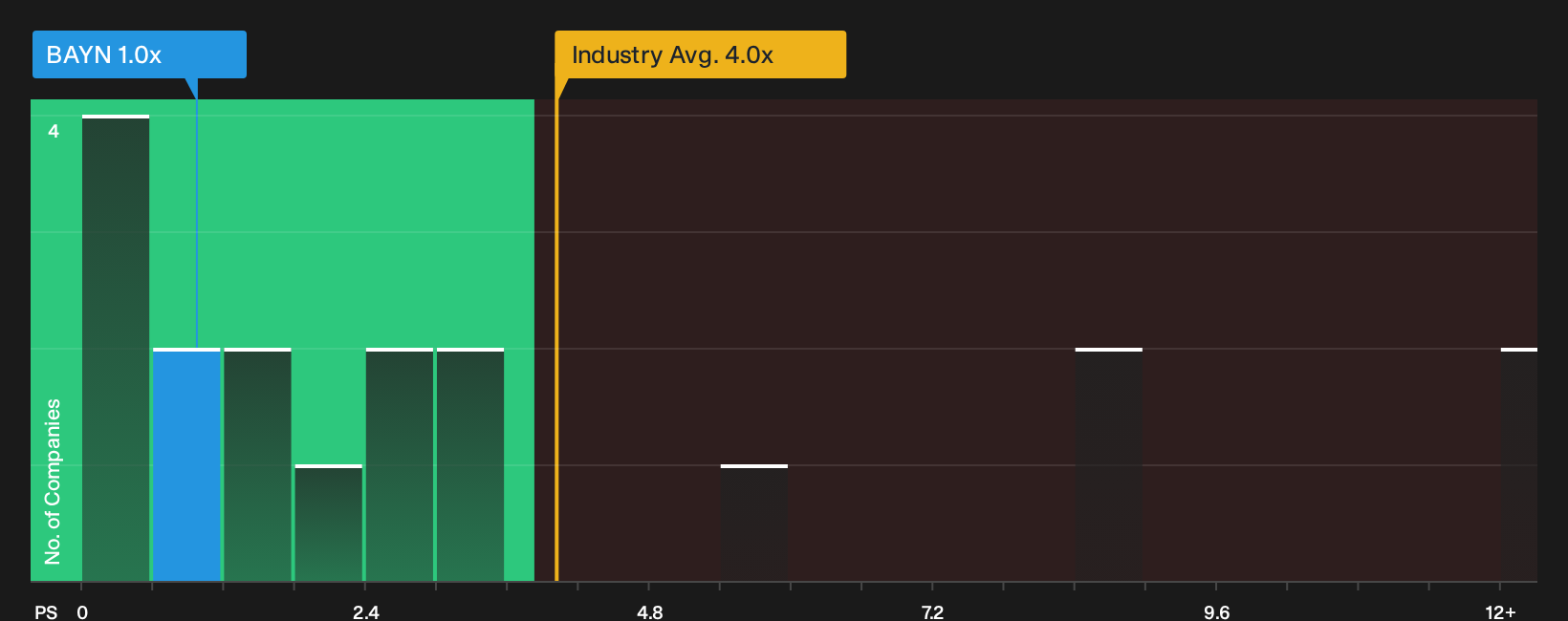
The P/S ratio is a useful yardstick for Bayer because revenue is a cleaner line item than earnings for a company facing legal and restructuring charges. Bayer currently trades on a P/S of 1.1x, compared with a Pharmaceuticals industry average of 2.6x and a peer group average of 3.2x. On a simple sales multiple, the stock sits well below both benchmarks.
The tailored fair P/S ratio for Bayer is 2.3x, based on its margins, risk profile and size. Compared with the current 1.1x, this suggests the shares trade at a material discount to where this framework indicates they might sit if priced closer to those fundamentals. Despite the recent attention around the Ruveon glyphosate consolidation and the new U.S. clinical research alliance, Bayer’s P/S multiple still reflects a lower valuation than broad industry and peer references.
On the preferred P/S yardstick, Bayer stock appears clearly undervalued relative to both its fair ratio and sector peers.
See what the numbers say about this price — find out in our valuation breakdown.
The Bayer Narrative: What Would Justify Today's Price?
To make sense of Bayer's valuation puzzle, Simply Wall St Narratives lay out the specific combinations of future growth, margins and earnings that would need to hold for the stock to be worth meaningfully more or less than today's price, and they sit on Simply Wall St's Community page. Each one is framed as a thesis about Bayer's business that you can track over time, rather than a single static fair value number.
The community sits on two very different stories for Bayer, with one side focused on upside from litigation clarity and the other fixated on the remaining legal and earnings risks.
Bull case: 21% undervalued
"Substantial investments in digital farming, precision agriculture, and product innovation are unlocking recurring-revenue streams across Crop Science sooner than anticipated..."
Read the full Bull Case to see why Bayer could be undervalued
Bear case: 43% overvalued
"Large, unresolved litigation exposures (glyphosate and PCB-related), ongoing settlements, and significant legal provisioning (€1.2 billion for glyphosate and €530 million for PCBs in Q2 2025 alone) put persistent pressure on net income..."
Read the full Bear Case to see why Bayer could be overvalued
Do you think there's more to the story for Bayer? Head over to our Community to see what others are saying!
The Bottom Line
Bayer still screens as undervalued on the market on multiple checks, even after the strong 1 year return. The key question is whether that discount reflects lingering concerns around litigation, regulation and execution, or if the market is underpricing the cash flow potential that supporters see in the core businesses. For you, the crux is whether Bayer’s current multiple is a value opportunity or a value trap, which largely comes down to how those legal and regulatory risks are resolved over time.
This article by Simply Wall St is general in nature. We provide commentary based on historical data and analyst forecasts only using an unbiased methodology and our articles are not intended to be financial advice. It does not constitute a recommendation to buy or sell any stock, and does not take account of your objectives, or your financial situation. We aim to bring you long-term focused analysis driven by fundamental data. Note that our analysis may not factor in the latest price-sensitive company announcements or qualitative material. Simply Wall St has no position in any stocks mentioned.
Have feedback on this article? Concerned about the content? Get in touch with us directly. Alternatively, email editorial-team@simplywallst.com