
Could SpaceX's Starmind Make Amazon's, Microsoft's, and Google's Cloud Businesses Obsolete? Here's What Investors Need to Know.
Key Points
SpaceX hopes to launch up to 1 million satellites to handle AI workloads.
The effort, named Starmind, could address several key challenges for Earth-based AI data centers.
Amazon, Microsoft, and Alphabet's Google unit will likely closely watch Starmind's progress.
Elon Musk's most ambitious project to date now has a name. He recently confirmed on X (formerly Twitter) that Space Exploration Technologies' (NASDAQ: SPCX) planned artificial intelligence (AI) satellite constellation will be called "Starmind."
Musk briefly became the world's first trillionaire following SpaceX's initial public offering (the largest IPO ever). And his wealth could expand significantly if Starmind fulfills its potential.
Where to invest $1,000 right now? Our analyst team just revealed what they believe are the 10 best stocks to buy right now, when you join Stock Advisor. See the stocks »
Could Starmind even render Amazon (NASDAQ: AMZN) Web Services (AWS), Microsoft (NASDAQ: MSFT) Azure, and Alphabet's (NASDAQ: GOOG) (NASDAQ: GOOGL) Google Cloud obsolete? Here's what investors need to know.
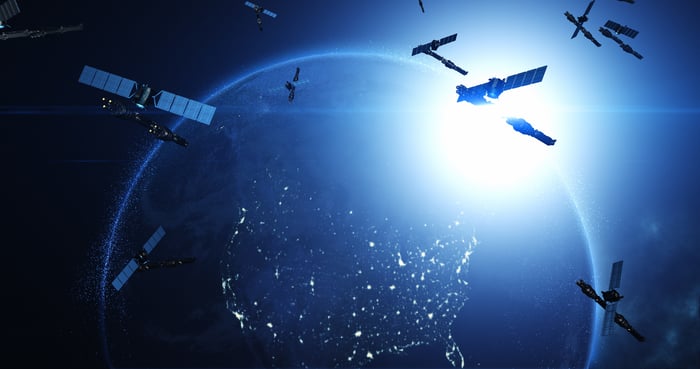
Image source: Getty Images.
Leaving Starlink in the stardust
SpaceX's Starlink satellite internet service business has been the company's crown jewel so far. However, that could change if Musk achieves his goal for Starmind.
He plans to launch up to 1 million satellites that run AI workloads in orbit. This number is roughly 100 times the number of satellites currently operated by Starlink. It's also several times the total number of satellites launched in human history. The idea is for the satellites to process their data in space, then beam the results back to Earth.
Two of the biggest challenges for AI data centers on Earth are the need for massive amounts of electricity and the significant heat they generate, which requires cooling. Starmind addresses both issues. Its satellites will be solar-powered. As Musk likes to say, "It's always sunny in space." Also, much less cooling will be needed because the AI processors will radiate heat into space.
There's another big plus to orbiting AI data centers: no permitting or zoning obstacles. The main drawback for Starmind's approach is the cost of launching the satellites -- but SpaceX's reusable Starship spacecraft should help on that front.
Obsoleting the hyperscalers?
AWS, Microsoft Azure, and Google Cloud currently rank as the world's three largest AI hyperscalers. Will these businesses be made obsolete by Starmind, with SpaceX growing exponentially? I wouldn't go that far.
For one thing, SpaceX still faces significant technological and regulatory hurdles in building Starmind at full scale. Also, Amazon, Microsoft, and Alphabet won't simply allow their fastest-growing businesses to go away without a fight. The three tech giants could become SpaceX customers. Amazon could leverage its Leo satellite business and connection with founder Jeff Bezos' Blue Origin to compete more effectively.
Musk has also made grandiose predictions in the past that haven't come true. It could happen again with his planned AI satellite constellation.
Still, Amazon, Microsoft, and Alphabet will almost certainly be closely watching Musk's audacious strategy with Starmind. Investors should, too.
Keith Speights has positions in Alphabet, Amazon, and Microsoft. The Motley Fool has positions in and recommends Alphabet, Amazon, and Microsoft. The Motley Fool has a disclosure policy.