
Apollo's chief economist: If the AI boom recedes, I'm afraid the dollar will also plummet
The Zhitong Finance App learned that Apollo Global Management's chief economist Torsten Slok (Torsten Slok) issued a warning on Monday: if the sell-off in artificial intelligence-related stocks intensifies further, the recent rise in the US dollar will face significant risks. Slock pointed out that over the past 12 months, international investors have actively laid out AI themes to drive a record rolling net foreign capital inflow in the US stock market. However, most of these investors did not hedge their exposure to the dollar against exchange rate risk.
“If AI disappoints and causes capital inflows to fall back, it will pose a significant downside risk to the dollar,” Slock wrote in a report released on Monday. This means that the US dollar actually “hides a dependency on AI transactions.”
The dollar's “implicit dependence” on AI
In the report, Slock pointed out that in the past 12 months, international investors have actively laid out AI themes, driving a record rolling net foreign capital inflow in the US stock market. However, the vast majority of these investors are not hedging their foreign exchange risk.
This detail forms the core mechanism of “implicit dependence” on the US dollar: overseas investors need to exchange the local currency for the US dollar before purchasing US stocks, which provides important support for the US dollar. At the same time, compared to other major economies, US interest rates remain high, making it too expensive to buy US dollar exchange rate risk hedging tools, so the trend of the US dollar is also more susceptible to stock market fluctuations.
“Therefore, if AI disappoints and causes capital inflows to fall back, it will pose a significant downside risk to the dollar,” Slock warned. This means that the US dollar actually “hides a dependency on AI transactions.”
Deutsche Bank echoes: The US dollar is transforming from a “safe-haven asset” to a “high tech beta”
Deutsche Bank's analysis echoes Slocke's judgment. In her report to clients, Deutsche Bank's senior financial market analyst Malika Sachdeva pointed out that global capital is pouring into US technology stocks on an unprecedented scale, and this trend is fundamentally changing the risk attributes of the dollar — it is gradually transforming from a traditional safe-haven asset to a “high tech beta” asset highly linked to the Nasdaq 100 Index.
For a long time, America's “double deficit” (current account deficit of about 1.12 trillion US dollars in 2025) was mainly covered by purchasing US Treasury bonds through foreign official agencies and long-term allocations. This type of capital has obvious countercyclical characteristics. In times of economic recession or risk asset recovery, capital often flows into US debt and US dollars simultaneously, forming a natural buffer mechanism.
But this buffer mechanism is falling apart. Sajdeva warned: “If the financing model shifts to a more cyclical, retail-driven stock type capital flow, the US dollar exchange rate will also become riskier and more dependent on the super bull market associated with artificial intelligence.” Once AI profit expectations cool down and US stocks are deeply adjusted, foreign investors may simultaneously reduce their stock holdings and actively hedge their exposure to the US dollar, thereby weakening the dollar's safe-haven support.
Record foreign capital inflows and unhedged risk exposure
The scale of the influx of foreign capital into US stocks in 2026 has indeed reached an unprecedented level. The Bank of America strategy team quoted EPFR data as saying that in the week ending June 17, the net inflow of US stock funds was 119.2 billion US dollars, the highest in history. On an annualized basis, US equity funds are expected to attract $739 billion in capital for the whole year in 2026, which will also set a historical record.
AI is the core driver of this financial torrent. Investors from Europe, Asia and other places believe that their own market lacks AI leading companies with scale and depth; they can only lay out this wave of technology through the US stock market. Funding is highly concentrated on AI infrastructure construction and targets related to cloud computing.
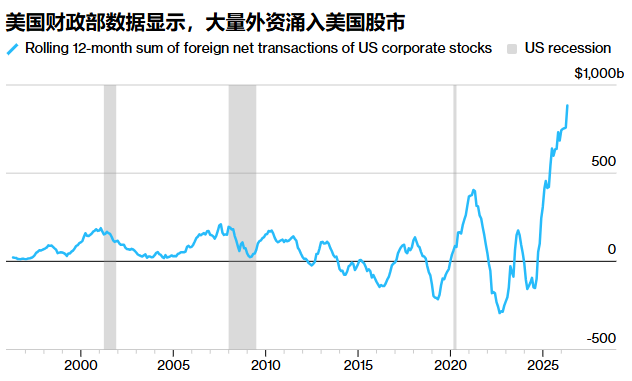
According to cMoney's analysis, most overseas investors are not hedging exchange rate risks — they must actually buy US dollars while buying US stocks, further boosting the US dollar index. This makes the strength of the US dollar increasingly dependent on stock market capital inflows supported by AI themes, rather than just traditional interest rates or trade factors.
However, this funding structure also represents significant potential risk. Once foreign investors lose confidence in the AI theme and start selling stocks, the dollar may fall at the same time. Unlike traditional treasury bond financing, equity capital flows driven by retail investors are more cyclical, and the US dollar exchange rate will also become riskier and more dependent on AI-related markets.
Signs that AI trading is cooling down are increasing
Slock's warning didn't come out of nowhere. Recently, the market has shown several signs that AI trading is cooling down:
AI concept stocks retreated sharply from their highs. As of July 10, many of the AI concept stocks that doubled in price during the year had retraced by more than 20% from their highs during the year, and some individual stocks had even retraced more than 40%.
Technology stocks have experienced continued sell-off. At the beginning of July, due to news that Meta plans to sell idle AI computing power, Micron fell 10.57%, SanDisk fell 10.62%, and the Philadelphia Semiconductor Index fell 6.27%. The Science Innovation 50 Index once fell by more than 5% in a single day.
Capital is beginning to focus on more realistic operating indicators, such as whether orders continue to grow and whether revenue can deliver profits, rather than simply chasing AI concepts.
Goldman Sachs brokerage previously reported that hedge funds sold technology stocks on a record scale before the Russell Index was rebalanced, and the total exposure and net exposure insurance of the “Big Seven Tech” both fell to their lowest level during the year.
Bank of America Securities believes that the biggest risk facing the market is that oil prices continue to soar sharply, forcing the Federal Reserve to maintain a hawkish stance and push real interest rates to rise further, thus triggering a deeper correction in overvalued AI stocks.
Outlook: The vulnerability of the US dollar's “AI premium”
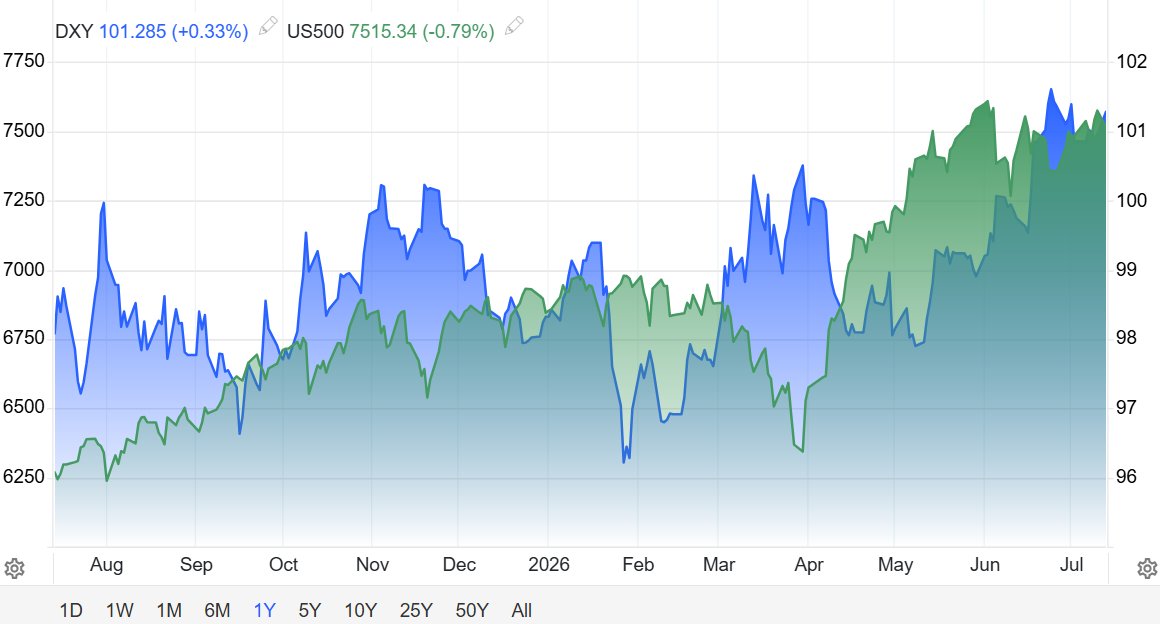
Since this year, the US dollar spot index has accumulated a cumulative increase of about 1.4%. This increase was largely supported by AI-driven inflows of foreign capital and expectations of the Federal Reserve's interest rate hike. However, Slock's warning revealed a structural risk that has been widely overlooked by the market: once AI trading recedes, the dollar may lose its core support.
As Deutsche Bank analysts warned, the dollar is losing the stabilizer provided by countercyclical demand for US bonds. In a context where geopolitical rift weakens the will of international investors to hold US debt for a long time, the US Treasury may need to pay a higher maturity premium to complete treasury bond auctions in the future.
For investors, this means that the dollar's trend is becoming more and more like a “technology stock” — closely linked to the rise and fall of the AI concept. When the AI boom recedes, the US dollar's “AI premium” may also evaporate.
The “double-edged sword” of interest rate hikes
Traders are still expecting the Federal Reserve to raise interest rates as early as September. According to Kalshi data from the forecast market, as of July 13, traders expect the probability that the Federal Reserve will raise interest rates before the end of this year is about 54%. Federal funds futures have been priced with a probability of over 60% of interest rate hikes in September.
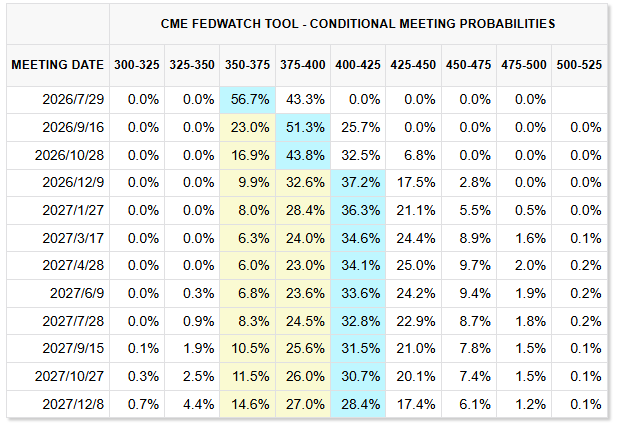
Expectations of interest rate hikes themselves support the dollar — because other major economies are less resilient, central banks are less willing to tighten their policies. However, interest rate hike expectations are also a “double-edged sword”: if expected interest rate hikes are driven by soaring oil prices and concerns about inflation, it may also trigger a sell-off of AI stocks, thereby weakening the US dollar through the “AI → foreign capital inflow → US dollar” transmission chain.
Bank of America Securities pointed out that if oil prices continue to soar and forces the Federal Reserve to maintain a hawkish stance, it will trigger a deeper correction in overvalued AI stocks. This is the core scenario of Slock's warning: a chain reaction of AI sell-off → slowing foreign capital inflows → weakening of the US dollar.
Market Divergence: Has the AI Narrative Reached an Inflection Point?
Despite concerns raised by Slock's warning, the market is still divided on the extent of this risk.
Optimists believe that the core driving force behind the strengthening of the US dollar is still the policy stance of the Federal Reserve and the resilience of the US economy, rather than AI-driven equity flows. As long as the US economic data does not weaken significantly, it will be difficult for the US dollar to fall. The net long position on the US dollar reached $34.3 billion, the highest level since January 2025, but this may mean that the dollar is overbought rather than about to reverse.
Pessimists, on the other hand, are represented by Deutsche Bank and believe that the US dollar is losing the stabilizer provided by countercyclical demand for US debt. Once AI profit expectations cool down and US stocks are deeply adjusted, foreign investors may simultaneously reduce their stock holdings and actively hedge their exposure to the US dollar, thereby weakening the dollar's safe-haven support. Nor will US bonds automatically receive sufficient overseas purchases as before.
According to cMoney's analysis, global capital is focusing on a single theme and betting on a small group of American AI companies. This highly concentrated capital structure means that once the AI boom cools down, capital may plummet, causing simultaneous turmoil in the foreign exchange market and the stock market.
Slock's warning revealed a structural weakness in the current dollar trend that is easily overlooked: record inflows of foreign capital into AI stocks, compounded by the widespread abandonment of exchange rate hedging by these investors, making the US dollar “implicit dependence” on AI transactions. In a context where AI concept stocks have retreated sharply from their high point and the market is questioning the return on AI capital expenditure, this structural risk deserves close attention.
The US CPI data to be released this week and Federal Reserve Chairman Walsh's congressional testimony will be a key point in testing this risk. If inflation exceeds expectations and raises expectations of interest rate hikes, it may have complex effects on AI stocks and the US dollar at the same time — and this is the “most dangerous scenario” that Slock warned of.