
Disrupt perceptions! AI is not stealing jobs; instead, it is expanding employment! The “Jevans Paradox” simultaneously boosts demand for jobs, wages, and AI computing power
The Zhitong Finance App learned that a recent research report shows that large-scale penetration of artificial intelligence technology into various industries may not cause large-scale job losses. Fintech company Ramp analyzed artificial intelligence expenses and employee recruitment and abolition records of 21,559 US companies. Research results after long-term follow-up showed that artificial intelligence is helping companies expand the size of employees rather than replace workers on a large scale.
Behind this counterintuitive conclusion that AI brings employment rather than large-scale unemployment in human society, Apollo Global Management (Apollo Global Management), the world's top alternative investment and private equity giant, explained it as “the employment and AI computing power expansion effect brought about by the Jevins Paradox,” and pointed out that AI semiconductor, advanced packaging and semiconductor manufacturing equipment, and actual demand for AI computing power equipment, and energy will also continue to expand on a large scale for a long time.
According to a research report by Ramp tracking companies after embedding artificial intelligence applications, the overall number of employees unexpectedly increased by 10% within two years after companies adopted artificial intelligence technology. According to the research report, this growth is being strongly driven by all types of companies that use artificial intelligence intensively, and entry-level jobs at these companies unexpectedly increased by about 12%.
The “employment effect brought about by the Jevins Paradox” is particularly reasonable in expandable service markets such as law, accounting, consulting, and finance: after unit service costs drop, SMEs and individual customers can purchase more services, thereby increasing the need for AI implementation, data engineering, model governance, cybersecurity, compliance reviews, and industry experts; at the same time, “high-exposure, low-complementarity” jobs such as repetitive documentation, primary programming, basic customer service, and standardized analysis are likely to continue to be compressed.
Stock market investment targets benefiting from the large-scale penetration of AI technology leading to a year-on-year surge in the number of employees and actual productivity include not only AI GPU/AI ASICs, data center high-performance CPUs, DRAM/NAN/HBM storage, AI PCBs, liquid cooling systems, data center optical interconnect systems, ABF carrier boards/glass substrates, MLCCs, advanced electronic fabrics and extensive wafer foundry, advanced packaging, etc., but also those that can transform AI productivity into a major revenue expansion rather than simple layoffs An industry with long-unmet needs, physical delivery links, professional responsibilities, and regulatory barriers.
The employment effect of the Jevins Paradox
Research by Ramp and Revelio Labs on more than 21,000 US companies found that companies that use AI intensively grew by an average of about 10% and entry-level jobs increased by an average of about 12% after two years. The employment growth model highlighted by economists reflects what economists call the “Jevans paradox” — when artificial intelligence tools reduce the actual operating costs of professional-type high-cost tasks such as drafting contracts, preparing audit reports, or producing presentations, the demand for these services will rise sharply.
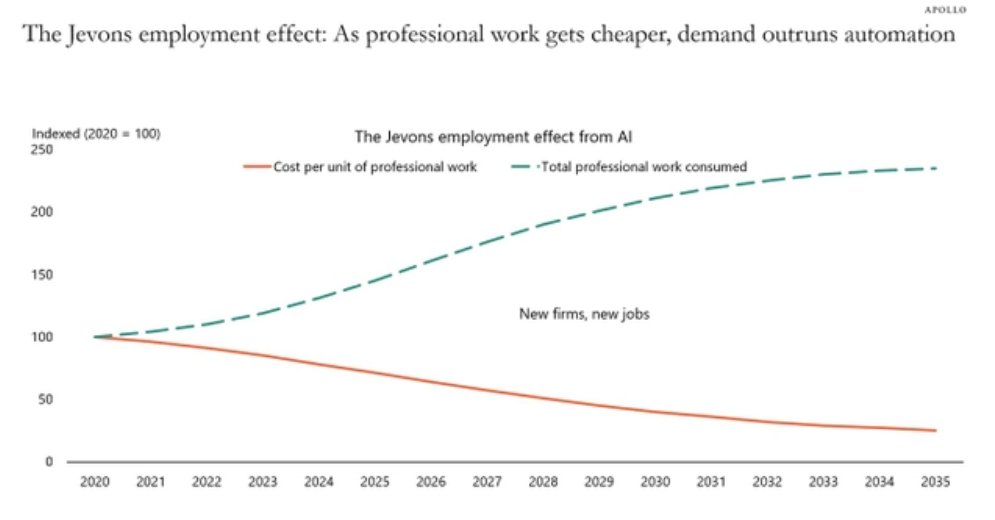
“When the cost of professional work falls drastically, the accessible market will expand, and the total number of companies and employees in this field will also increase,” said Thorsten Slock, chief economist at Apollo Global Management.
This phenomenon is similar to historical precedents during the Industrial Revolution. When steam engines increased the efficiency of coal use, the UK did not reduce coal consumption; instead, it used more coal. Researchers believe the same dynamic is playing out in the legal, consulting, and financial services industries today.
“Cheaper inputs won't shrink the industry,” Slock said. “Instead, artificial intelligence will simultaneously increase labor productivity and employment levels in human society.”
This impact is not only reflected at the level of individual companies, but also extends to the broader macroeconomy. According to the analysis report, ADP's weekly non-farm payroll data shows that “there is no evidence at all that artificial intelligence has caused job losses.”
In contrast, the AI spending boom is driving strong demand for technical experts at the AI deployment and AI function implementation level, raising the salary level of AI professionals, and continuing to drastically accelerate the expansion of AI data center construction processes, thereby boosting AI semiconductors, semiconductor manufacturing equipment, data center core power chain equipment, and energy demand and sales prices. In other words, as cutting-edge AI technology penetrates into various industries around the world on a large scale, the actual demand for AI semiconductors, advanced packaging and semiconductor manufacturing equipment, data center power equipment, and energy driven by AI deployment engineering and expert recruitment to help enterprises embed AI at the workflow level, and strong demand for AI computing power infrastructure will also continue to expand on a large scale for a long time.
For example, even as human society fully enters the AI era, there are still some jobs that are becoming more popular. For example, jobs that “actually embed models into the enterprise workflow”, such as FDE, are exploding, and demand has increased 42 times between 2023 and 2025. There is an open secret in the enterprise AI boom: it's easy to buy permission to use a powerful super AI model, yet it's not easy for you to integrate it into a chaotic enterprise system. To bridge this gap, the world's leading AI labs and AI startups are massively recruiting for a hybrid “special operations” position: the so-called Forward Deployed Engineer (FDE).
This approach was first promoted by Palantir — embedding engineers within government and military customers — and now the FDE model has become the hottest market expansion strategy in the AI era. According to a recent LinkedIn report, the report tracks the global AI job situation from 2023 to 2025, and demand for FDE and similar AI engineering jobs increased 42 times. Although only about 9,000 new FDE jobs have been added globally, they are targeting the industry's biggest bottleneck: making sure AI actually works in the real world.
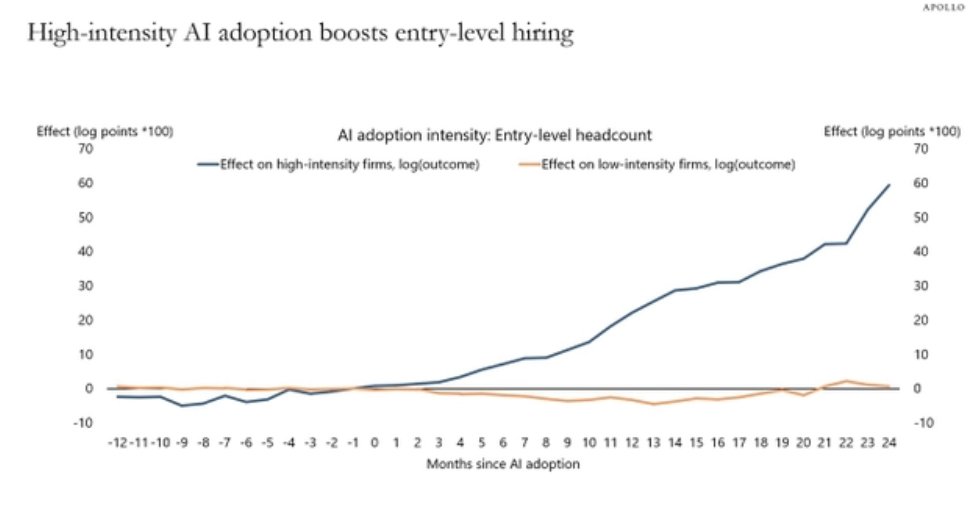
“An unprecedented boom in artificial intelligence spending is simultaneously driving up employment and wage inflation, and will also continue to drive demand for AI computing power infrastructure.” Researchers at Ramp and Revelio Labs concluded, adding, “This is the real-time embodiment of the Jevens paradox: cheaper and more advanced technology is creating larger market demand and larger jobs.”
Recently discussed, the so-called Jevons Effect (Jevons Effect), also known as the Jevons Paradox, is a counterintuitive economic theory: when current technological advances improve the efficiency of the use of certain resources (such as energy, raw materials, or AI computing power infrastructure resources), it will reduce the unit cost, thereby stimulating a large-scale expansion of market demand, which ultimately causes the total consumption of all types of resources to increase rather than decrease. The concept was first proposed by the English economist William Stanley Jevons (William Stanley Jevons) in the book “The Coal Problem” in 1865.
The “Jevans Paradox” rewrites the AI investment landscape: medical, industrial, financial and AI computing power infrastructure expands, and low barriers SaaS ushered in a major shift in profit pools
While AI technology is penetrating on a large scale, if it continues to increase labor productivity and employment scale in human society, the current racetrack with the hardest logic in the global market — the AI data center computing power and power chain — will undoubtedly continue to be the biggest beneficiary sector in the stock market.
For example, “supply-side limitation+extremely high technical barriers”, the world's most advanced chip manufacturers and package testers, HBM/high-end server memory chip manufacturers, high-performance AI server foundries and AI data center core hardware equipment assemblers such as data center power infrastructure, liquid cooling equipment, etc., and a series of important processing processes and components (such as AI PCBs, MLCCs, electronic distribution, etc.) required to build these chips and high-performance AI training/inference server clusters (such as AI PCBs, MLCCs, electronic distribution, etc.), mainly because once AI applications enter the real production environment, heavy-level inference loads, storage, and networks Demand for cooling and power supply will continue to rise; currently, the White House is pushing large technology companies to pay their own additional electricity costs for AI data centers. The core reason is that the AI infrastructure expansion frenzy has put immeasurable pressure on power grids and electricity prices at a real level.
Nomura, a well-known investment institution on Wall Street, released a research report to refute the “semiconductor peak theory,” and the latest research report released by Bank of America (BofA) this week shows that by 2027, against the backdrop of a strong trend where AI inference computing power continues to surge under the big wave of AI agents, global capital expenditure on cloud computing and artificial intelligence related infrastructure will reach 1.5 trillion US dollars, and points out that the current summer correction of AI semiconductors, including memory chip stocks, is a healthy reset trajectory, rather than any structural changes at the level of AI computing power requirements.
According to Goldman Sachs, the AI computing power super bull market is far from over. Instead, it has moved from the “AI chip purchase frenzy” to the second stage of “large-scale AI factory construction” — that is, the next round of excess alpha revenue will no longer only belong to the list of the strongest leaders in the AI GPU/AI ASIC field, but will also spread systematically to data center high-performance CPUs, DRAM/NAND/HBM storage, AI PCBs, liquid cooling systems, data center optical interconnection systems, ABF carriers/glass substrates, MLCC, electronic distribution, and extensive foundry of “AI factories” full-stack AI computing Power infrastructure layer.
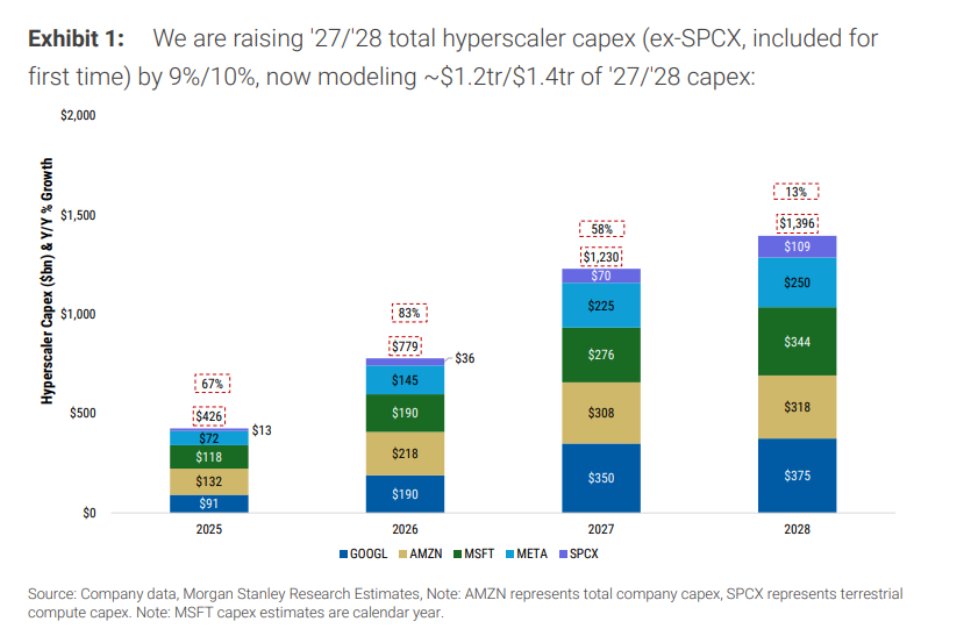
Brian Nowak, a senior analyst from Wall Street financial giant Morgan Stanley, led the analysis team and released the latest research report on July 12, which once again significantly raised the 2027/2028 capital expenditure forecasts for the five largest hyperscale cloud computing and vendors (Meta, Amazon, Microsoft, Google, SpaceX) in the global market, to about $1.2 trillion and $1.4 trillion, respectively. The agency's capital expenditure forecast for major US tech giants in 2026 was drastically raised from 433 billion US dollars a year ago to 805 billion US dollars.
Morgan Stanley's latest study raised Meta's 2027 and 2028 capital expenditure forecasts by 29% and 22%, respectively, to US$225 billion and US$250 billion; Amazon's corresponding forecasts were raised 15% and 29% to US$308 billion and US$318 billion. Morgan Stanley said that the capital expenditure supercycle is not over yet, but 2026 and 2027 are probably the steepest years of growth. After 2028, what determines the stock price will no longer be just “who spends the most money,” but “who can quickly turn AI computing power resources into revenue, profit, and free cash flow.”
What is most likely to turn AI productivity into large-scale expansion of revenue and profit rather than simple layoffs are industries with long-term unmet demand, physical delivery links, professional responsibilities, and regulatory barriers — such as healthcare, finance, industry, and professional services leaders. Healthcare services can use AI to process medical records, scheduling, insurance review, and assisted diagnosis, so that doctors and nurses can serve more patients, but ultimately require humans to diagnose, care, and assume responsibilities; industrial manufacturing, logistics, energy, utilities, and buildings can improve equipment utilization through predictive maintenance, digital twins, supply chain optimization, and robotics; and banking, insurance, pharmaceuticals, and professional services can expand the serviceable market through risk pricing, R&D screening, compliance automation, and customer coverage.
The US Bureau of Labor Statistics still anticipates an 8.4% increase in medical and social assistance employment from 2024-2034, which is expected to increase significantly by about 2 million jobs, and the professional, scientific and technical service groups are expected to grow by 7.5%; microresearch also found that generative AI will greatly increase the productivity of specialized service workers by about 14%, and less experienced employees will benefit the most.
Not all traditional SaaS software companies have the highest risk, but rely on horizontal software that charges per employee seat, functions are easily replicated in models, lacks proprietary data, and has low customer conversion costs: when AI agents can directly complete data entry, report generation, simple marketing content, basic code, and workflow orchestration, customers may reduce seats and lower unit prices, and large-scale cloud platforms such as Google and Microsoft may also build related functions into basic capabilities. The relative winners of the traditional software industry will be vertical software and platforms that master industry-specific data, deeply embed key business processes, assume security compliance responsibilities, and charge based on transaction volume, asset size, or business results; improving AI efficiency will not only reduce costs, but also expand the scale of transactions, diagnosis and treatment, R&D, or final production capacity.