
US stock outlook | The three major stock index futures had mixed ups and downs, CPI, financial reports, and the Walsh Congress debut one after another, and IBM (IBM.US)'s initial performance fell short of expectations, and software stocks collapsed
Pre-market market trends
1. Before the US stock market on July 14 (Tuesday), futures for the three major US stock indexes had mixed ups and downs. As of press release, Dow futures were down 0.57%, S&P 500 futures were down 0.17%, and NASDAQ futures were up 0.42%.

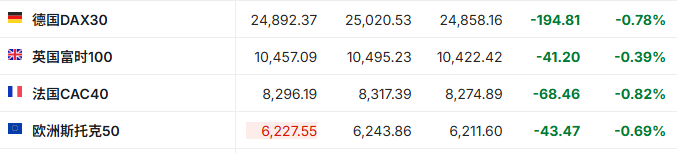
2. As of press release, the German DAX index fell 0.78%, the UK FTSE 100 index fell 0.39%, the French CAC40 index fell 0.82%, and the European Stoxx 50 index fell 0.69%.
3. As of press release, WTI crude oil rose 2.37% to $79.99 per barrel. Brent crude rose 3.84% to $86.50 per barrel.

Market news
Super Tuesday is here! The three-tier clash between CPI, the financial report of the Big Bank and the debut of the Wash Congress, ushered in a critical pricing window for high-ranking US stocks. The US stock market will usher in intense and major events on Tuesday, with all kinds of key data and agendas coming one after another, but stock traders don't seem to agree. This indifferent attitude leaves the market in a delicate state of fragility — after all, US stocks are currently hovering near historic highs. According to data compiled by Citigroup, the implied fluctuation of the S&P 500 index this Tuesday was about ± 0.7%. For such a heavy trading day, such fluctuations in expectations are moderate — not only will the critical consumer price index (CPI) be released on the day, but it will also usher in the first batch of major bank reports of the earnings season, as well as the Federal Reserve Chairman's congressional testimony, not to mention the geographical risks brought about by the re-heating situation in the Middle East. Notably, this level of implied fluctuation also largely coincides with the average fluctuation over the past 12 CPI release days. According to Piper Sandler's data, this calm expectation will continue at least until this Friday: based on cross-option pricing on the S&P 500 index, the market is expected to fluctuate around ± 1.1% this week, which is the smallest expected weekly fluctuation since December last year. The reason behind this phenomenon is probably the traditional “summer off-season” effect — major trading desks are understaffed and market trading is light. However, the risk of insufficient liquidity is that once events fall short of expectations, market fluctuations may be dramatically amplified.
The US state of New York will temporarily ban the construction of new large-scale data centers. New York Governor Kathy Hoochul's office said that she plans to sign an executive order on Tuesday to stop the construction of large-scale data centers. The ban will last for a maximum period of one year. The ban takes effect immediately and applies to data centers that consume 50 megawatts of electricity and above. The moratorium will buy time for the state to enact data center regulations that are both environmentally friendly and secure the operation of the power grid. The move makes New York State the latest state to deal with the infrastructure needed to tackle the AI boom. No other state has implemented a similar moratorium before. However, dozens of cities and counties across the US have issued temporary bans on data center construction, and many states have proposed similar ban ideas. As data centers continue to be built across the US, more and more communities have opposed this and promoted the development of an anti-AI movement. Opponents believe that these data centers, which support artificial intelligence and computing systems, could overwhelm local electricity supplies and drive up utility costs for residents. Some voters are even trying to remove politicians who support data center development.
SoftBank Masayoshi Son: The AI boom will require an annual investment of 5 trillion US dollars. SoftBank Group founder Sun Zhengyi said that by 2040, global artificial intelligence infrastructure will require an annual investment of 5 trillion US dollars to support the expansion of data centers, power supplies, and humanoid robots, thereby driving the shift from a “human-centered” work model to a new model. He pointed out that as artificial intelligence develops into “artificial superintelligence” (ASI), the resulting revenue will justify these huge expenses. “Artificial intelligence will completely change our lives — and that change will bring profit,” Sun Zhengyi said.
The four departments of the South Korean government will hold a meeting on Thursday to study how to deal with the impact of single-share leveraged ETFs on the stock market. Leveraged products tracking Korea's core chip stocks have recently plummeted, which has had a huge impact on the Korean stock market and financial market. According to data compiled by the industry, there are more than a dozen leveraged open index funds (ETFs) tracking Samsung Electronics (SSNLF.US) and SK Hynix (SKHY.US) that were listed in late May, and the current prices are close to the waist. According to reports, the senior coordination mechanism of the four major economic departments of the South Korean government will hold a meeting on Thursday to study and respond to the impact of single-share leveraged ETFs on the stock market. This is the first time that this topic has officially entered this mechanism to discuss. The mechanism is the highest-level economic coordination platform involving the Ministry of Finance and Economy of Korea, the Financial Services Commission, the Bank of Korea, and the Financial Supervisory Service.
Oil prices approaching $90 have revived concerns about inflation, and expectations of interest rate hikes by the Bank of England and Europe are making a comeback. After soaring oil prices reignited concerns about inflation, traders increased their bets on the Bank of England and the ECB speeding up interest rate hikes. For the first time in a month, traders have fully absorbed the Bank of England's expectations of a 25 basis point rate hike before September, followed by another rate hike before the end of the year. They also expect the ECB to raise interest rates by 25 basis points in September, and raising interest rates again before the end of the year is almost a foregone conclusion. This shift comes at a time when the escalating tension between the US and Iran is driving the price of Brent crude oil closer to 90 US dollars per barrel. At the beginning of this month, expectations for the Bank of England and the ECB to raise interest rates until next year in swap transactions were less than 25 basis points. However, US President Trump re-imposed a blockade on Iranian ships passing through the Strait of Hormuz and demanded payment for all other goods, completely disrupting the calm in the market.
Individual stock news
Bank of America expects SK Hynix to actually increase production capacity by 2028 to only one-sixth of the original plan. Bank of America's latest analysis shows that SK Hynix's actual new memory chip production capacity by 2028 is probably only one-sixth of the original plan. This judgment not only greatly reduces the South Korean government's blueprint for capacity expansion, but also provides key evidence in the ongoing DRAM price manipulation class action lawsuit. Affected by factors such as the closure of old factories, technology upgrades, and process miniaturization, South Korea can actually increase its operating storage wafer production capacity by less than 10% every year. This means that the increase in production capacity by 2030 will be far lower than the “doubling production capacity by 2030” target previously set by South Korean President Lee Jae-myung. This judgment directly impacted supply expectations in the DRAM market.
Samsung denies considering going public in the US: it has not assessed the possibility of issuing ADR. According to reports, Samsung Electronics denied a media report on Tuesday. According to the report, Samsung is in the early stages of exploring the possibility of issuing American Depositary Receipts (ADR) in the US. A Samsung spokesperson said in a statement: “Samsung is not evaluating the possibility of issuing ADR.” Earlier, people familiar with the matter said that Samsung has had preliminary discussions with banks, but has yet to decide whether to advance the ADR issuance plan. Furthermore, the report also said that in the end, these discussions may not lead to a listing. Samsung had previously evaluated the possibility of issuing ADR, but ultimately decided to give up. However, the successful listing of competitor SK Hynix in the US gave Samsung a fresh impetus to re-examine this idea.
IBM (IBM.US)'s initial revenue for the second quarter fell short of expectations, and US software stocks collectively declined. IBM's preliminary revenue data for the second quarter was US$17.2 billion, up 1%, and estimated at US$17.86 billion; of these, software revenue increased 5%; infrastructure revenue fell 7%. Diluted earnings per share were $2.27, down 2% year over year; operating (non-GAAP) was $2.93, up 5% year over year. IBM said it expects a single-digit decline in infrastructure revenue starting this quarter. IBM said that in the last few weeks of June, we saw customers shift quarterly capital expenses to server, storage, and memory purchases to secure tight infrastructure before expected prices rise. Affected by the above news, US software stocks fell across the market. IBM plummeted nearly 23%, Accenture (ACN.US) fell more than 7%, ServiceNow (NOW.US) fell 8%, and Microsoft (MSFT.US) fell more than 3%.
Market research agency Counterpoint: Q2 global smartphone sales fell 11% year on year. Samsung and Apple (AAPL.US) are still leading the market. Market research firm Counterpoint Research said on Monday that global smartphone sales fell 11% year-on-year in the second quarter of this year, while Apple and Samsung Electronics continued to lead the market. Counterpoint said that between March and June this year, global smartphone shipments declined and hit the lowest level in the second quarter since 2013, as the shortage of memory chips worsened further. Despite the overall market decline, Samsung has regained the number one position in the global smartphone market, accounting for 24% of the market share. In contrast, Apple's smartphone shipments in the second quarter increased 3% year over year, accounting for 20% of the global market share at the end of the second quarter.
CleanSpark (CLSK.US) won a 20-year data center lease agreement, which surged more than 23% before the market. Data center developer CleanSpark announced that it has signed a 20-year infrastructure lease agreement with a leading global technology company with two 5-year extension options for the company's Sandersville, Georgia campus. The initial lease term of the lease is expected to generate approximately $6.6 billion in contract revenue.
Stock market revenue soared sharply, and J.P. Morgan Chase (JPM.US) profit exceeded expectations to the highest level in five years. J.P. Morgan Chase's profit performance in the second quarter was impressive, and investment banking expenses and activity both accelerated, driving all business segments of the bank to hand over record reports. Q2 net profit increased 41.2% year over year to $21.16 billion, and earnings per share rose from $5.24 to $7.70, significantly exceeding analysts' average expectations of $5.59. Earnings per share exceeded expectations this time, the highest since the first quarter of 2021. Total revenue increased 27.7% to $57.35 billion, far higher than analysts' expectations of $51.09 billion. By business segment, corporate and investment banking revenue increased 27.2% to US$24.85 billion, of which market and securities business revenue increased by 33.1% to US$13.69 billion, while stock market revenue soared 86% to US$6 billion. Investment banking revenue increased 45% to $3.9 billion. Consumer and community banking revenue increased 7.6% to US$20.07 billion; asset and wealth management revenue increased 18.9% to US$6.85 billion.
Goldman Sachs (GS.US) Q2 net profit surged 80%, surpassing expectations, and investment banking business revenue reached a record high. Goldman Sachs's net profit for the second quarter surged nearly 80% year on year to reach 6.6 billion US dollars, setting the bank's best quarterly performance in five years. The increase in revenue from the investment banking business combined with the stock trading business reached a record high, which together boosted the company's net profit. Previously, analysts had agreed to expect net profit of only 4.7 billion US dollars. Investment banking business revenue increased by more than 50% year-on-year, reaching 3.4 billion US dollars, and the performance was superior to institutional expectations; however, the most prominent sector in this financial report was still the stock trading business. Goldman Sachs's stock trading segment's revenue reached 7.4 billion US dollars, a year-on-year increase of 72%, which was 2.4 billion US dollars higher than analysts' estimates. It set a new historical record for the company's stock trading revenue in a single quarter and surpassed the previous high value set in the previous quarter.
Wealth management and investment banking business strengthened, and Wells Fargo Bank (WFC.US)'s second-quarter results exceeded expectations. Wells Fargo's second-quarter earnings report showed that thanks to increased revenue from wealth management and investment banking fees, the bank's performance for the quarter was better than Wall Street expectations. Non-interest revenue for the quarter increased 13% to $10.3 billion, higher than analysts' expectations of $9.44 billion. The bank said in a statement on Tuesday that the results include net value-added income of US$728 million from venture capital. As an important indicator for measuring the profitability of bank loan business, net interest income was US$12.3 billion, which is basically in line with market expectations. In the three months to the end of June, the bank's net profit increased 17% to US$6.4 billion, or US$2 per share. Analysts had expected adjusted earnings of $1.71 per share. Revenue for the quarter increased 9% to US$22.6 billion.
Bank of America (BAC.US) had second-quarter revenue of $31.6 billion, up 15% year over year. Bank of America's total revenue for the second quarter was $31.6 billion, up 15% year over year. Diluted earnings per share were $1.21 ($0.9 in the previous period), up 34% year over year. Net profit was $9.10 billion, up 27% year over year. Among them, consumer banking revenue was US$11.336 billion, up 5% year on year; global market revenue was US$8.022 billion, up 34% year on year; global wealth and investment management revenue was US$6.871 billion, up 16% year on year; and global bank revenue was US$6.236 billion, up 10% year on year.
Citibank (C.US)'s second-quarter revenue increased 14% to US$24.8 billion, exceeding market expectations. Citi announced financial results for the second quarter of fiscal year 2026 on Tuesday. The data showed that the bank's total revenue reached 24.8 billion US dollars, a year-on-year increase of 14%. The performance was better than analysts' previous expectations. At the same time, Citi recorded net profit of 5.8 billion US dollars for the quarter, a significant increase of 45% over the same period in 2025. Diluted earnings per share (EPS) soared 60.7% year over year to $3.15.
Key economic data and event forecasts
20:15 Beijing time: US ADP employment data for the week ending June 27.
20:30 Beijing time: US June CPI.
21:00 Beijing time: ECB President Lagarde and US Treasury Secretary Bezent hold talks.
22:00 Beijing time: Federal Reserve Chairman Walsh attended the House Financial Services Committee's “Federal Reserve Semi-Annual Monetary Policy Report” hearing.
The next day at 00:40 Beijing time: Federal Reserve Governor Barr delivered a speech on artificial intelligence at the Federal Reserve's annual financial inclusion conference.
At 01:00 Beijing time the next day: 2027 FOMC voting committee and Chicago Federal Reserve Chairman Goulsby attended a fireside conversation.
The next day at 01:30 Beijing time: Federal Reserve Governor Lisa Cook delivered a speech at the Federal Reserve's annual financial inclusion conference.
The next day at 02:55 Beijing time: Federal Reserve Governor Bauman delivered a speech at the Federal Reserve's annual financial inclusion conference.
04:30 Beijing time the next day: Changes in US API crude oil inventories for the week ending July 10.
Performance Forecast
Wednesday pre-market: ASML.US (ASML.US), Johnson & Johnson (JNJ.US), Morgan Stanley (MS.US), BlackRock (BLK.US)