
Jeff Bezos Put $2 Billion of His Own Money Into Blue Origin's Funding Round
Key Points
The real vote of confidence here came from outside investors, not Bezos.
Blue Origin's funding round is another sign the commercial space industry is maturing.
I don't think the world should get carried away by this headline. Jeff Bezos writing a $2 billion check to his rocket company, Blue Origin, sounds like a titanic show of faith, and the press dutifully treated it that way. But $2 billion is less than 1% of Bezos' fortune. For a man worth a quarter-trillion dollars, that's equivalent to the average person spending a couple of hundred dollars on high-end concert tickets.
This isn't a "founder bets big on himself" narrative. Still, this news should genuinely be considered bullish.
Missed Nvidia in 2009? This Rare Signal Is Flashing Again. In 2009, a "Double Down" signal flashed for a little-known chipmaker called Nvidia. For the first time in years, that same "Total Conviction" signal is flashing for a company 1/100th the size of Nvidia. Continue »
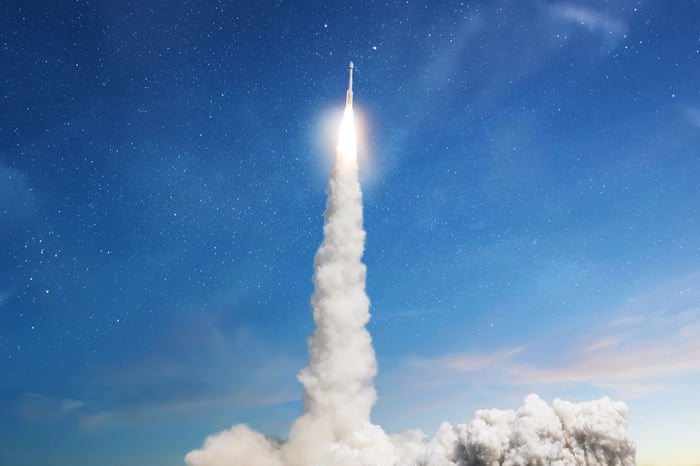
Image source: Getty Images.
The cynical read comes first
Here's what nobody in the cheering section wants to say out loud. For 25 years, Bezos funded Blue Origin almost entirely himself, quietly selling roughly $1 billion of his shares of Amazon (NASDAQ: AMZN) stock each year to keep the lights on. Now, suddenly, he's raising about $10 billion from outsiders at a $130 billion valuation. Read that cynically, and it looks less like conviction, and more like a savvy operator finally spreading his risk around, meaning he's letting hedge funds and institutions ride shotgun on a money-losing venture he's been carrying alone. His $2 billion, in that light, is partly theater: skin in the game just visible enough to coax the other $8 billion out of everyone else's pockets.
Why it's bullish anyway
But that's exactly why I lean bullish. The important buyers here aren't Bezos, they're the outside investors, led by a big commitment from the hedge fund Coatue, which cracked open the books, kicked the tires, and agreed to pay up. These are not sentimental people. If Blue Origin were still a billionaire's expensive hobby, they'd have passed. Their willingness to fund it at a nine-figure valuation signals that Blue Origin has crossed the line from a vanity project to an actual business.
What the company is doing backs that up, too. Blue Origin's New Glenn rocket flew a mission this spring carrying a NASA spacecraft and landed its reusable booster at sea. The company has real government work lined up, including a role in NASA's return to the moon. Yes, one of its rockets blew up on a test stand in late May -- space is brutal, and I won't pretend otherwise -- but the company cleared the wreckage in days and says it'll fly again by year-end.
The takeaway for investors
Here's my honest, slightly jaded conclusion. The $2 billion is a rounding error for Bezos, and the reverent coverage is overcooked. What actually matters is that hard-nosed outside money is now willing to bankroll Blue Origin, which tells you the business is finally worth taking seriously.
The catch for ordinary investors is the annoying one: You can't buy it. Blue Origin is private, so this round is reserved for Bezos and the big funds. The best most of us can do is read the signal -- smart money is betting the space economy is real -- and note that the closest public proxy, Space Exploration Technologies Corp., is now trading for anyone who wants a piece of the same trade.
Micah Zimmerman has no position in any of the stocks mentioned. The Motley Fool has positions in and recommends Amazon. The Motley Fool has a disclosure policy.