
New product explosion+acceleration of globalization. Peijia Medical-B (09996) relies on a dual-engine strategy to achieve the transition from “following” to “leading”
When the neurointerventional business became the core profit mainstay, and the valve business first crossed a commercial profit inflection point, Peijia Medical-B (09996)'s “neurological intervention+valve therapy” dual-engine strategy had already gone from concept to reality, and the rapidly advancing globalization process and continuous iterative differentiated innovation gave this innovative device leader more room for imagination.
In fact, recent years have coincided with the expansion of domestic procurement, and the reshuffle process of the medical device industry has accelerated markedly. Despite rapid changes in the external environment, Peijia Healthcare has achieved “revenue growth and loss reduction” at the financial level. While improving the profit structure, the company also has clear profit expectations. What is behind the acceleration in performance is its continuous innovation and implementation and breakthroughs in overseas markets.
In recent years, through a sound strategic blueprint and solid clinical data, Peijia Healthcare has once again demonstrated to the industry and market its certainty in a volatile market, showing why the company wants a premium for differentiated innovation and efficiency for refined management, thus successfully completing the transformation from “following” to “leading”.
The full valve layout is beginning to take shape and is about to enter an intensive harvest period
With the rapid commercialization process in recent years, steady and rapid revenue growth, and a well-laid out and highly competitive product pipeline, Peijia Medical has established itself as the leading brand in the field of interventional valvular treatment in China.
Take the transcatheter aortic valve replacement (TAVR) circuit as an example. Peijia Healthcare's core value as a leader in the industry is reflected in higher R&D efficiency and market share.
From a market perspective, the number of patients with heart valve disease in China will increase to 40.2 million in 2025, but the number of surgical cases per year is less than 100,000, and the market size is about 3 billion yuan. Among them, TAVR's penetration rate in China is only 1% (far lower than 15% in the US), and there is huge unmet market demand. Among these, excessive treatment costs are a major constraint. However, in recent years, TAVR has also begun to enter a new price cycle under the influence of factors such as breaking the ice in health insurance policies and expanding procurement capacity in many places.
However, even so, Peijia medical pipeline products are still in the field of aortic stenosis (AS) indications, and have achieved continuous volume after price adjustments.
The core reason is that, relying on higher R&D efficiency, Pegasus Healthcare has formed an echelon product portfolio of “TaurusOne (basic model) + TaurusElite (recyclable model) + TaurusMax (high-end model)” in the AS product layout. This means that among products in the same price segment, the Pegasus Taurus series can use better performance to form a greater “generational advantage” over other brand products.
In addition, a perfect hierarchical product layout also allows Peijia to flexibly implement reasonable production and marketing arrangements and price adjustments throughout the entire production and sales cycle according to market dynamics, and stabilize its own moat while expanding market accessibility.
In addition to further consolidating the company's leading position in the AS brand, Pegasus is also accelerating its expansion into aortic valve reflux (AR) indications.
In December of last year, Peijia's TaurustriO transcatheter aortic valve system was approved in China, becoming the first approved interventional treatment device for integrated positioning key transfusion aortic valve reflux, marking that China has taken the lead in “leading the way” in the field of minimally invasive interventional treatment for aortic valve reflux. The product was also launched in the first half of this year under the impetus of Peijia's efficient commercialization.
The Zhitong Finance App learned that TaurriO has completed the Internet connection and operator training in 97% of China's provinces. In total, it has been implanted in more than 200 hospitals, and nearly 100 online/offline academic training activities have covered more than 800 experts. As of June of this year, Taurio implants accounted for more than 30% of Peijia's overall TAVR implants, and it is expected to increase further.
Driven by the large-scale release of AS+AR dual-indication products, Peijia's TAVR implantation volume accelerated. From January to June this year, more than 2,800 cases were implanted, a sharp increase of about 37% over the previous year. According to information disclosed by Peijia Healthcare at the corporate open day on July 3 this year, Pegasus's market share in the TAVI market reached 28% in the first half of this year, achieving the highest market share.
Another highlight of Peijia's valve business is that the company's full valve layout is beginning to take shape, and a treatment matrix covering “full valve” diseases is clearly visible.
With the support of efficient innovative research and development capabilities, Peijia Healthcare has built a full-anatomical diagnosis and treatment network covering the “aortic valve, mitral valve, and tricuspid valve”. The company's pipeline width (covering the types of valve diseases) and depth (technical platform and reserves) layout is no less comfortable than international giant Edward Life Sciences.
In terms of the domestic market, Peijia Medical's valve business has 4 commercialized products and 9 products under development at various stages. The number of pipelines is in the first tier in the country, and the pipeline types are more comprehensive than other domestic friends.
Continued technological breakthroughs and patent accumulation have also brought Peijia Medical closer to the intensive harvesting period of the valve business.
According to information disclosed by the company during the corporate open day, TaurusNXT's registration application was accepted by the State Drug Administration in December last year and included in the special approval process for innovative medical devices; while the GeminiOne system has submitted an EU MDR CE Mark registration application, which is expected to be approved by the end of this year, and US EFS clinical trials are ongoing; global clinical research on the MonarQ TTVR system is ongoing, and more than 40 clinical trials have been carried out at 9 centers in the US, Canada, and Europe.
It is worth mentioning that the GeminiOne system is the only domestically produced TEER product that has broken through Abbott MitraClip and Edward's PASCAL patented FTO. It is expected to open up 10 billion dollar market growth for Pegia after being successfully approved in the future.
Dig deeper into the value of globalization and accelerate “scale growth”
In recent years, going overseas has accelerated to open up a second curve of market growth, and has become a “must-have option” for leading domestic neurointervention companies. However, in choosing the path of globalization, Peijia did not follow the trend of domestic manufacturers and chose emerging markets such as Latin America and Southeast Asia. Instead, they chose to face multinational giants, enter high-end European and American markets with strong payment capabilities, and dig deeper into global values.
In March of this year, the DCWire microguide wire independently designed and developed by Gachi Biotech, a subsidiary of Peijia Healthcare, obtained FDA 510 (k) approval. As a legal entry certificate for Class II medical devices in the US, it is a key stepping stone for domestic medical equipment to enter the formal medical supply chain in North America.
According to the Zhitong Finance App, FDA certification, as one of the core thresholds for entering the global high-end medical market, is a litmus test for the hard power of products. The review system has high requirements for the quality of clinical data, product design, and patient benefits of the product. Therefore, domestic enterprises passing the above certification not only mean market entry, but also an independent endorsement of the company's technical strength.
However, this approval is not only the first FDA 510 (k) obtained in the field of neurointerventional microguide wire in China since US FDA regulations became stricter, but also the first overseas registration certificate for Peijia Healthcare. As a result, DCWire officially opened the door to the high-barrier market in the US, marking a key step towards the international stage of innovative domestically produced microguide wire, and an important milestone in Peijia Healthcare's expansion into the international market.
As the company continues to increase overseas markets, it is optimistically estimated that by 2030, Peijia Healthcare's share of overseas revenue is expected to reach 50%.
In fact, the reason Peijia has the ambition to compete in high-end markets in Europe and the US and dig deeper into global value lies in its technical and operational advantages that have been proven by the domestic market.
Take the DCWire microguide wire, which successfully passed the Mina certification. In 2025, with its excellent performance, the domestic market share expanded dramatically, and sales revenue soared by nearly 140% year on year; according to the company's disclosure at the company's open day, the number of implants of this product increased by more than 50% year on year.
In recent years, Pei Jia's R&D path on the neurology business side has entered the original development stage for unmet clinical needs around the world, and has laid out 14 commercial products and 8 products under development in the three major product lines, showing a pattern of “leading the channel, increasing ischemia, and steady bleeding”, making the neuroscience business the cornerstone for the company to consolidate its profitability and withstand policy fluctuations.
In addition, Pegia is also further increasing the scale dividend by optimizing the product structure and expanding market coverage. Following the exclusive distribution of Nuanyang Medical's YonFlow dense net stents, YonLeading microcatheters, YonTrack remote access catheters, and QiDA scabbards of Enlightenment Medicine, on June 1 of this year, Peijia's Gage Biotech signed an exclusive distribution agreement with Belang Healthcare to obtain exclusive distribution rights for SeQuent Please CIS paclitaxel drug-coated intracranial balloon dilatation catheters (SeQuent Please CIS) in mainland China, further enriching Peijia's neurological intervention product portfolio. The company has taken a leading position in the neurovascular intervention market.
“Major shareholders' holdings+profit expectations” boosts confidence
The Zhitong Finance App observed that from the second half of 2025 to the first half of this year, the Hong Kong stock innovative pharmaceutical sector changed its previous bullish market and emerged from a volatile downward trend. In particular, after mid-April this year, the Hang Seng Healthcare Index continued to decline. The Hang Seng Healthcare Index fell all the way after mid-April this year, and the intraday index once fell to a low of 2938.07 points on June 22. Looking at the long-term timeline, since the second half of 2025, the biggest decline in the index range has exceeded 35%.
In fact, behind the decline in the pharmaceutical sector of the Hong Kong stock market is the resonance of multiple factors such as capital, market sentiment, and geopolitics, but as a result, the stock prices of many innovative pharmaceutical products with stable fundamentals, including Peijia Healthcare, were mistakenly killed.
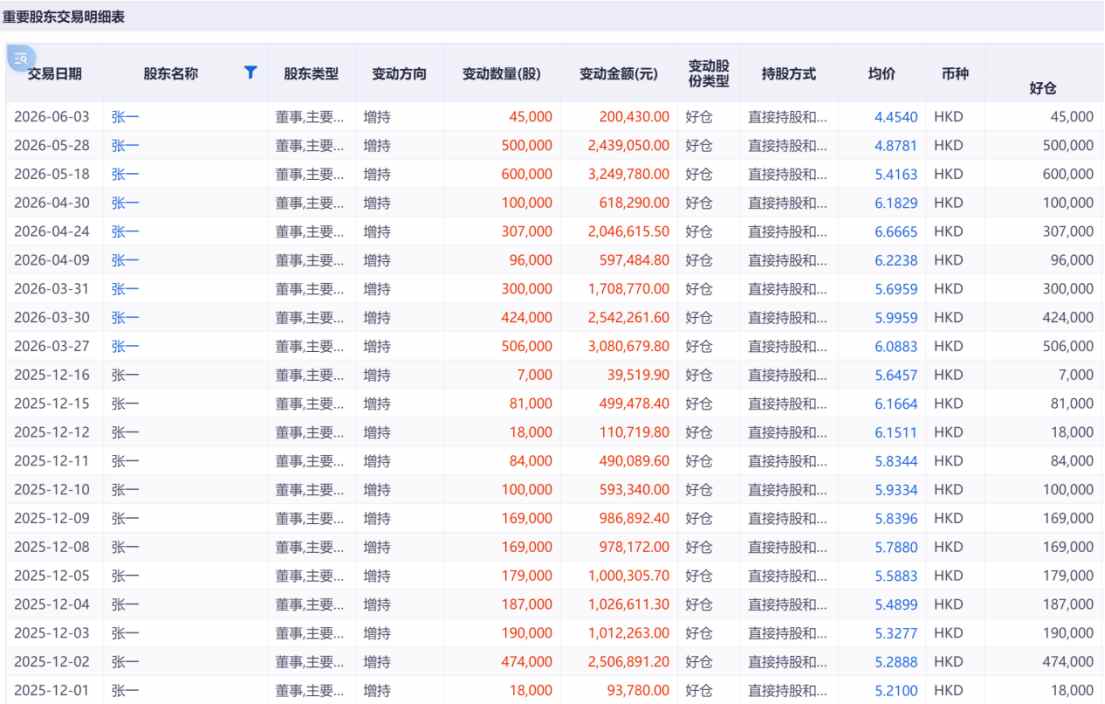
However, in the face of uncertainty in the market, the majority shareholders of Peijia Healthcare chose to continue to increase their holdings, further sending a positive signal to the market that the company's intrinsic value needs to be re-evaluated urgently.
Since December of last year, Zhang Yi, Chairman and CEO of Peijia Healthcare, has increased his holdings by 21 times, increasing his holdings by 4.554 million shares, increasing his holdings by more than HK$25 million, fully demonstrating the company's management's sincere attitude of being responsible to shareholders. Combined with the “the entire group will reach break-even by 2026” performance guidelines given by Pegia at the corporate opening day, it also shows management's greater confidence in the company's future development.
epilogue
Investors can easily see that with the gradual deepening of the R&D pipeline and international layout, the all-round and deep industrial synergy benefits brought by Peijia Healthcare's “internal and external training” have already been demonstrated, and helped the company complete the transformation from “following” to “leading” the industry.
Despite the obvious competitive advantage of Peijia Healthcare's systematization at present, the market has yet to give it a reasonable valuation. The company's current PS valuation is only 3.45 times, which is not only lower than the industry average, but also lower than the company's recent valuation center, indicating that it is still undervalued.
And this contrast was also recognized by research institutes. CITIC Construction Investment Securities previously stated that looking ahead to 2026, the company is expected to usher in a critical inflection point in performance growth, accelerate revenue growth, and turn losses into profits throughout the year.
The bank said that with the commercialization of the company's Taurustrio reflux valve and many major innovative products such as the third-generation TAVR product TaurusNXT and the mitral valve edge repair reflux product GeminiOne, which is expected to be approved for listing within 2026, the company's product portfolio in the field of structural heart disease continues to be rich, and its technological leadership and long-term competitiveness will be further consolidated.