
National Bureau of Statistics: GDP grew 4.7% year-on-year in the first half of the year
The Zhitong Finance App learned that on July 15, the National Bureau of Statistics issued an article stating that in the first half of the year, under the strong leadership of the CPC Central Committee with Comrade Xi Jinping at the core, departments in all regions earnestly implemented the decisions and arrangements of the Party Central Committee and the State Council, adhered to the general tone of steady progress, completely, accurately and comprehensively implemented the new development concept, accelerated the construction of a new development pattern, focused on promoting high-quality development, and effectively implemented more active and promising macroeconomic policies. The economy withstood the pressure and operated within a reasonable range, production and supply grew rapidly, the employment situation was generally stable, prices rose moderately, and foreign trade was growing well. Rapid growth of kinetic energy People's livelihood security is strong and effective, and development resilience continues to be demonstrated.
According to the National Bureau of Statistics, according to preliminary accounting, the gross domestic product for the first half of the year was 69570.4 billion yuan, an increase of 4.7% over the previous year at constant prices. By industry, the primary sector added value of 3152.2 billion yuan, an increase of 3.7% over the previous year; the secondary sector added value of 25047.3 billion yuan, an increase of 3.9%; and the tertiary sector added value of 41370.9 billion yuan, an increase of 5.2%. On a quarterly basis, GDP grew 5.0% year on year in the first quarter and 4.3% in the second quarter. On a month-on-month basis, GDP grew by 0.9% in the second quarter.
1. Summer grain production and harvest increased, and the animal husbandry industry grew steadily
In the first half of the year, agricultural (planting) value added increased by 3.6% year-on-year. The country's total summer grain output was 15.75 million tons, an increase of 1 million tons over the previous year, an increase of 0.7%. In the first half of the year, pork, beef, lamb and poultry production was 50.5 million tons, up 4.3% year on year. Among them, pork and poultry production increased by 3.3% and 9.4% respectively, beef and lamb production decreased by 1.0% and 3.9% respectively; milk production increased by 2.4%, and egg production decreased by 2.2%. At the end of the second quarter, 424.91 million pigs were kept, an increase of 0.1% over the previous year; in the first half of the year, 372.46 million pigs were released, an increase of 1.7%.
2. Industrial production is growing rapidly, and the equipment manufacturing industry and high-tech manufacturing industry are growing well
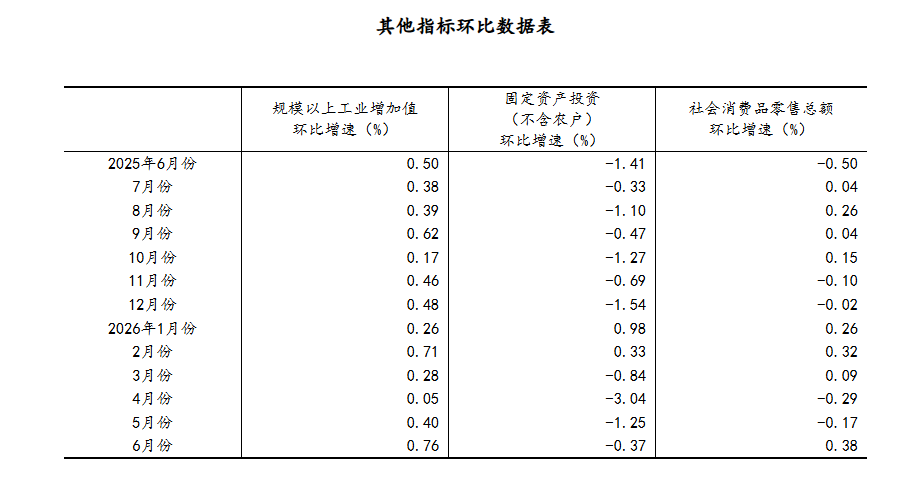
In the first half of the year, the value added of industries above the national scale increased by 5.4% year-on-year. Looking at the three major categories, the value added of the mining industry increased by 3.6% year on year, the manufacturing industry grew by 5.6%, and the production and supply of electricity, heat, gas and water increased by 5.5%. The value added of the equipment manufacturing industry increased by 9.3% year on year, and the value added of the high-tech manufacturing industry increased by 13.3%, which is 3.9 and 7.9 percentage points faster than the value added of industries above all sizes, respectively. By economic type, the value added of state-owned enterprises increased 4.3% year on year; joint-stock enterprises increased 5.9%; foreign-invested enterprises, Hong Kong, Macao and Taiwan grew by 3.2%; and private enterprises increased 4.6%. By product, production of 3D printing equipment, lithium-ion batteries, and industrial robot products increased by 48.5%, 39.3%, and 28.0% year-on-year, respectively. In June, the value added of large-scale industries increased by 5.3% year-on-year, 0.8 percentage points faster than the previous month; the month-on-month increase was 0.76%. In June, the manufacturing purchasing managers' index was 50.3%, up 0.3 percentage points from the previous month; the expected index of enterprise production and operation activity was 54.3%, up 0.4 percentage points. From January to May, industrial enterprises above the national scale achieved a total profit of 3144 billion yuan, an increase of 18.8% over the previous year.
3. The service industry is growing steadily, and the modern service industry is developing well
In the first half of the year, value added in the service sector increased by 5.2% year-on-year. Among them, the value added of leasing and business services, information transmission, software and information technology services, finance, and lodging and catering increased by 11.9%, 10.7%, 6.7%, and 5.0%, respectively. In June, the national service industry production index increased 4.7% year on year, 0.3 percentage points faster than the previous month. Among them, the production indices of leasing and business services, information transmission, software and information technology services, and financial services increased by 9.7%, 9.6%, and 5.8%, respectively. From January to May, the revenue of large-scale service enterprises increased 6.6% year-on-year. In June, the index of business activity in the service sector was 50.4%, up 0.1 percentage points from the previous month; the expected index of business activity in the service sector was 56.0%, up 0.6 percentage points. Among them, the index of business activity in telecommunications, radio, television and satellite transmission services, Internet software and information technology services, monetary and financial services, insurance and other industries is in a high boom range of over 55.0%.
4. The consumer market continues to expand, and retail services are growing rapidly
In the first half of the year, total retail sales of consumer goods and services increased 2.7% year-on-year. Among them, retail sales of services increased 5.3% and retail sales of goods increased 1.1%. Among retail sales of services, retail sales of communication and information services, travel consulting and rental services, and cultural, sports and leisure services are growing rapidly. In the first half of the year, total retail sales of consumer goods amounted to 24872.2 billion yuan, an increase of 1.3% over the previous year. According to the location of the business unit, retail sales of urban consumer goods amounted to 2155.6 billion yuan, an increase of 1.2% over the previous year; retail sales of rural consumer goods amounted to 3321.6 billion yuan, an increase of 2.5%. By type of consumption, retail sales of goods were 22046.7 billion yuan, up 1.1% year on year; food and beverage revenue was 2825.5 billion yuan, an increase of 2.8%. Sales of basic lifestyle products and some upgraded products grew rapidly. Retail sales of food, clothing, shoes, hats, knitwear, textile products, and communication equipment per unit above the limit increased by 7.4%, 6.7%, and 14.4%, respectively. In June, total retail sales of consumer goods amounted to 4269.1 billion yuan, up 1.0% year on year, down 0.6% last month; up 0.38% month on month. In the first half of the year, retail sales of online goods and services nationwide reached 10071.5 billion yuan, an increase of 5.2% over the previous year. Among them, retail sales of online products amounted to 6429.6 billion yuan, an increase of 4.8%; retail sales of online services amounted to 3641.9 billion yuan, an increase of 6.0%.
5. Investment in fixed assets declined, and investment in intellectual property products grew faster
In the first half of the year, the country's fixed asset investment (excluding rural households) was 22637 billion yuan, a year-on-year decrease of 5.7%; fixed asset investment after deducting real estate development fell 2.7%. Among them, investment in intellectual property products increased 9.4% year over year, 1.5 percentage points faster than in the first quarter. By sector, investment in infrastructure fell 2.4% year on year, investment in manufacturing fell 1.2%, and investment in real estate development fell 18.0%. The sales area of newly built commercial housing nationwide was 401.4 million square meters, a year-on-year decrease of 11.6%; sales of newly built commercial housing amounted to 3794.5 billion yuan, a decrease of 13.6%. By industry, investment in the primary sector increased by 0.9% year on year, investment in the secondary sector decreased by 1.1%, and investment in the tertiary sector decreased by 8.4%. Private investment fell 8.5% year over year; private investment after deducting real estate development fell 4.9%. Investment in high-tech industries increased 4.6% year on year. Among them, investment in aviation, spacecraft and equipment manufacturing, computer and office equipment manufacturing, and information services increased by 23.3%, 8.1%, and 15.5%, respectively. In June, fixed asset investment (excluding rural households) fell 0.37% month-on-month.
6. Import and export of goods are growing rapidly, and the trade structure continues to be optimized
In the first half of the year, the total import and export volume of goods was 25468.6 billion yuan, up 16.9% year on year. Among them, exports amounted to 1473.14 billion yuan, an increase of 13.4%; imports amounted to 1073.72 billion yuan, an increase of 22.1%. Imports and exports to the joint “Belt and Road” countries increased by 14.8%. Private enterprise imports and exports increased by 17.0%, accounting for 57.0% of total imports and exports. Exports of mechanical and electrical products increased by 20.1%, accounting for 63.5% of total exports. In June, the total import and export volume was 4782.3 billion yuan, up 24.2% year on year, 7.3 percentage points faster than the previous month. Among them, exports amounted to 2820.7 billion yuan, an increase of 20.8%; imports amounted to 1961.6 billion yuan, an increase of 29.4%.
7. Consumer prices rose moderately, while industrial producer prices rose year-on-year
In the first half of the year, the national consumer price (CPI) rose 1.0% year on year. By category, prices of food, tobacco, and food and drink fell 0.2% year on year, clothing prices rose 1.6%, housing prices fell 0.2%, household goods and services prices rose 1.9%, transportation and communication prices rose 1.8%, education, culture and entertainment prices rose 1.2%, healthcare prices rose 2.0%, and prices of other goods and services rose 11.6%. Among food, tobacco, alcohol, and food and beverage prices, pork prices fell 13.4%, food prices fell 0.3%, fresh fruit prices rose 1.5%, and fresh vegetables increased 4.1%. In June, consumer prices across the country rose 1.0% year on year and fell 0.3% month on month. Core CPI, after deducting food and energy prices, rose 1.2% year over year in the first half of the year. Among them, the core CPI rose 1.0% year on year in June.
In the first half of the year, the ex-factory prices of industrial producers across the country rose 1.5% year on year. Among them, the year-on-year increase in June was 4.1%, an increase of 0.2 percentage points over the previous month; the month-on-month decrease was 0.3%. In the first half of the year, the purchase price of industrial producers across the country rose 2.4% year on year. Among them, the year-on-year increase in June was 6.4%, and the month-on-month decrease was 0.2%.
8. The employment situation is generally stable, and the urban survey unemployment rate has declined
In the first half of the year, the average unemployment rate in the national urban survey was 5.2 percent. In June, the unemployment rate in the national urban survey was 5.0%, down 0.1 percentage points from the previous month. The unemployment rate in the local household registration labor force survey was 5.0%; the unemployment rate in the foreign household registration labor survey was 4.9%, of which the unemployment rate in the foreign agricultural household registration labor survey was 4.8%. The unemployment rate in the urban survey of 31 major cities was 5.0%, down 0.1 percentage points from the previous month. The average weekly working time of employees in enterprises nationwide is 48.2 hours. At the end of the second quarter, the total number of rural laborers working outside the home was 192.27 million, an increase of 0.5% over the previous year.
9. The income of residents is growing steadily, and the income of rural residents is growing faster than that of urban residents
In the first half of the year, the country's per capita disposable income was 22,981 yuan, a year-on-year increase of 5.2% in nominal terms. Excluding price factors, the actual increase was 4.2%. According to the place of permanent residence, the per capita disposable income of urban residents was 30,126 yuan, a nominal increase of 4.4% over the previous year, and an actual increase of 3.4%; the per capita disposable income of rural residents was 12,699 yuan, a nominal increase of 6.4% over the previous year, and an actual increase of 5.5%. In terms of revenue sources, per capita wage income, net operating income, net property income, and net transfer income of the country's residents increased nominally by 5.3%, 6.5%, 1.1%, and 5.8%, respectively. In the first half of the year, the ratio of the per capita disposable income of urban and rural residents (with rural residents as 1) was 2.37, a decrease of 0.05 from the previous year.
Overall, in the first half of the year, the national economy operated within a reasonable range. New quality productivity was cultivated and expanded, and high-quality development was moving towards new excellence. It should also be noted that there are many external instability and uncertainties, the contradictions between strong domestic supply and demand are prominent, and the foundation for a positive economy still needs to be consolidated. In the next stage, we must adhere to Xi Jinping's ideology of socialism with Chinese characteristics in the new era, adhere to steady progress, improve quality and efficiency, increase countercyclical and cross-cycle adjustment efforts, continue to expand domestic demand, optimize supply, improve growth, revitalize stocks, focus on building a strong domestic market, step up the cultivation and expansion of new momentum, step up efforts to stabilize employment, stabilize enterprises, stabilize markets, and stabilize expectations, and promote effective improvement in the quality of the economy and reasonable growth in volume.
This article was edited by the National Bureau of Statistics, Zhitong Finance Editor: Xu Wenqiang.