
Japanese retail investors are frantically shorting the dollar! Net shorts soared to 2.79 trillion yen, the highest in history since 2008
The Zhitong Finance App learned that net short positions in the US dollar held by Japanese retail investors surged to the highest level in nearly 20 years last month, and the market generally speculates that the Japanese government may once again intervene to boost the yen exchange rate.
According to data from the Financial Futures Association of Japan (Financial Futures Association of Japan), retail traders' net dollar positions surged more than threefold from the previous month to 2.79 trillion yen (about 17.2 billion US dollars), making it the largest in history since records began at the end of 2008. Although these bearish bets may also involve other currency pairs, the size of open positions related to the yen is large, indicating that they are mainly focused on USD/JPY positions.
Retail traders dominate the liquidity in the Tokyo spot foreign exchange market, and the direction of their positions will largely determine whether the effects of the Japanese government's intervention in the foreign exchange market can last. Since this year, the yen has been at the bottom of the G10 currencies. However, as retail investors are already betting on the weakening of the US dollar on a large scale, this may mean that the Japanese government's operation to sell the US dollar to buy the yen will have less impact on the market than expected.
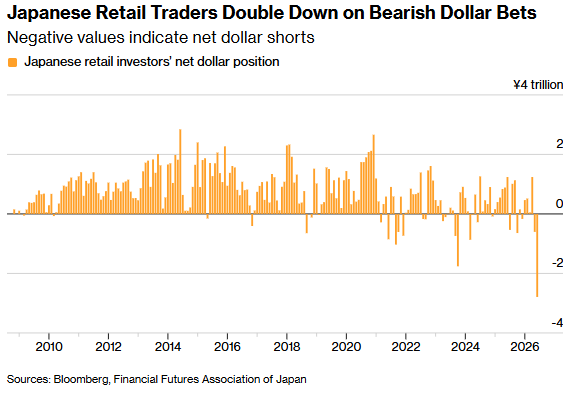
Hideki Shibata, a senior interest rate and foreign exchange strategist at the Tokai Tokyo Intelligence Laboratory (Tokai Tokyo Intelligence Laboratory), said that when the Japanese authorities intervene, “these retail traders will sell off yen to make up their positions,” thus driving the reverse recovery of the USD/JPY exchange rate. He pointed out that “in the low range, Japanese importers are also facing a large amount of demand for dollar purchases,” and this kind of holding structure may cause Japan's Ministry of Finance to be more cautious about entry intervention.
Japan's Ministry of Finance has invested 11.73 trillion yen to support the yen exchange rate in the month ending May 27, but since hitting a ten-week high on May 6, the yen has weakened by more than 4% cumulatively.