
The new drug market is booming, and it's hard to hide the fatigue of devices: medical device growth is slowing down, and Cheng Johnson (JNJ.US)'s Q2 earnings report is “dragging the fuel bottle”
The Zhitong Finance App learned that Johnson & Johnson (JNJ.US) sales in the second quarter exceeded expectations thanks to strong growth in drugs to treat cancer, inflammatory diseases, and intractable depression. According to financial reports, Johnson & Johnson's Q2 revenue reached US$25.31 billion, up 6.6% year over year, exceeding expectations of US$250 million; non-GAAP earnings per share were US$2.90, exceeding expectations of US$0.05.
Johnson & Johnson also slightly raised its 2026 sales and profit performance guidance. The company expects 2026 revenue of $101.1 billion (previously $10.8 billion) and adjusted operating earnings per share of $11.58 (previously $11.40).
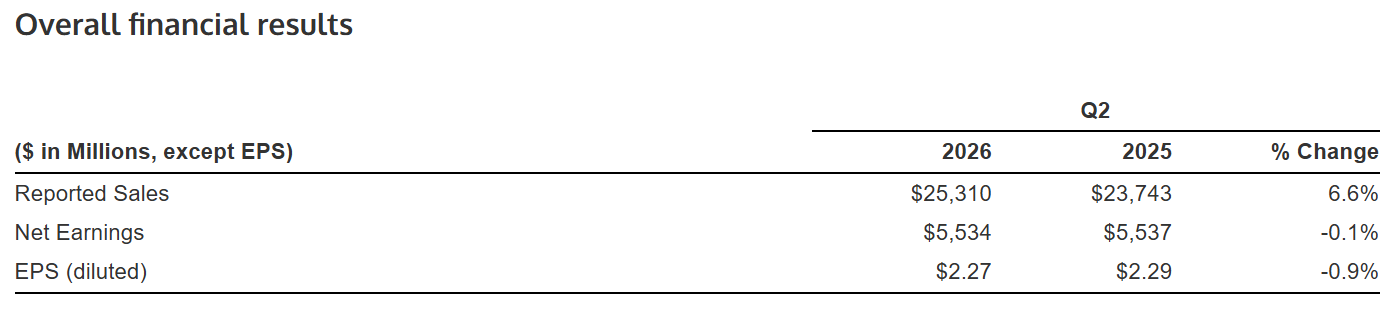
By sector, revenue from the Innovative Drugs business segment increased 7.8% year over year (about US$16.4 billion), while revenue from the medical technology business segment increased 4.5% (about US$8.9 billion) year over year. Notably, sales in the medical technology business segment fell slightly short of expectations.
Johnson & Johnson shares fell 1.7% in pre-market trading in New York. By the close of trading on Tuesday, Johnson & Johnson's stock price had accumulated a cumulative increase of more than 60% over the past 12 months.
Johnson & Johnson's quarterly earnings are released earlier than its rivals and are seen as a barometer for the industry. Its second-quarter report shows that despite recent turmoil in the US Food and Drug Administration (FDA) and Johnson & Johnson and his rivals have reached an agreement with the White House to lower the net prices of certain drugs, large pharmaceutical companies are still booming.
Despite a decline in sales of the psoriatic (psoriasis) drug Stelara (Stelara), which was pressured by cheaper competitors, revenue increased 6.6% over the previous year.
Several newer drugs are driving strong growth, including Tremfya (gusecumab), which grew 72.5% to about $2 billion; Carvykti (sitacarabatic autoleucine), which grew 49.4% to $657 million; and Darzalex (daretuizumab), which grew 18.9% to $4.2 billion.
This is the first quarter that Icoytde, a novel oral psoriatic drug, saw full sales, and the company hopes the drug will become a bestseller.
Johnson & Johnson Chief Financial Officer Joseph Walker said in an interview that the acceptance of the treatment was “very impressive” and that it has been used by more than 11,000 patients. He said, “This will generate billions of dollars in revenue for the company. It could become one of Johnson & Johnson's biggest drugs.”
Johnson & Johnson is investing heavily in the launch of a new drug line to try to make up for the shrinking revenue caused by Starano's loss of monopoly last year. In addition to the cancer sector, Johnson & Johnson is also investing in drugs to treat mental illness, including Caplyta, a drug it bought last year to treat schizophrenia and bipolar depression.
In the medical device sector, Johnson & Johnson is focusing on faster growing products and has announced plans to split its mature orthopedic business from the rest of the company. Medical device sales increased 4.5% during the quarter.