
PPI teamed up with CPI to wipe out expectations for July interest rate hikes! US PPI fell for the first time in nearly a year in June, and the war in the Middle East is still the biggest variable in inflation
The Zhitong Finance App learned that a key producer inflation index (PPI), which measures the underlying inflation of US producer prices, unexpectedly fell short of economists' unanimous expectations, further indicating that the rise in energy prices caused by the Iran war and a series of inflationary effects extended by high oil prices are still largely under control. It also shows that before the latest round of Iran war broke out recently, the pressure on market expansion and the early stages of production pipeline construction had been greatly mitigated. Following the unexpected weakening of the CPI data released on Tuesday, PPI data once again confirmed the continued cooling trajectory of inflation, which was dominated by falling energy prices. Traders immediately drastically cut their expectations for the Federal Reserve to restart interest rate hikes in July. Currently, mainstream interest rate hikes in the interest rate futures market have declined sharply from July to December.
According to data released by the US Bureau of Labor Statistics on Wednesday, the June core producer price index (i.e. core PPI), which excludes food and energy, rose 4.7% from the same period last year, significantly lower than economists' unanimous expectations. Overall producer price inflation, which includes food and energy (the so-called “PPI index”), showed a significant slowdown, mainly due to a sharp drop in gasoline prices of 12%.
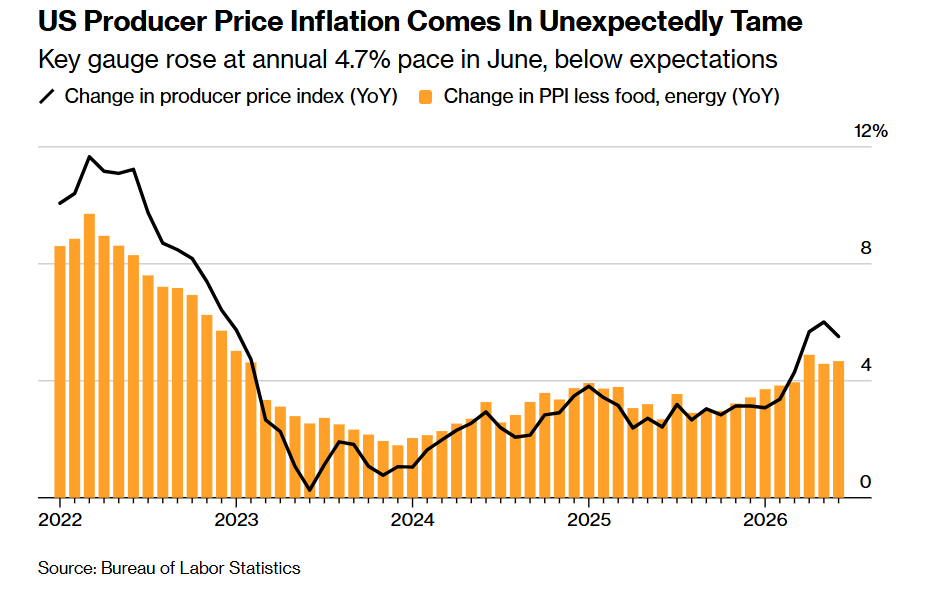
As shown in the chart above, producer price inflation in the US was unexpectedly moderate — the key indicator rose by only 4.7% year on year in June, which was significantly lower than expected.
The PPI index unexpectedly fell 0.3% month-on-month in June. The surprise recorded its first decline since last year, which was significantly lower than economists' expectations of about 0% month-on-month; the year-on-year PPI increase narrowed significantly to 5.5%, which was significantly lower than the 6.2% expected by economists. Core PPI excluding food and energy rose 4.7% year over year, lower than economists' agreed expectations of about 5.1%. Core PPI was 0.2% month-on-month, lower than economists' agreed expectation of 0.3%. The previous value was about 0.4%.
The PPI index has the title of “upstream price pressure barometer”. PPI measures sales prices received by domestic producers and can reflect changes in raw materials, energy, transportation, and intermediate goods costs earlier, so it has certain leading and predictive significance for future CPI and PCE inflation; however, corporate profit margins, productivity, import prices, and cost transfer capacity will weaken transmission, so it is not possible to judge future inflation based on PPI alone. A comprehensive analysis of CPI, core PCE, wages and inflation expectations is still needed.
The June CPI and PPI jointly sent a signal that inflation has cooled marginally and that the urgency of raising interest rates has declined recently. According to the latest statement by New York Federal Reserve Chairman Williams, the third person in the Federal Reserve, he admits that current inflation is still “unquestionably too high” at about 4%, but judging that the supply and demand gap caused by tariff price shocks, housing inflation, energy costs, and artificial intelligence investment may gradually ease. Overall inflation is expected to fall to about 3.25% by the end of the year and return to 2% in 2028. Wall Street financial giant Citi's latest public forecast shows that the agency expects that as inflation continues to cool down, the Fed will not shift to an interest rate hike position, and is betting that the Fed will cut interest rates by 25 basis points each in October and December 2026. The third rate cut will occur in January 2027; it had only previously anticipated continuous interest rate cuts in September, October, and December 2026.
The US PPI was unexpectedly moderate, and bets on the Fed's July rate hike all dissipated
This PPI data report shows that several key categories that have risen in recent months due to the impact of the war have generally cooled down. This could provide more room for the Federal Reserve to delay rate hikes — especially after another report on Tuesday showed US consumer prices were just as moderate in June. However, many economists believe that with the recent sharp rise in the geopolitical conflict in the Middle East, this easing of energy and core inflation may only be short-lived.
After the report was released, US stock index futures rose, US Treasury yields fell, and investors drastically cut their bets on the Federal Reserve's July rate hike. Current interest rate futures and exchange market pricing together show that the probability of interest rate hikes in July has been reduced to about 5%, and the probability of interest rate hikes in September is about 40%.
Federal Reserve Chairman Kevin Walsh warned during his testimony in Congress on Tuesday that “the task is complete” to fight inflation cannot be declared because consumer price reports are beneficial.
According to data released on Wednesday, energy prices in June fell 6.4% from the previous month, and transportation and storage prices also fell. Even so, truck freight rates remain high due to rising fuel costs and a reduction in the number of drivers due to President Donald Trump's tightening immigration policies.
Meanwhile, food prices fell for the first time in three months. Since this year, food prices have generally been rising due to multiple factors such as bad weather, wars, and tariffs.
Several segments of the producer price index have also received special attention from the Federal Reserve, as these items will be included in its preferred inflation indicator, the personal consumer spending price index. The performance of the relevant segment was mixed: ticket prices surged 1.9%, but the increase in portfolio management fees was far lower than in May.
The US Bureau of Economic Analysis plans to release the June personal consumption expenditure price data (the so-called PCE), as well as revenue and expenditure data, on July 30, EST.
“With the current data available, we estimate that the personal consumer spending price inflation index (PCE) will be slightly better than the consumer price index, which performed moderately in June, but it may still be moderate enough to keep interest rates unchanged for the next few meetings and until the end of the year.” Troy Dooley, a senior economist from Bloomberg Economics, said.
An indicator of inflationary pressure at an earlier stage in the production process — the price of processed goods with intermediate demand excluding food and energy — rose by only 0.6%, the smallest increase since the beginning of this year. Prices of plastic resins and materials, which are key raw materials for many consumer products, declined for the first time in 2026.
The report also shows that two other new sources of inflationary pressure this year — data centers and defense production — have all cooled down. Prices of electronic components and accessories fell for the second month in a row, and prices related to government defense procurement fell 2.2%.
Details of profit margins on wholesale and retail trade services in producer price index reports have also been closely watched to determine the extent to which enterprises absorb the costs associated with tariffs themselves or pass them on to consumers. Profit margins rebounded in June after falling sharply in May.
Although the US Supreme Court overturned a number of tariffs imposed by Trump earlier this year, the administration is looking for other ways to tax imported goods. The US also recently decided not to renew long-term trade agreements with Canada and Mexico and instead conduct annual reviews, which may bring more uncertainty to businesses in the coming months.
Another report released by the Federal Reserve Bank of New York on Wednesday showed that as new orders and shipments increased, and employment indicators rose to the highest level since December 2022, the overall manufacturing business condition index rebounded in July. Payment price indicators have declined, but they are still high; companies' expectations for future payment prices and sales prices have declined.
Williams released a dovish buffer, Walsh held the hawkish bottom line, and Citi bet on the “cut interest rate three times” script
In June, CPI and PPI jointly sent a signal of marginal cooling in inflation and a recent decline in the urgency of interest rate hikes: overall CPI fell 0.4% month-on-month, slowed from 4.2% to 3.5% year on year, core CPI remained flat and fell to 2.6% year on year; in June, final demand PPI fell 0.3% month-on-month and rose 5.5% year on year; core indicators excluding food, energy and trade services rose only 0.1% month-on-month. The two reports show that falling energy prices, slowing housing inflation, and cooling of some production-side costs are temporarily reducing the inflation slope, but PPI is still high year over year, and segments related to the personal consumer expenditure price index, such as air tickets and asset management fees, are still resilient, so it is more appropriate to define it as a downgrade of hawkish risk rather than a complete victory for inflation.
The hearing of the new Federal Reserve Chairman Walsh actually established a hawkish policy response function, but did not give the next course of action: he emphasized “zero tolerance” for continued high inflation, refused to announce “task completed” due to a moderate CPI, and deliberately did not promise interest rate hikes in July or subsequent meetings, and also reiterated that interest rates and balance sheets are usable tools. The real New Deal signal is to weaken traditional forward-looking guidance, strengthen conference-by-meeting and full-data decision-making, and re-examine the adequate reserve framework, asset holding structure, and Federal Reserve communication mechanism; this helps preserve policy flexibility, but increases the marginal impact of every inflation, employment, and oil price data on the market.
Williams's wording is conditionally neutral: he admits that current inflation is still “unquestionably too high” at around 4%, but judging that the supply-demand gap caused by tariff price shocks, housing inflation, energy costs, and artificial intelligence investments may gradually ease. Overall inflation is expected to fall to about 3.25% by the end of the year and return to 2% in 2028; at the same time, Williams believes that the US non-farm labor market is not putting additional inflationary pressure, and the unemployment rate is expected to slowly fall back to 4%.
However, New York Federal Reserve Chairman Williams, who has permanent voting rights in the Federal Reserve's FOMC during his term, did not advocate immediate interest rate cuts, and the internal members of the Federal Reserve's FOMC are still roughly equally divided between the “no interest rate hikes this year” and “at least another 25 basis points.” Therefore, there is no fundamental conflict between Walsh and Williams: the former emphasizes not to let down guard until they see continuing evidence, while the latter believes that the current interest rate level of 3.50% to 3.75% is sufficient to wait for inflation to fall naturally. To a certain extent, they both point to a suspension in July and maintain a two-way option thereafter, but Walsh's stance is clearly more hawkish.
According to economists, the fall in the current round of US inflation is largely due to the fall in energy prices in June — the CPI energy segment fell 5.7% month-on-month, and PPI energy prices fell 6.4%; and after the US-Iran conflict escalated again, oil prices have risen again. At the same time, economists generally predict that the core personal consumption expenditure price index (that is, core PCE) may still reach about 3.3% year on year in June, which is significantly higher than the Fed's 2% target; although New York Federal Reserve Chairman Williams believes that inflation may have peaked, he still described current inflation as “unquestionably too high.”
Therefore, according to most economists, the Federal Reserve's choice to stay on hold in July is close to consensus; the probability of staying on hold throughout the year has risen markedly, but the risk of interest rate hikes will remain after September this year.
If core inflation remains moderate for several months in the future, employment and consumption cool down markedly, and the situation in the Middle East eases and lowers energy prices, then Citi's dovish path may indeed become the main line of the market. The Citigroup economists' team expects the Federal Reserve's FOMC to cut interest rates by 25 basis points each in October and December 2026. However, Citi also acknowledged that just one CPI and PPI were lower than expected is not enough to prove that the Fed will quickly implement multiple interest rate cuts while the economy is still resilient.