
Lead prices hit a new low in nearly three years! Tork's record lead delivery discount explodes imbalance between supply and demand, and LME inventory reaches a record high
The Zhitong Finance App learned that the London Metal Exchange (LME) lead market is experiencing an epic supply shock. On Wednesday (July 15), lead stocks tracked by LME surged 86,500 tons per day to 456,575 tons, the highest level since records began in 1970. The price of lead fell 0.8% to $1,852 per tonne. At one point, it hit $1,840 in the intraday period, the lowest since April 2025, and is approaching its lowest level since 2022.
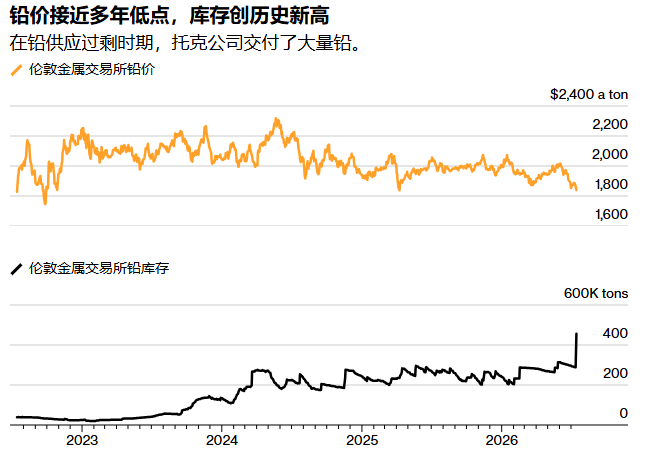
According to people familiar with the matter, a batch of 80,700 tons of lead flowed into the LME warehouse on Tuesday, pushing the total inventory to 370,075 tonnes — the highest since 2012. Further deliveries on Wednesday pushed inventory to an absolute peak in the history of LME data. According to people familiar with the matter, both of these record deliveries are linked to global commodity trading giant Trafigura Group (Trafigura Group). Delivery locations are all in Singapore — the city-state has absorbed more than 90% of lead stocks in LME's global warehousing network.
Storage arbitrage: 51 cents per ton per day for a “money printer”
TOK's delivery is not a simple physical shipment, but a sophisticated financial arbitrage operation. According to people familiar with the matter, this delivery is related to a “rent deal” (rent deal): the party that delivered the metal can share with the warehouse the daily storage rent paid by the new owner during the metal storage period. Lead storage rent in Singapore is 51 cents per tonne per day. Based on 80,000 tons, the daily rental income alone is over $40,000. Huge amounts of inventory can generate considerable cash flow in warehouses, motivating metals to maintain a “registered warehouse receipt” status (ready for delivery), thus continuously suppressing prices in recent months.
Part of the reason why Singapore has become a lead-zinc storage center is that once the metal arrives in this densely populated city-state, it is expensive and the logistics are complicated. According to previous reports, if Citigroup were to ship lead from Singapore, it would have to pay a transportation cost of about 53 US dollars per ton. This “easy to get in and hard to get out” structure is extremely beneficial to storage companies — they can earn daily rental income from the metal arriving at the warehouse, and usually provide concessions to trading companies to encourage the continued inflow of metals. Torc acquired the Singapore business of local warehousing company Grafton Logistic Services last year to strengthen its warehouse layout in Singapore.
The complex trading ecosystem built around the LME warehousing network means that analysts and investors are often very careful when interpreting individual stock flow data, making it difficult to use it as a signal of changes in market fundamentals. However, this time of day delivery coincides with the lead industry facing deeper structural challenges.
Singapore: The “ultimate destination” for surplus metal
Singapore has become a “reservoir” of the world's excess lead. LME's lead inventory in Singapore now accounts for more than 90% of its global warehousing network.
This concentration itself is a source of market risk. Warehouse utilization rates often exceed 90%, and organizations often face high costs or inflexible logistics. Inventory frequently flows between registered and unregistered states, forming a circular mechanism similar to a “revolving door” and promoting a complex ecosystem where warehouse queuing and rent incentives coexist. As long as Singapore's huge inventory is not consumed or transferred out of registered warehouse receipt status, lead prices are likely to continue to be under pressure and lag behind the performance of LME's other metals — because the market can point to a 55-year high inventory “ceiling”.
Structural woes: electric cars are “killing” lead demand
The fate of lead is almost entirely tied to lead-acid batteries — these batteries are used to start the starter motors of internal combustion engines. As electric vehicle sales continue to grow, this pillar of demand is loosening.
Morgan Stanley analysts pointed out in a report last week that since demand is mainly related to lead-acid batteries, “consumption is facing structural resistance from the industry's decline.” “Continued growth in secondary production and weak demand growth continue to lead to oversupply in the market.”
The data confirms this judgment: the average annual growth rate of lead demand over the past four years was only 0.5%. In the Chinese market, the continuous increase in the penetration rate of new energy vehicles has directly reduced the application space of lead-acid batteries in the transportation field; in the electric two-wheeler scenario, lithium batteries are gradually replacing lead-acid batteries as mainstream due to their high energy density and long cycle life. After the implementation of the new national standard for electric vehicles, vehicle weight restrictions have become stricter, and the penetration rate of lithium-ion batteries in the low-end electric vehicle sector has increased to about 28%.
Lead is the only industrial metal traded by LME to record a decline so far this year, with a cumulative decline of nearly 8%; while tin rose 33% over the same period, leading other metals. This contrast clearly outlines the trajectory of lead being marginalized in the electrification era.
Where is the price of lead going from here?
TOK's delivery behavior has attracted market attention — does this mean that inventory accumulated off the market is being systematically thrown into the LME system? Analysts pointed out that large-scale deliveries usually suggest that traders have pessimistic expectations about short-term price prospects.
In the short term, the supply shock of LME lead inventories, which reached a record high, was doubly suppressed by weak demand during the off-season for lead-acid battery consumption. Whether TOK will have more subsequent deliveries will be a key variable in determining whether lead prices can stabilize. If other traders follow up on the sell-off, lead prices may be under further pressure.
In the long run, the erosion of demand for lead-acid batteries by the transformation of electric vehicles is an irreversible structural trend. Although the energy storage sector may provide some incremental demand, it is difficult to hedge against shrinking traditional demand in the short term.
It is worth noting that there is also a subtle correlation between lead price trends and geopolitics. The tense situation in the Strait of Hormuz is driving up oil prices. If the situation in the Middle East continues to deteriorate, rising energy costs may provide some support for lead prices on the cost side, but this is two different things from fundamental improvements on the demand side.
The lead market's “perfect storm” — record inventories, shrinking structural demand, and traders' rent arbitrage — is fermenting simultaneously. Under the double pressure of 460,000 tons of inventory and structural substitution of electric vehicles, the “darkest hour” for lead is probably far from over.
In this energy transition driven by electric vehicles, lead is probably going through the same path as coal: when alternative technologies irreversibly change the structure of demand, the redefinition of the price bottom is often harsher and more durable than expected by the market.