
Is extreme optimism the opposite of shackles? The perfect “blonde girl” has arrived, but US stocks have not been able to rise
The Zhitong Finance App learned that bullish stock market investors are already addicted to the beautiful scene of the “blonde girl,” and risk appetite has also been pushed to an extreme high level, so it is becoming more and more difficult to determine where the market's next upward momentum actually comes from.
US inflation data fell short of expectations and injected a boost into the market at one point, but the effect was fleeting, and stock indexes were still struggling when they hit new highs. The 10-year US Treasury yield continued to hover around 4.6%, and the US dollar index remained stable at around the May 2025 high. Despite an overall positive start to the earnings season, the above conditions are currently limiting the upward space in the stock market.
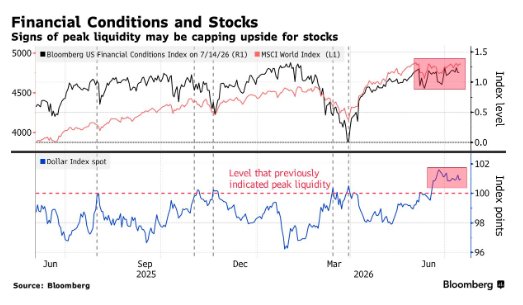
Richard Privorotsky, partner at Goldman Sachs Group, said, “Whether the stock market can continue to rise depends ultimately on performance guidelines and position levels, not the headlines themselves. Energy is still a key macro risk factor, but for now, the inflationary environment is improving.”
Privorotsky pointed out that the current earnings season is likely to deliver good results. The banking industry has basically passed the performance threshold, while ASML.US (ASML.US) earnings report shows that semiconductor capital expenditure demand is still healthy. “As with most AI-related individual stocks, the question is no longer limited to the data itself, but rather whether this data is impressive enough compared to current positions,” he added.
Institutional positions light up red: cash bottoms out, systematic strategies are “full of arms”
According to the Bank of America fund manager survey released this week, the cash holding ratio of professional investors has dropped to a very low level, while the bank's “Bull and Bear Index” also sends warning signals.
Furthermore, data from Deutsche Bank shows that the systemic strategy currently holds extremely large positions, leaving little room for further incremental purchases. Trend-tracking CTA positions in stocks have been pushed to the upper end of the historical range, at the 72nd percentile; while the positions of volatility control funds are more extreme and are already at the 91st percentile.
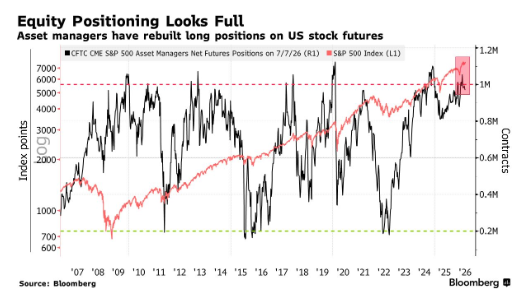
High positions are also reflected in the upward flow of capital. Société Générale strategist Arthur van Slooten and others pointed out that although the amount of capital flowing into bond funds and money market funds this year exceeds that of stock funds, compared to the surge in the amount of assets managed by the latter, both are dwarfed. Equity funds currently account for 64.7% of total assets in EPFR Global's fund portfolio, which covers a total of $72.9 trillion excluding commodities, a record high. “In other words, fund investors' risk appetite is at its highest level on record,” they wrote.
The multi-pronged logic is still strong, but “moving forward” requires a new story
Despite this, in the current context of falling inflation and strong economic growth and corporate profits, it still seems reasonable to take a bullish stance. Coupled with both US CPI and PPI data showing that price pressure is easing, the Federal Reserve may shift to a more dovish stance in the coming weeks.
J.P. Morgan's market intelligence team, led by Andrew Tyler, said: “For market bulls, the current situation even surpasses the best scenario a 'blonde girl' can imagine.” The team believes that the inflation data should dispel market concerns about the July rate hike, and may also ease concerns about the September action. “This has laid the foundation for a further rise in the market and the spread of the market.”
The J.P. Morgan Chase team continues to prefer a “barbell” arrangement, taking into account technology stocks and cycle stocks, while holding the healthcare sector as a low-correlation asset. Within the tech sector, they believe that the current market consensus — that is, going long on semiconductors and shorting the “Big 7” or software stocks — may change. Given that valuations are already attractive, the possibility of capital flowing back to the “Big 7” is rising.
However, the team also warned that investors may first need to see changes in the AI adoption rate of end users, or the acceleration of corporate profits, thereby reducing future dependence on the credit market.
Meanwhile, the next phase of the market's rise may still depend on momentum trading. After a recent round of significant sell-off, position conditions in related sectors may have improved, but overall investor exposure is still high. Although the rotation of some sectors may help maintain gains, considering the strong impetus given by momentum trading over the past year, the market may need more catalytic factors to drive the benchmark index higher.
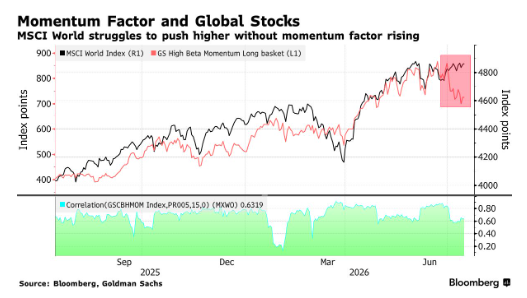
Goldman Sachs strategist Andrea Ferrario and her team said, “Over the past three weeks, market dominance forces have been tested, and the momentum factor has experienced the most intense sell-off since the early 2000s. Although oil prices are once again an important driver of cross-asset returns, the momentum effect still dominates the stock market.”