
Japan wants to build a “robotics national team” and plans to purchase 27,500 Nvidia Rubins! The AI computing power supercycle is moving from the cloud to “physical AI”
The Zhitong Finance App learned that an alliance between the Japanese government and large Japanese companies — that is, the newly founded company Noetra Corp plans to purchase 27,500 next-generation AI GPUs from Nvidia, and plans to build a very large AI computing power infrastructure cluster through large-scale procurement of NVIDIA Rubin-architecture AI GPUs, the most advanced AI computing power product to accelerate the construction of artificial intelligence models based on Japanese robots, as well as accelerate the construction of a large robot cluster led by the Japanese government and policy support of the Japanese government.
The newly established company Noetra Corp is essentially a “national team” project funded and supported by the Japanese government and jointly formed and operated by large Japanese companies. The newly established Noetra Corp includes dozens of companies including SoftBank, Preferred Networks, NEC, and Fujitsu. It is responsible for building large-scale data centers and integrating the AI R&D capabilities of various companies. It plans to purchase 27,500 next-generation AI GPUs using the Rubin architecture from Nvidia to develop basic models in Japan and eventually build a “sovereign physical AI” system for robots; the Japanese government mainly plays a role as a financial supporter and industrial policy driver.
27,500 Rubins ignite the “Japan Robotics National Team”, and Nvidia CEO Huang Renxun's recent trip to Japan to cooperate with established industrial giants such as Fanuc, Yaskawa Electric, Kawasaki Heavy Industries, and Fujitsu to promote physical AI collaboration, and incorporate SoftBank, NEC, Hitachi, Sony, Preferred Networks, etc. into the Cosmos ecosystem, as well as the exclusive Nvidia AI chip manufacturer — TSMC's recently announced strong performance exceeding expectations and the increasingly optimistic future outlook for AI computing power demand It proves that the global AI computing power investment cycle is far from over. The expansion of computing power is being upgraded to a single arms race led by US hyperscale cloud vendors, and is being upgraded to a multi-center resonance of “cloud AI, sovereign AI, and physical AI”.
Big purchase of 27,500 Rubin! The government invested 387.3 billion yen to bet on physical AI, and Japanese giants joined hands with Nvidia to build a national base for robotic AI
The Japanese corporate giants plan to purchase 27,500 next-generation Rubin AI GPUs and invest at least US$2.4 billion to build local infrastructure models and large-scale data centers, which means that GPU demand will no longer only rely on commercial customers such as Microsoft and Meta, but will receive financial and capital support driven by national security, technological autonomy, and demographic pressure. Rubin is also not an isolated AI chip product from Nvidia, but rather a rack-level AI factory platform integrating GPU, CPU, NVLink, network, and DPU. As a result, Japan's current procurement will simultaneously drive comprehensive AI data center computing power infrastructure requirements for HBM/DRAM/NAND storage chips, advanced packaging, high-speed optical interconnect/optical communication, data center power equipment, and liquid cooling systems.
The newly founded Noetra company said it will be responsible for coordinating the project and building a large-scale artificial intelligence data center. As of March next year, the new company co-founded by the Japanese giants will receive up to 387.3 billion yen (about 2.4 billion US dollars) of government financial support from government finances. Dozens of companies, including SoftBank, where legendary Japanese investor Sun Zheng is at the helm, as well as Preferred Networks and NEC, which are supported by Japanese automobile giant Toyota Motor Corporation, are helping to set up and operate Noetra efficiently.
Japan's latest AI computing power infrastructure order is impressive, but it's still small compared to the US tech giant Microsoft's plan to eventually build a huge data center equipped with hundreds of thousands of Nvidia Vera Rubin architecture CPU+AI GPU chips.
This plan is one of a series of important measures by the Japanese government to reduce dependence on foreign technology and comprehensively strengthen national security. Noetra President Hiroki Tamba said that Japan has many of the world's largest and top industrial robot manufacturers, so it is expected to create an alternative to the American and Chinese artificial intelligence supersystems. Hiroki Tamba was responsible for leading the development of the Big Language Model for Japan led by SoftBank.
“Our goal is to create a real third option — one that Japan and other countries can choose from.” Tamba said in an interview. He emphasized that Noetra was founded to integrate large-scale artificial intelligence projects from dozens of companies that are separate from each other.
The joint venture plans to release a major model of cutting-edge artificial intelligence by March next year, and then update and iterate regularly. Tamba said that the long-term goal is to launch a large-scale superphysical AI model for the most advanced robotics applications within the next few years.
Noetra will recruit engineers from companies such as SoftBank, Preferred Networks, NEC, and Fujitsu, all of which have developed their own proprietary big models of artificial intelligence. SoftBank has the Sarashina Big Language Model, Preferred Networks owns Plamo, and NEC's flagship model is called Cotomi.
The development of local physical artificial intelligence models is at the core of Japan's broader strategy to build a world-leading artificial intelligence and cutting-edge humanoid robot industry center. The Japanese government aims to occupy at least 30% of the estimated 60 trillion yen global robot market by 2040.
The global dispute to develop an artificial intelligence model capable of controlling extremely complex behavior and the most intelligent cutting-edge humanoid robot motion system is intensifying. Promoting this technology has become a very urgent task for Japan in the context of a declining population and severe labor shortages.
“Japan has a lot of great ideas, but there isn't enough labor.” Nvidia CEO Hwang In-hoon told reporters during an interview in Japan on Wednesday, “With automation, artificial intelligence, and robotics, the Japanese economy is expected to prosper again.”
From big model arms races to sovereign robotics races, AI investments spread from the cloud to the physical world
The strategic value of Hwang In-hoon's current trip to Japan is also far greater than an ordinary customer visit. Nvidia is promoting physical AI collaboration with Fanuc, Yaskawa Electric, Kawasaki Heavy Industries, and Fujitsu, and incorporating SoftBank, NEC, Hitachi, Sony, Preferred Networks, etc. into the Cosmos ecosystem. Essentially, it binds robot bodies, precision manufacturing, sensors, and industrial data accumulated in Japan over many years to Nvidia's world models, digital twins, training platforms, and edge computing stacks. After AI requirements are further extended from big language model training to robot simulation, reinforcement learning, visual reasoning, and real-time control, the same robot requires not only data center training computing power, but also terminal side inference computing power resources such as Jetson, thus opening up a broader and more durable semiconductor demand curve than traditional chatbots.
Hwang In-hoon's reunion with “Life Saver” 30 years ago has brand and historical narrative value, but what really affects asset pricing is Nvidia's systematic binding to Japanese robot bodies, automobiles, chip equipment, storage, materials, and optical communication supply chains.
According to Sega's disclosure, Hwang In-hoon attended an event hosted by SEGA (SEGA) on July 15, local time, and was on the same stage again after many years with Shoichiro, the former president of Sega. Hwang In-hoon said with emotion at the event, “Nvidia wouldn't have survived to this day without everything Sega has done, and if it hadn't been for everything Shoichiro has done.”
This period dates back to around 1996. When Nvidia, which had just been established at the time, was developing graphics chips for Sega's next-generation console, the project completely failed due to a mistake in the technical route, and the company was on the verge of bankruptcy. Huang Renxun took the initiative to confess his failure to join SEGA's vice president, Shoichiro, and did not choose to be held accountable. Instead, he pushed Sega to invest about 5 million US dollars in this “food-cut” startup.
Physical AI does not simply install chat models into robots, but requires continuous digital twin simulation, synthetic data generation, vision-language-action model training, reinforcement learning, and real-time endside inference; this will simultaneously create data center training computing power and robot edge inference requirements. Japan has a comparative advantage in industrial robots, precision manufacturing, and real factory data, so its AI investment logic is not to replicate the US general model, but to establish a third-pole ecosystem connecting the “sovereignty model — basic robot model — industrial equipment.”
Whether Vera Rubin can be mass-produced on schedule is a key variable in this industry chain moving from narrative to revenue recognition. Nvidia has made it clear that Rubin is entering full mass production; from a technical perspective, it is not a single GPU upgrade, but rather a Vera CPU, Rubin GPU, NVLink 6, ConnectX, BlueField, and Ethernet switch chips are co-designed as a rack-level AI factory. The goal is to reduce the cost of inference per token by up to 90% compared to Blackwell and complete some MoE model training with about a quarter of the number of GPUs.
In his latest statement, Huang Renxun's denial of media reports relating to Vera Rubin's delay helps mitigate the major risk of customers delaying computer room, power, and network deployment, but it does not completely eliminate the downhill risk of HBM4, complex circuit boards, liquid cooling, and rack integration; investors should observe not “whether the chip is flowing”, but whether the entire frame is shipped, customer inspection, and stable utilization can be realized simultaneously.
AI investment frenzy has cooled down, but the supercycle of computing power infrastructure construction is far from over
The recent collective correction in AI computing power stocks is more like a contraction in financial pricing caused by overvaluations, crowded positions, interest rate disturbances, and return on investment anxiety, rather than a reversal in industrial capital expenditure. The capital market is ending the expansion of indiscriminate valuation of AI assets, and real demand for computing power is spreading from US hyperscale cloud vendors to the three incremental curves of sovereign AI, enterprise intelligence, and physical AI.
Even though some AI-themed ETFs rebounded in a single day in July, they still fell by about 6% to 8% during the month, reflecting a phased divergence between stock prices and fundamentals. At the investment level, the key is no longer chasing all AI assets without discrimination, but rather focusing on bottlenecks that can transform continuous capital expenditure into revenue, cash flow, and technical barriers — CoWS/3D advanced manufacturing processes, HBM/DRAM/NAND memory chips, data center high-performance CPUs, CoWoS-grade advanced packaging, rack interconnections, data center power chains, AI server liquid cooling systems, and physical AI superplatforms with the ability to land real humanoid robots. The “AI investment frenzy” is not over yet, but the market has moved from the buying story to the second stage of verifying orders, utilization, and return on capital.
Japan's Noetra, formed with government financial support and the participation of dozens of companies including SoftBank, plans to purchase 27,500 Rubin accelerators and has received 387.3 billion yen and about 2.4 billion US dollars in government funding as of March next year to build large-scale data centers and local infrastructure models; at the same time, Nvidia is promoting robotic AI cooperation with Fujitsu, Fanuc, Yaskawa Electric, and Kawasaki Heavy Industries, indicating that Japan is transforming labor shortages, manufacturing automation, and technological sovereignty into a long-term, non-commercial computing power budget.
TSMC's latest performance provides the most valuable verification of the AI chip manufacturing side and the core production capacity and demand side of the AI computing power industry chain for computing power requirements. TSMC's second-quarter dollar-denominated revenue reached an astonishing $40.2 billion, up 33.7% year on year; net profit reached NT$706.56 billion, up 77.4% year on year, and gross margin and operating margin rose to 67.7% and 60.3%, respectively. High-performance computing already accounts for 66% of the company's revenue, advanced processes of 7 nm and below account for 77% of wafer revenue, and the newly introduced 2 nm has contributed 3%.
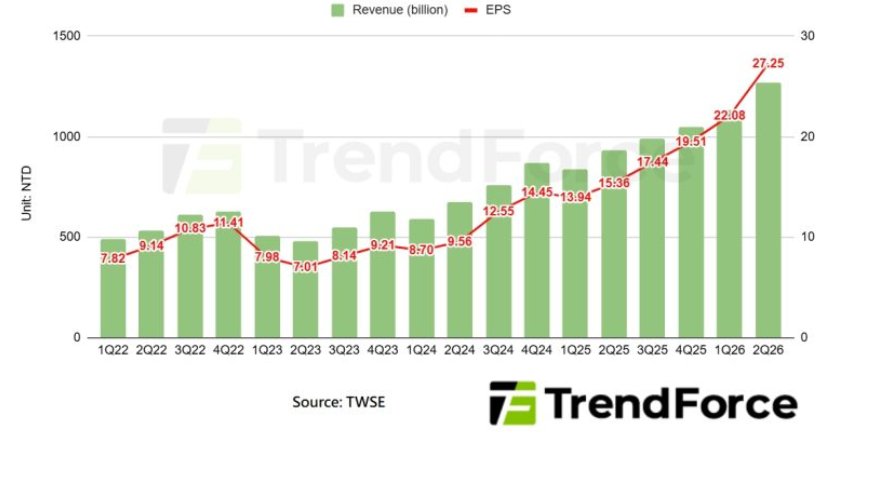
More importantly, TSMC's revenue guidance for the third quarter was further raised to 44.6 billion to 45.8 billion US dollars. At the same time, the company drastically raised its 2026 capital expenditure from 52 billion to 56 billion US dollars to 60 billion to 64 billion US dollars, raised the annual US dollar revenue growth guide to slightly more than 40%, and added 100 billion US dollars in US investment, bringing the total commitment in the US to about 265 billion US dollars. As the final production capacity of core AI chip customers such as Nvidia and the manufacturing chain undertaker to meet AI computing power requirements, TSMC has shown through profit, utilization, and capital expenditure that the visibility of AI computing power infrastructure demand around advanced process logic chips, cutting-edge 2 nm manufacturing processes, and advanced packaging is still rising, rather than global AI computing power demand falling into a period of weakness.
According to Wall Street analysts, the decline in the AI computing power theme is closer to deleveraging crowded positions, the impact of interest rates and geo-risk, and the market's repricing of debt financing and return on investment. The AI industry infrastructure supercycle is far from over, but the undifferentiated computing power fanaticism driven by liquidity has entered a stage of brutal verification of orders, utilization rates, and return on capital.
Research reports recently released by the Bank of America (BofA) show that it is expected that by 2027, against the backdrop of a strong trend where AI inference and computing power continues to surge under the wave of AI smart devices, global capital expenditure on cloud computing and artificial intelligence related infrastructure will reach 1.5 trillion US dollars. It also points out that the current summer correction of AI semiconductors, including memory chip stocks, is a healthy reset trajectory, rather than any structural changes in AI computing power demand.
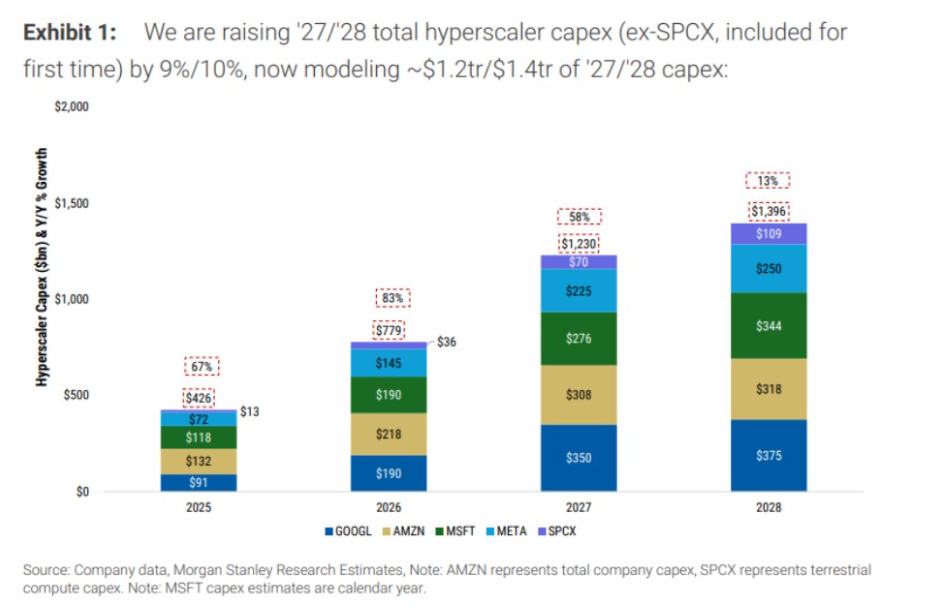
Brian Nowak, a senior analyst from Wall Street financial giant Morgan Stanley, led the analysis team and released the latest research report on July 12, which once again significantly raised the 2027/2028 capital expenditure forecasts for the five largest hyperscale cloud computing and vendors (Meta, Amazon, Microsoft, Google, SpaceX) in the global market, to about $1.2 trillion and $1.4 trillion, respectively. The agency's capital expenditure forecast for major US tech giants in 2026 was drastically raised from 433 billion US dollars a year ago to 805 billion US dollars.
Morgan Stanley's latest study raised Meta's 2027 and 2028 capital expenditure forecasts by 29% and 22%, respectively, to US$225 billion and US$250 billion; Amazon's corresponding forecasts were raised 15% and 29% to US$308 billion and US$318 billion. Morgan Stanley said that the capital expenditure supercycle is not over yet, but 2026 and 2027 are probably the steepest years of growth. After 2028, what determines the stock price will no longer be just “who spends the most money,” but “who can quickly turn AI computing power resources into revenue, profit, and free cash flow.”