
Disrupt Wall Street! From the edge of the market to the center of pricing, this group of “giant whales” is rewriting the rules of the US stock game
The Zhitong Finance App learned that retail investors who were once on the edge of the market have now gone to the center of the stage. Bobby Moravi, head of executive services for Europe, the Middle East and Africa at Goldman Sachs Group, pointed out in a report that market data shows that the influence of retail investors is increasing day by day and is now significant enough to profoundly change the trend of the US stock market. He described this group as now “a combination of price makers, subject makers, and capital flow drivers.”
According to Goldman Sachs statistics, retail investors currently account for about 30% of the daily trading volume of US stocks. In May of this year, retail investors' stock trading volume was 10% higher than the previous record set during the “MEME stock” craze in January 2021, and hit a new record high again in June.
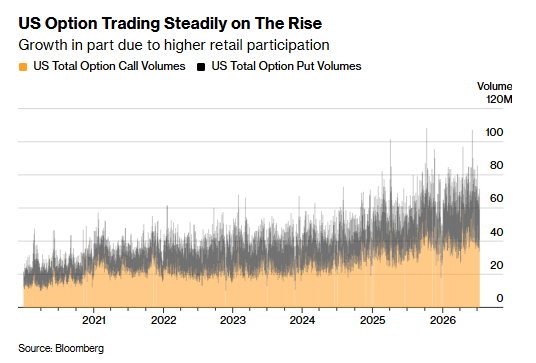
At the same time, retail transactions have also boosted the activity of the stock derivatives market. The total volume of futures contracts on multiple trading dates has exceeded 50 million this year, setting the highest daily average in history, doubling from three years ago.
Institutions are cautious, and retail “must buy when it falls” continues to work
Institutional investors have generally remained cautious for most of the past 18 months, often in a state of low allocation, low leverage, and lack of confidence. These professional investors seem to have been waiting for a pullback, but the pullback has never arrived; instead, they have been forced to chase the upside many times as the artificial intelligence (AI) boom is driving the market to new highs.
The retail community, on the other hand, did the opposite — buying on dips, following momentum strategies, leveraging operations, and trying again and again.
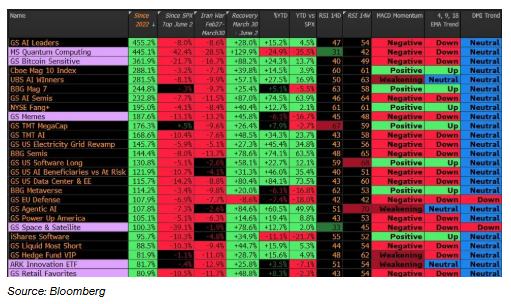
Currently, retail investors have a wide range of popular trading instruments, from initial public offerings (such as SpaceX (SPCX.US)), which they are passionate about subscribing to, to products such as one-day bullish options, common and leveraged ETFs, perpetual futures contracts, and predictive markets. In recent months, the retail boom has swept through various markets such as the US, China, South Korea, and Taiwan.
Scott Rubner of Castle Securities wrote earlier this week: “Retail investors are still the strongest structural buying force for US stocks. Since July, there has not been a single net sale trading day on our retail spot stock platform.” According to the data, July of this year was the second-strongest month for retail net purchases since January 2020, and the strongest July in Castle Securities data records.
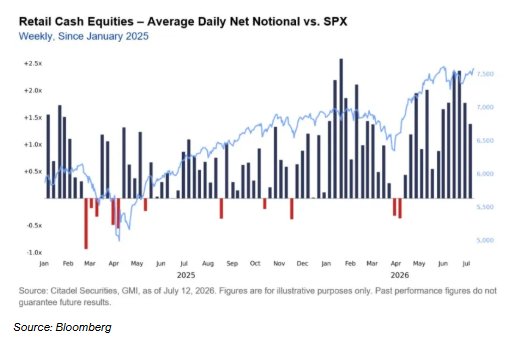
Perhaps more noteworthy is the growing evidence that this trend is enduring. The rise of retail power is nothing new; five years have passed since the “MEME stock” era. What has changed, however, is that today's capital flow has evolved from a phased phenomenon to a structural normal. Whether it's the outbreak of war in Iran or the sharp decline in chip stocks, retail sentiment has hardly wavered; in fact, the opposite is true.
The observations released by J.P. Morgan's stock strategy and quantitative research team last month also confirm this. Despite the complex market environment, retail confidence remains strong. The team, led by Alan Jain, pointed out that the collapse in technology stocks “did little to dampen the enthusiasm of retail investors to participate,” but instead provided them with a good opportunity to buy on dips.
From a longer-term perspective, the size of retail investors far exceeds the scope presented by daily and monthly transaction data. According to Goldman Sachs estimates, self-directed brokerage accounts hold about 12 trillion US dollars in stock assets, accounting for about 10% of the US corporate stock market.
Goldman Sachs's Moravi further pointed out that those retail investors who are seen as active traders are only a small part of the huge retail community in the US. However, American households directly or indirectly own most of the market with a total market value of 111 trillion US dollars, and they are the real “giant whales.”
Even Europe, where interest in stocks has always been low, is changing. Not only are more new American-style brokers emerging to provide faster, more convenient, and lower cost market access, but changes at the political level also indicate that stock investment will grow.
Germany is replacing the old pension model with a modern government-subsidized “retirement investment account.” The system, which is expected to be launched in early 2027, removes strict capital protection requirements, allows up to 100% share allocation to pursue higher return on investment, and provides exclusive options for people under 18. Furthermore, German Chancellor Mertz said that he will consider adding a mandatory pension contribution to inject at least 30 billion euros (about 34.4 billion US dollars) into capital market funds every year to consolidate the sustainability of the pension system.
Unrehearsed steadfastness
However, the current trend of retail investors, which continues to rise, has yet to experience a major and long-lasting market shock test. Since 2022, this group has not experienced a continuous pullback for more than a few months. It remains to be seen how retail investors will respond as the market continues to decline, especially when combined with a weak job market and declining household income.
At least for now, the “stick to positions and increase layout” strategy seems more firm than ever before.
As Moravi said, “All in all, retail investors are becoming an indispensable part of the US stock ecosystem — whether they are creating momentum, strengthening momentum, buying on dips, or simply in terms of daily trading volume and price formation.”