
“It's getting harder to find reasons to be bearish”! UBS took the lead, and many major banks raised European stock expectations at the same time
The Zhitong Finance App learned that a recent survey shows that as the profit growth rate of European companies continues to pick up, and the market generally believes that this round of rising prices can withstand recent geopolitical turmoil, the optimism of major investment bank strategists about the European stock market continues to heat up.
In the July survey, UBS became the most aggressive bullish institution. After raising the benchmark index target, the Stoxx 600 index is expected to rise 8% by the end of the year. Bank of America, Deutsche Bank, and Kepler-Cheuvreux also raised expectations simultaneously.
The 18 strategists interviewed on average expect the index to close at 647 points by the end of 2026. Although this level is less than 1% above the current level, the bearish sentiment has been drastically reduced, and only 5 respondents expect the index to fall.
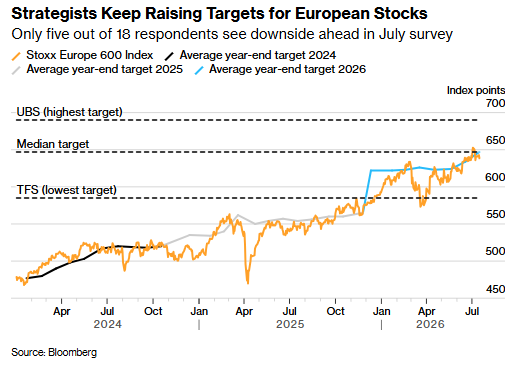
“Looking at it now, the upside risk clearly outweighs the downside risk,” UBS strategist Gerry Fowler said. He called his previous views “too cautious” and raised the target to 690 points.
Fowler pointed out that bottom-up evidence shows that negative catalysts are becoming “increasingly difficult to find” in weighty sectors such as healthcare, essential consumer goods, and luxury goods. At the same time, the list of topics with room for positive correction is being lengthened, and AI is mentioned to empower businesses, banks, and the industrial sector.
This month, the European stock market hit another record high. As market concerns about the war in Iran subsided after the April cease-fire agreement, investors once again increased their allocation to Europe. This round of gains has so far withstood the test of another escalation of tension. Despite a rise in oil prices, it is still about 40 US dollars below the April intraday high.
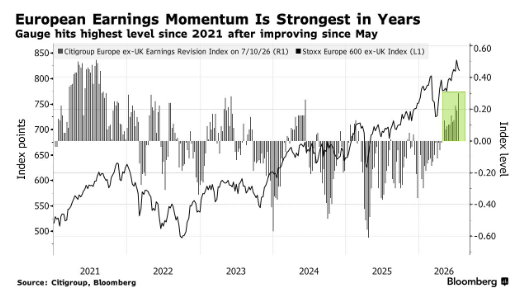
From an optimistic perspective, the positive global macroeconomic environment and large-scale fiscal stimulus in Europe, combined with the benefits brought by AI investment and implementation, have all boosted market sentiment. Citigroup strategists said that the revised European (excluding the UK) profit index compiled by it has soared to the highest level in five years, and currently 80% of the sector is in a net upward range.
“We continue to be optimistic about the outlook for the European stock market over the next 12 months, and are encouraged by the recent positive changes in European profit revisions,” said Beata Mantey, head of European equity strategy at Citigroup. “This round of increases is not only significant, covering a wide range of industries, but the timing is also quite interesting.”
In this survey, the forecast range of various agencies expanded, but only two strategists predicted a decline of more than 5%. TFS remains the most pessimistic. The index is expected to fall 9% to 585 points, followed by Société Générale, which is expected to decline by about 6%.
“We expect the Stoxx 600 index to fall slightly by the end of the year, with a target of 600 points, which mainly reflects our more conservative profit outlook,” said Roland Caroyan, head of stock strategy at Societe Generale Europe. “We believe that the main risk is not a lack of profit growth, but that the recovery may not be as strong as the market has already set.”
He suggested that market expectations are already high, and the strongest performance is concentrated in the AI and energy sectors. Kaloyan believes that the macroeconomic threat to the stock market cannot be ignored. He mentioned factors such as the fragile situation in the Middle East, the US midterm elections, tariff risks, and rising bond yields.
Senior stock strategist Laurent Duyer said, “The record high of the Stoxx 600 Index conceals the fact that institutional participation has declined and trading volume is lower than pre-conflict levels in the Middle East. Institutional investors have turned net sellers. The upward trend is narrow. It mainly relies on financial and AI stocks, and half of the sectors are underperforming the market. If the scope of corporate profit reduction expands and the energy advantage recedes, the current round of the market is likely to lose momentum.”
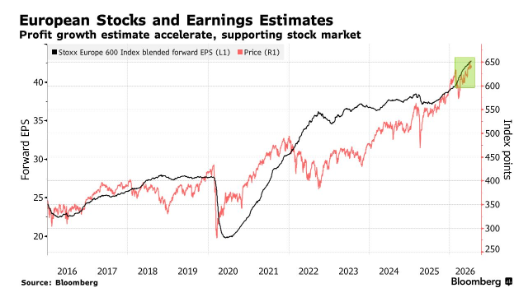
However, during the war, earnings expectations in Europe continued to rise. Earnings per share are expected to increase by 14% in 2026 and 10% in 2027. The second-quarter earnings season, which has just begun, has seen numerous cases of “exceeding expectations and raising guidelines”, including ASML.US (ASML.US), the company with the largest market capitalization in Europe.
Up to now, the performance of more than 45% of companies has exceeded expectations, and only 27% have fallen short of expectations. According to statistics, the year-on-year profit growth rate was 11.6%, in line with market consensus.
According to the Bank of America fund manager survey released this week, European investors recently showed signs of being bullish again after turning more cautious last month, and global asset allocators have begun to “refocus” on the region.
European investors, with a net share of 37%, expect the economy to experience a “blonde girl” scenario over the next three months — that is, steady growth and falling inflation — this is the first time since October 2024 that this view has become a mainstream market view. Bank of America strategists (including Paulina Strzelinska) said that investors with a net share of 54% expected the region's stock market to rise in the next few months, while investors with a net share of 4% expected the market to fall in June.
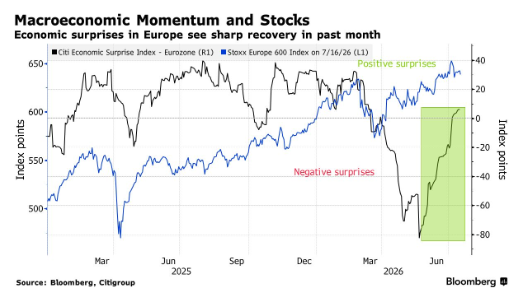
“Valuations are still attractive. Profit resilience is a key backing to hedge against rising interest rates and provides fundamental support for the spread of style, but the trend of oil prices is still an uncertain factor,” Barclays Bank strategist Emmanuel Kao said.