
3 U.S. Regional Bank Stocks Most Exposed To Higher Interest Rates
The Fed’s renewed hawkish tone, paired with volatile energy prices and a firm labor market, is reshaping how investors think about interest rate risk. For U.S. regional banks, tighter policy can shift the balance between what they earn on loans and what they pay on deposits, while swings in inflation expectations influence funding costs and credit demand. This article uses a focused screener of mid sized lenders to highlight 3 regional bank stocks whose business profiles could be especially sensitive to the latest comments from Chairman Kevin Warsh and the recent CPI and energy market moves.
Eagle Bancorp (EGBN)
Overview: Eagle Bancorp is the holding company for EagleBank, a Bethesda based lender that focuses on relationship banking for businesses, investors, non profits, and consumers in the Washington, D.C. region, offering a broad mix of deposits, commercial and consumer loans, real estate financing, and digital banking services.
Operations: Eagle Bancorp generates its US$21.4 million in revenue entirely from banking activities in the United States.
Market Cap: US$847.2 million
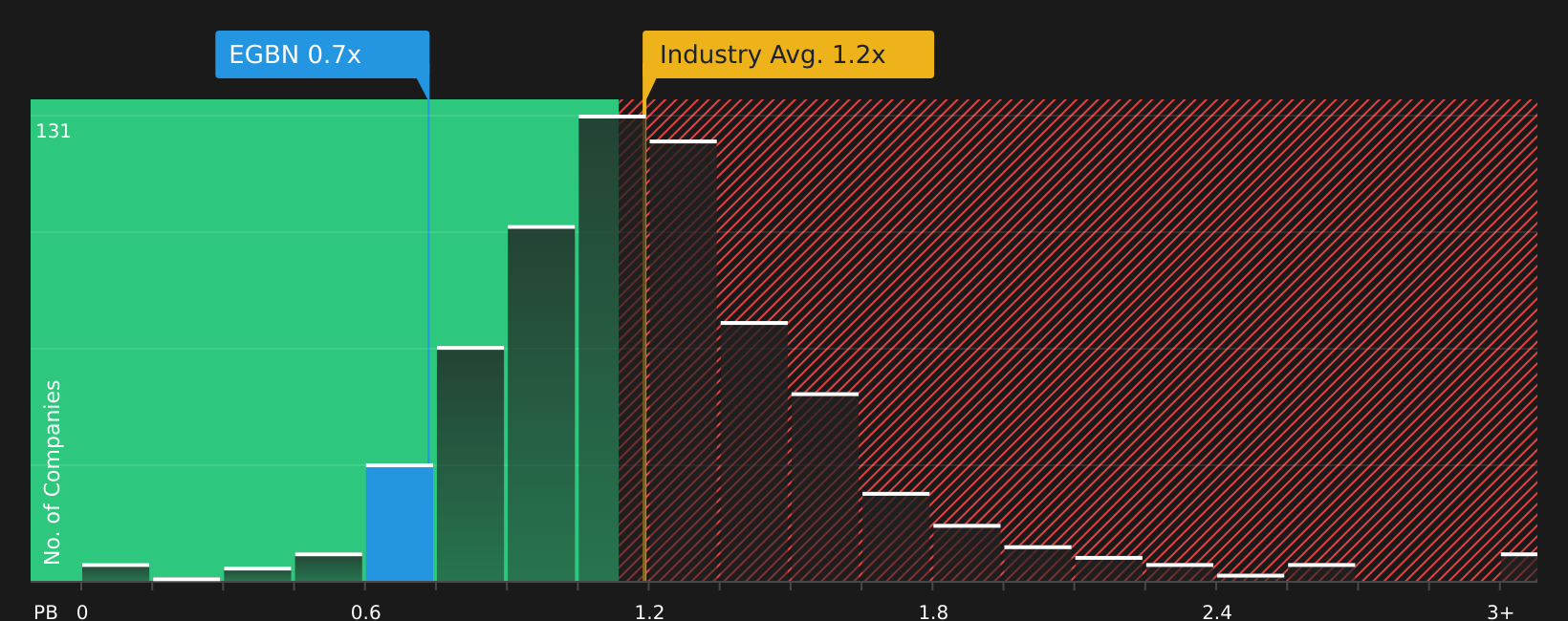
Investors looking at Eagle Bancorp in light of Kevin Warsh’s hawkish stance are getting a regional bank that is directly exposed to interest rate trends, but also in the middle of an internal reset. The company has worked through office credit issues and is shifting more toward commercial and industrial lending, with a focus on government contractors in a Washington, D.C. economy that management has described as relatively resilient. The stock trades at a low P/B multiple, and Eagle Bancorp is only just returning to profitability and still dealing with credit clean up and leadership transition as a new CEO steps in. That mix of repair story and rate sensitivity is where the key opportunity and risk currently sit for this bank.
Eagle Bancorp’s reset story, low P/B and shift toward commercial and industrial lending can look intriguing, but the real question is whether the repair phase matches the valuation. Get the full picture in the DCF valuation analysis for Eagle Bancorp
Peapack-Gladstone Financial (PGC)
Overview: Peapack-Gladstone Financial is a New Jersey based regional bank that combines commercial and private banking with a sizeable wealth management arm, serving businesses, non profits, families and real estate investors across the Metro New York and New Jersey area.
Operations: Peapack-Gladstone Financial generates about US$207.7 million from banking and US$67.1 million from wealth management services, all from clients in the United States.
Market Cap: US$826.6 million
Peapack-Gladstone Financial gives you a mix of interest sensitive commercial lending and fee based wealth management at a time when Kevin Warsh’s hawkish tone keeps the focus firmly on net interest income. Management highlights strong liquidity, high quality capital and a diversified loan book, which can matter if stagflation risks or energy driven inflation persist. Recent earnings, balance sheet repositioning and the build out of services like remote check printing point to a bank working to deepen client relationships while controlling costs. At the same time, insider selling, low return on equity and a valuation that is not obviously cheap relative to cash flows mean this is not a one way story, and the details behind that trade off are where the real insight lies.
Peapack-Gladstone Financial’s mix of lending, wealth management and balance sheet repositioning could be masking a sharper story around risk and reward. For the full context, see the analysis report for Peapack-Gladstone Financial

Community West Bancshares (CWBC)
Overview: Community West Bancshares is a Fresno based regional bank holding company that offers traditional deposit accounts and a wide range of commercial, agricultural, real estate and consumer loans to small and mid sized businesses and households across California.
Operations: Community West Bancshares generates about US$146.6 million in revenue from banking operations in the United States.
Market Cap: US$760.3 million
Community West Bancshares sits right in the crosshairs of Kevin Warsh’s firm stance on inflation and interest rates, with a classic California lending franchise that is closely tied to U.S. monetary policy. The company has paired strong recent earnings and revenue growth with a net profit margin of 28.2%, and its addition to the S&P Regional Banks Select Industry Index has raised its profile with institutions. At the same time, a P/E of 17.8x versus cheaper peers, recent shareholder dilution and a modest 9.9% ROE mean investors are paying up for that growth. How those strengths balance against governance shifts and a higher valuation multiple is where the real story for Community West Bancshares starts to get interesting.
Community West Bancshares looks like an accelerating regional story, where strong recent earnings, revenue growth and index inclusion could be masking a deeper trade off between its 17.8x P/E, 9.9% ROE and governance shifts. The analysis report for Community West Bancshares hints at one factor investors may be underestimating.

The three banks covered here are just a starting point, as the full U.S. regional banks screener surfaced 25 more companies with equally compelling interest rate exposure, funding profiles and credit stories, all captured in the U.S. Regional Banks screener. Use Simply Wall St to identify and analyze the specific catalysts and narratives that matter most to you so you can focus on the highest conviction regional bank opportunities.
Take Control of Your Investment Journey
If Community West Bancshares or any of these companies sound like a great opportunity, register for FREE with Simply Wall St and add your companies to a Watchlist to monitor the share price against the fair value the ideal entry point. Once you've made your move, manage your holdings with our Portfolio Command Center that filters out the noise to deliver only the most critical, actionable updates. Throughout your journey, our Community allows you to filter the best ideas from thousands of investor perspectives. By uncovering hidden catalysts and risks early, you'll accelerate your decision-making and stay one step ahead of the market.
Seeking Fresh Alternatives Beyond Regional Banks?
Some of the most interesting breakouts, rebounds and dropping valuations move quietly before the crowd notices. Scan these fresh ideas while it matters, and consider them early in your research process.
- Spot potential turnaround stories by reviewing the curated 47 high quality undervalued stocks that brings together companies where price and fundamentals are starting to move out of sync.
- Track where real AI cash generation may be building by scanning the hand picked 62 profitable AI stocks that aren't just burning cash before that theme attracts broader institutional attention.
- Follow the money into critical infrastructure by assessing the focused 33 power grid technology and infrastructure stocks while these backbone plays remain relatively under the radar.
This article by Simply Wall St is general in nature. We provide commentary based on historical data and analyst forecasts only using an unbiased methodology and our articles are not intended to be financial advice. It does not constitute a recommendation to buy or sell any stock, and does not take account of your objectives, or your financial situation. We aim to bring you long-term focused analysis driven by fundamental data. Note that our analysis may not factor in the latest price-sensitive company announcements or qualitative material. Simply Wall St has no position in any stocks mentioned.
Have feedback on this article? Concerned about the content? Get in touch with us directly. Alternatively, email editorial-team@simplywallst.com