
Par Pacific (PARR) Stock Could Be Cheap On Fresh Profitability News
Par Pacific Holdings stock has produced very strong returns over the past few years, and the recent share price move puts a spotlight on whether the current valuation still leaves room for a reasonable margin of safety or if expectations have already been built into the price.
- Par Pacific Holdings has delivered a very large 412.4% return over the past 5 years, which puts recent gains under closer scrutiny for signs of overheating or ongoing value.
- Stronger profitability and regional refining advantages highlighted in recent coverage can support the current share price, while exposure to commodity cycles and refining margins remains a key risk for how sustainable that valuation is.
- The company screens as undervalued on most of Simply Wall St's broader checks, with 5 out of 6 signals indicating that the shares may be trading below what the fundamentals suggest.
The stock's next move may depend on whether those fundamentals continue to justify the strong share price performance or if expectations have moved ahead of what Par Pacific Holdings can reasonably deliver.
Does Par Pacific Holdings Look Undervalued on Earnings?
The P/E ratio is a useful gauge for Par Pacific Holdings because it directly links the current share price to the earnings that support it.
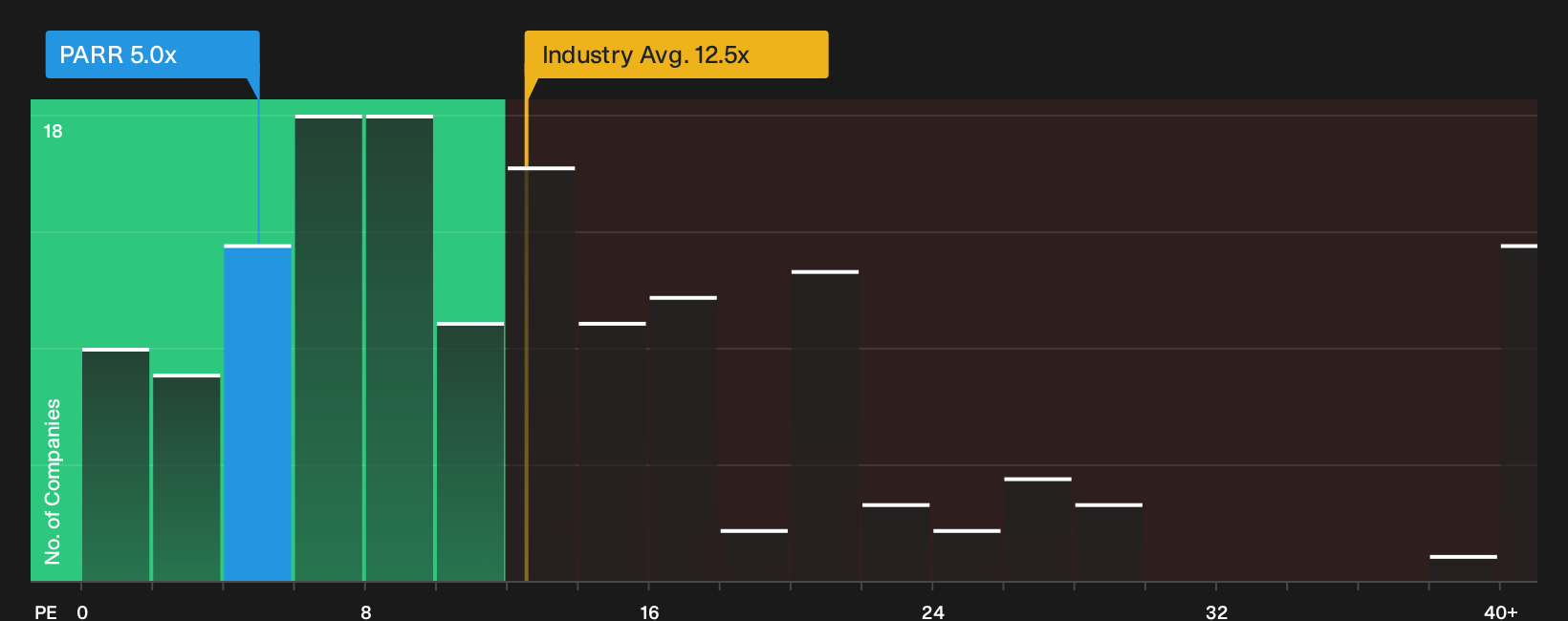
Par Pacific Holdings trades on a P/E of 8.4x, which is well below the Oil and Gas industry average of 13.9x and also below the peer group average of 16.4x. On Simply Wall St's fair multiple framework, a P/E of about 12.7x would be more in line with what might be expected for Par Pacific Holdings given its profile. This level is still comfortably above where the stock trades today.
Because recent coverage has highlighted solid profitability despite revenue pressure, this discount suggests the market is pricing Par Pacific Holdings more cautiously than both its sector and this tailored fair ratio imply. The gap between the current 8.4x and the 12.7x fair multiple indicates a sizeable difference if earnings are maintained.
Overall, Par Pacific Holdings stock appears undervalued on its current P/E multiple.
See what the numbers say about this price — find out in our valuation breakdown.
The Par Pacific Holdings Narrative: What Would Justify Today's Price?
Simply Wall St Narratives for Par Pacific Holdings aim to connect the valuation gap you have just seen with the specific assumptions that would need to hold on growth, margins and earnings for the stock to be worth meaningfully more or less than it trades at today. Hosted on Simply Wall St's Community page, each narrative links a fair value estimate to a particular set of potential catalysts and risks so you can see over time which version of Par Pacific Holdings' story is unfolding.
Par Pacific Holdings attracts very different narratives in the community, with one side focused on upside from projects and buybacks and the other wary of structural and regulatory risks.
Bull case: roughly fairly valued
"Par Pacific's integrated logistics and retail assets are poised to deliver stable, countercyclical cash flows and margin expansion, even during periods of feedstock volatility..."
Read the full Bull Case to see why Par Pacific Holdings could be undervalued
Bear case: 17% overvalued
"Rising electric vehicle use and tougher emissions rules threaten long-term revenue, profitability, and net margins due to lower fuel demand and higher compliance costs..."
Read the full Bear Case to see why Par Pacific Holdings could be overvalued
Do you think there's more to the story for Par Pacific Holdings? Head over to our Community to see what others are saying!
The Bottom Line
Par Pacific Holdings still screens as undervalued on its P/E multiple, which suggests the share price is not fully reflecting the earnings the company is currently generating. The strong score across broader valuation checks points in the same direction, even after a sharp share price move. For investors, the key question is whether refining margins and regulatory pressures evolve in a way that allows current earnings to hold up, or whether the discount simply reflects the risk that profitability proves harder to sustain than the bull case assumes.
This article by Simply Wall St is general in nature. We provide commentary based on historical data and analyst forecasts only using an unbiased methodology and our articles are not intended to be financial advice. It does not constitute a recommendation to buy or sell any stock, and does not take account of your objectives, or your financial situation. We aim to bring you long-term focused analysis driven by fundamental data. Note that our analysis may not factor in the latest price-sensitive company announcements or qualitative material. Simply Wall St has no position in any stocks mentioned.
Have feedback on this article? Concerned about the content? Get in touch with us directly. Alternatively, email editorial-team@simplywallst.com