
Is Bank Of Nova Scotia (TSX:BNS) Undervalued On Bond Issuance And Fee Settlement News?
Bank of Nova Scotia (TSX:BNS) is back in focus after issuing new variable rate debentures and floating rate notes, along with court approval of a $10.45 million settlement over non sufficient funds fees.
See our latest analysis for Bank of Nova Scotia.
Against this backdrop of capital raising and the NSF settlement, Bank of Nova Scotia’s share price has climbed, with a 90 day share price return of 19.44% and a 1 year total shareholder return of 72.71%. This suggests momentum has been building rather than fading.
If these developments have you thinking about where else capital could flow, it may be worth scanning 33 power grid technology and infrastructure stocks as another angle on companies tied to large scale financial and infrastructure needs.
The jump in Bank of Nova Scotia’s share price is clear, but the valuation picture is not, with the stock trading above the average analyst target while still screening at an intrinsic discount. So where does fair value really sit?
Most Popular Narrative: 9% Overvalued
Compared with Bank of Nova Scotia’s last close at CA$125.28, the most followed narrative fair value of CA$115.21 points to a richer market price and sets up a debate around how much future growth is already priced in.
Expansion of banking and wealth management services in high-growth Pacific Alliance countries (Mexico, Peru, Chile, Colombia) positions BNS to capture revenue growth from increasing financial inclusion and rising middle-class demand for loans and investment products, supporting future top-line and earnings expansion.
Accelerated investment in digital platforms, including AI-driven solutions and enhanced online banking capabilities, is expected to drive operational efficiency, reduce costs, and boost net margins through scalable customer acquisition and improved client experiences.
Curious what kind of revenue lift and margin structure this narrative is baking in for Bank of Nova Scotia? The fair value hinges on a specific growth pace, thicker profitability, and a future earnings multiple that together do most of the heavy lifting behind that CA$115.21 figure.
Result: Fair Value of CA$115.21 (OVERVALUED)
Have a read of the narrative in full and understand what's behind the forecasts.
However, the Bank of Nova Scotia narrative can still be knocked off course by weaker loan growth in Canada or a sharper hit from Latin American volatility.
Find out about the key risks to this Bank of Nova Scotia narrative.
Another View on Bank of Nova Scotia’s Valuation
While the most popular narrative tags Bank of Nova Scotia as about 9% overvalued around CA$115 per share, the SWS DCF model points in a different direction. On that approach, BNS at CA$125.28 screens at an intrinsic discount, which raises a simple question: which story do you trust more?
Look into how the SWS DCF model arrives at its fair value.
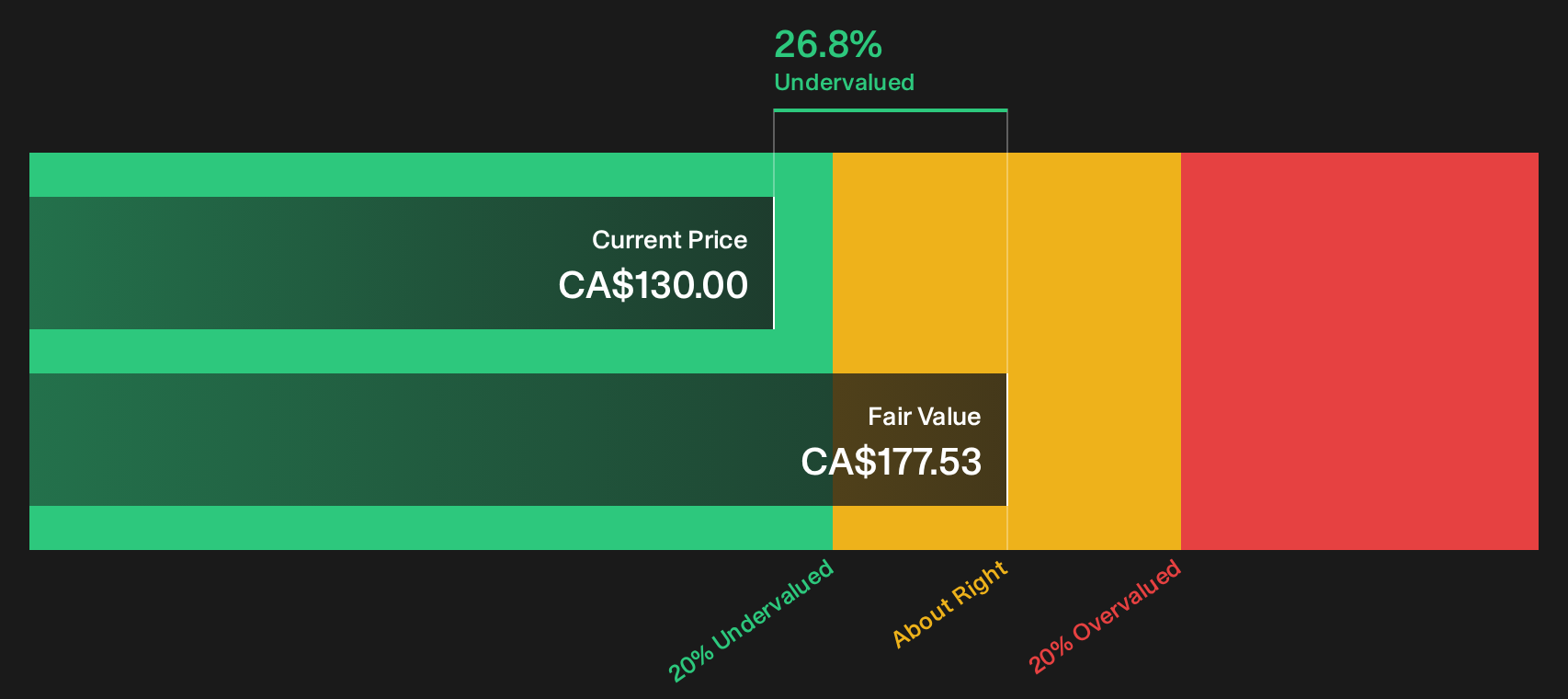
Simply Wall St performs a discounted cash flow (DCF) on every stock in the world every day (check out Bank of Nova Scotia for example). We show the entire calculation in full. You can track the result in your watchlist or portfolio and be alerted when this changes, or use our stock screener to discover 5 high quality undervalued stocks. If you save a screener we even alert you when new companies match - so you never miss a potential opportunity.
Next Steps
If the mixed signals around Bank of Nova Scotia have you torn, act quickly by reviewing both sides of the story and weighing the 4 key rewards and 1 important warning sign
Looking for more investment ideas beyond Bank of Nova Scotia?
Do not stop with Bank of Nova Scotia. Broaden your watchlist now so you can compare this story with other potential opportunities before the next move in markets catches you off guard.
- Target resilience by scanning companies with stronger finances and steadier profiles through the 10 resilient stocks with low risk scores.
- Zero in on quality at a discount by reviewing the 5 high quality undervalued stocks before prices and expectations shift further.
- Build a steadier income stream by comparing payout opportunities in the 6 dividend fortresses.
This article by Simply Wall St is general in nature. We provide commentary based on historical data and analyst forecasts only using an unbiased methodology and our articles are not intended to be financial advice. It does not constitute a recommendation to buy or sell any stock, and does not take account of your objectives, or your financial situation. We aim to bring you long-term focused analysis driven by fundamental data. Note that our analysis may not factor in the latest price-sensitive company announcements or qualitative material. Simply Wall St has no position in any stocks mentioned.
Have feedback on this article? Concerned about the content? Get in touch with us directly. Alternatively, email editorial-team@simplywallst.com