
Is the war in the Middle East getting out of control? Tankers attacked, oil infrastructure bombed, Brent crude oil soared above $90
The Zhitong Finance App learned that after the large-scale escalation of military hostilities between the US and Iran, the international oil price benchmark, the Brent crude oil futures price, rose sharply by 3% during the Asian session on Monday to break through the 90 US dollar super mark, which means the cumulative increase in the global oil price benchmark was as high as 20% in the past week. Recently, a series of escalating geopolitical conflicts include Iran's attack on ships trying to pass energy through the Strait of Hormuz, and a weekend attack on a very critical oil market facility in Kuwait.
The global crude oil benchmark price rose to a high of nearly 4% at the beginning of the Asian market, then recovered some of the gains and was still trading above $90 per barrel, hitting the highest level since mid-June; West Texas Intermediate crude oil (that is, the US WTI crude oil futures price) is close to $84 per barrel. Iran said that the short-term cease-fire agreement with the US has actually broken down, increasing the possibility that energy transportation in the Strait of Hormuz will be interrupted even more severely.
The lifeblood of Hormuz energy is once again in a blockade crisis! Has the US-Iran confrontation slipped from “limited retaliation” to a large-scale energy war?
According to the US Central Command, the US has launched attacks on Iran for nine consecutive nights with the aim of further weakening the country's military capability to attack commercial ships and civilian seafarers. Kuwait also said it is intercepting drone attacks launched by Iran.
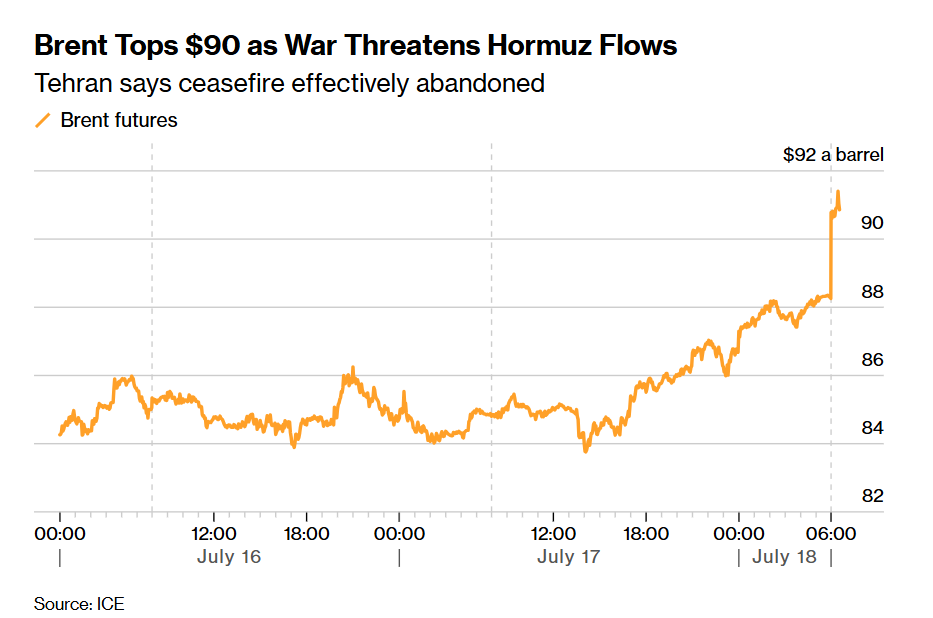
As shown in the chart above, a new round of geopolitical war in the Middle East threatened transportation in the Strait of Hormuz, and Brent crude rose violently to more than $90 — Tehran says the cease-fire has actually been abandoned.
The latest war situation shows that the military confrontation between the US and Iran is indeed showing a marked warming trend. The US has attacked Iran for nine consecutive nights. The targets include the Revolutionary Guard's military capabilities, missile and drone systems, and infrastructure such as transportation and electricity; Iran previously attacked US military facilities in Jordan, causing the deaths of two US soldiers and the disappearance of others, and then firing missiles into Jordan.
According to information, Iran's retaliation has covered Kuwait, Bahrain, Qatar and other Gulf countries with US troops or allies. Kuwait's electricity and seawater desalination facilities have been attacked continuously, and Bahrain, Jordan, and Kuwait have initiated air defense interceptions several times; at the same time, the US has re-imposed a maritime blockade against Iran's ports and shipping. Traffic volume in the Strait of Hormuz has dropped from an average of nearly 140 ships per day before the war to only 3 to 8 ships in a single day recently, indicating that the conflict is evolving from a “point military exchange” to a systematic and comprehensive military confrontation over control of the strait, energy exports, and regional infrastructure.
The Iranian Navy said on Sunday that it had stopped four unidentified ships after ignoring warnings and trying to cross the Strait of Hormuz via a “dangerous route.” Two of them “had an accident and were forced to stop,” while the other two “abandoned the route and immediately made a U-turn back,” the Iranian Navy said.
The British Maritime Trade Operations Office said it has learned from the military department that a boat caught fire northwest of Kumzar, Oman. The agency added that the cause of the fire has not yet been verified.
The one-week mutual attacks between the two sides have gone beyond the goal of pure military action and extended to more Middle Eastern countries, and the US continues to launch larger military attacks on major critical facilities such as bridges, utilities, and ports in mainland Iran, indicating that the possibility of returning to a fragile cease-fire state is very low. KOC said Iran attacked a critical oil facility on Saturday, causing serious damage.
Saul Kavonick, senior energy analyst at MST Marquee, said the continuing escalation of attacks “all indicate that there is still room for further expansion in the scope and duration of this conflict.” To further accelerate the rise in oil prices, “we also need large-scale missile attacks on the region's oil infrastructure, or a situation where the Houthis successfully blocked the Red Sea route.”
At a time when the geopolitical situation in the Middle East was highly tense, the Yemeni Houthis supported by Iran disrupted commercial shipping on a large scale through major channels in the Red Sea. Last week, after launching ballistic missiles and drones into Saudi Arabia, the group's leaders threatened a possible subsequent attack on Saudi oil facilities.
The war in the Middle East is approaching a “zero fault tolerance” moment for the energy market
The escalation of geopolitical hostilities in the Middle East has raised concerns in the market about supply shortages. According to a recent research report released by J.P. Morgan Chase, if China is excluded, global oil stocks are at an all-time low, leaving “almost no room for mistakes” in the global energy market.
Kuwait became the main recipient of Iran's weekend retaliation, and Bahrain was also attacked. Israel said on Sunday that it had intercepted an Iranian drone near the border between Israel and Syria. According to Iranian media reports, the US military attacked Qeshm Island in the Persian Gulf, as well as southern cities including Shadegan.
The US has resumed a full military blockade of the Strait of Hormuz — focusing on preventing Iranian oil tankers from passing through the strait in an attempt to cut off Iran's economic lifeline, and Iran's 24-hour precision attacks on ships surrounding this waterway jeopardize the trade model of oil producers in the Persian Gulf to ship goods through “secret shuttle transportation.” US Secretary of Energy Chris Wright said that the number of ships passing through the Strait of Hormuz has declined, but currently larger tankers are passing through.
ICE European Futures Weekly Futures and Options statistics show that the weekly increase in Brent crude oil long positions hit a record high since December 2016, pulling the overall position back from a seven-month low. For the week ending July 14, asset management institutions increased their net long positions on Brent crude oil by 75,996 lots to 357,154 lots, the biggest weekly increase since December 2016. Overall holdings rebounded sharply from the seven-month low hit a week ago.
The essence of the recent sharp rise in international oil prices is not simply a geographical risk premium; rather, the market is beginning to take into account the late scenario of a further decline in Gulf exports, restrictions on alternative energy transportation routes, and insufficient inventory buffers.
The short-term cease-fire framework between the US and Iran has become unbinding. The targets of the war have expanded from military facilities to shipping, energy, and civil infrastructure. The geographical scope of the exchange of fire has also spread from mainland Iran and the Strait of Hormuz to several Gulf countries, and there is a risk that it will affect Israel and Red Sea routes. However, this is not equivalent to an irreversible full-scale regional war. The key watershed remains whether the facilities of major oil producers such as Saudi Arabia and the United Arab Emirates continue to be attacked, and whether the Houthis actually blocked the Mander Strait.
As far as financial markets are concerned, the most direct pricing chain is rising oil prices — inflation expectations are rebounding — the probability that the Fed's interest rate monetary policy “will maintain high interest rates and last longer” or even return to interest rate hikes is rising — the US dollar index is strengthening — valuations of overvalued technology stocks are under pressure; energy, oil services, refining, and defense assets receive risk premiums, while aviation, transportation, chemicals, and high-debt growth stocks face the double impact of costs and discount rates. Currently, the most important leading indicators are not statements made by both parties, but rather the actual traffic volume in Hormuz, crude oil loading in the Gulf, and the extent of damage to energy facilities.