
AI computing power trading volatility soared to 36%! Goldman Sachs suggests breaking out of the AI crowded racetrack and moving towards “experiential consumption, high-quality compound interest, and mergers and acquisitions alpha”
The Zhitong Finance App learned that at a time when global transactions on topics related to AI computing power infrastructure are drastically fluctuating and reviving market interest in other sectors, Wall Street financial giant Goldman Sachs (Goldman Sachs) is similar to the main strategy of Wall Street peers in the latest — that is, actively urging investors to look beyond AI-related technology stocks.
Recently, the South Korean stock market, which has the title of an “AI computing power weather vane,” has frequently fallen into upside failure and collapse. The Philadelphia Semiconductor Index of the US stock market has plummeted more than 20% from its June high, falling into a technical bear market. In addition, global AI hash-themed stocks and the semiconductor sector have fallen into extreme sharp sell-off due to overcrowded and highly leveraged long positions. The investment trend in the global stock market seems to be shifting to high-quality fundamentals, low momentum, abundant cash flow, and strong fundamentals and defense cycles and this year's gains far less than popular technology stocks Shares.
A team led by Goldman Sachs senior stock strategist Ben Snyder said in a report released on Friday that the volatility of popular AI computing power infrastructure momentum transactions has risen to the highest level in history except during the recession, even though the weighted version of the S&P 500 Index (SP500) continues to hit new highs. The Goldman Sachs strategist team believes that the correlation within the stock market has fallen to the lowest level in history, keeping the overall index volatility low, which also means that the market is experiencing large fluctuations.
The global stock market and even the global financial market in a broad sense are facing a complex superstress test of “large-scale warming of the Middle East geopolitical conflict+return of energy inflation+AI computing power theme momentum deleveraging”: the Philadelphia Semiconductor Index has fallen more than 20% from the June high level and has officially entered a technical bear market; the Korean stock market has become the epicenter of a major reversal in global AI computing power trading due to excessive weight of memory chips, daily rebalancing of single-stock leveraged ETFs, and concentration of retail financing positions.
From the chip deleveraging craze in Seoul to Wall Street's search for “safe havens” through quantitative models, stocks that continue to have strong cash flow, strong balance sheets, and have failed the AI theme for a long time can now be described as a well-deserved “C position” in the stock market — such as the consumer electronics giant Apple (AAPL.US), which continues to have huge cash flow, which is regarded as an “AI laggard” and recently took back the position of “the company with the highest market capitalization in the world.”
The heightened geopolitical risks in the Middle East have undoubtedly made this financial stress test for tech giants more complicated. The renewed escalation of the US-Iran conflict has slowed the passage of oil tankers in the Strait of Hormuz, and Brent crude oil once exceeded 90 US dollars; the strait carries about 20% of global energy transportation, and continued shutdown will reopen the path of energy inflation, pressure on corporate profit margins, and the Federal Reserve's higher and longer pricing path.
Perhaps the most reasonable current market framework is not simply judging “the end of the AI super bull market” or “no brainstorming after a sharp fall,” but rather entering a stage where the surface of the index fluctuates, internal dispersion is extremely high, and cash flow regains pricing power. In the short term, single-share leveraged ETFs, short-term bullish options, and high-momentum exposures that rely solely on valuation expansion should be reduced to hedge oil price and interest rate risks with high-quality balance sheets, defensive cash flow, energy, and some undervaluation cycle assets.
AI momentum is shaking, and capital is tacitly seeking a “second battleground”: Goldman Sachs targets experiential consumption, high-quality compound interest stocks, and mergers and acquisitions
The agency said that the multi-momentum factor it has prepared is highly exposed to AI infrastructure companies, with a focus on semiconductors and high-end technology hardware stocks; over the past three months, the factor's annualized volatility has reached 36%. Goldman Sachs expects that this transaction will still face major challenges in the short term, mainly because hedge fund leveraged positions are still high, and after AI capital expenditure guidelines were drastically raised by a cumulative total of about 100 billion US dollars in the previous quarter, it is unlikely that tech giants in the North American market will once again drastically increase their capital expenditure guidelines during the current earnings season.
In contrast, Goldman Sachs highlighted three themes that it believes have limited correlation with AI-related stocks and are likely to provide alpha attractive investment opportunities: consumer experience companies, high-quality “compound interest growth companies,” and potential large-scale mergers and acquisitions.
The three alternative main lines proposed by Goldman Sachs essentially shift the pricing anchor from “computing power and capital expenditure beta” to “real demand, cash flow compounding, and event-driven alpha”: the experiential consumer basket rose 17% this year, and the growth rate of experience spending on sports, lodging, and entertainment rose from 1% in the first quarter of 2025 to 6% in the first quarter of 2026; high-quality compound interest companies have high return on invested capital, strong balance sheets, and free cash flow, but the relative valuation premium is at the 13th percent since 2016; the US has announced mergers and acquisitions reaching 1.2 trillion US dollars, a year-on-year increase. 32%, providing a catalyst for potential acquisition targets.
Consumer experience leader stocks
The Goldman Sachs strategist team said that these companies, which focus on offline physical consumer experiences, may benefit from continued strong growth in optional consumer spending by high-net-worth groups, and at the same time are relatively less vulnerable to a series of negative effects brought about by disruptions in cutting-edge AI technology.
The agency's specific screening list includes 36 companies in consumer segments such as hotels, cruises, casinos, and entertainment and leisure facilities. This equal-weighted stock mix has bucked the trend and surged 17% since this year, 17 percentage points higher than the equal-weighted optional consumer sector, but its valuation is still below the long-term average benchmark level.
According to the Goldman Sachs research report, experiential consumption spending is growing faster than overall service spending. According to Goldman Sachs estimates, the growth rate of spending on economic activities, including sports centers, parks, museums, gaming, and lodging, has risen from 1% in the first quarter of 2025 to 6% in the first quarter of 2026. In contrast, the overall service expenditure growth rate is about 2%.
Specific companies on Goldman Sachs's screening list include Walt Disney (DIS.US), Marriott International (MAR.US), Royal Caribbean Cruises (RCL.US), Hilton Worldwide (HLT.US), Viking Holdings (VIK.US), Live Nation Entertainment (LYV.US), MGM Hotels International (MGM.US), Wynn Resorts (WYNN.US), Fitness Planet (PLNT.US), and Vail Resorts (MTN.US).
A high-quality compound interest growth enterprise that trades at a discount
Goldman Sachs also selected a stock basket of 15 “compound interest growth companies.” These companies have strong profit growth, a high return on invested capital, a sound balance sheet, and the ability to generate healthy free cash flow.
Although the earnings per share growth rate of companies with median market capitalization of this group of stocks in the past three years has been more than double that of the S&P 500 median companies, this stock basket has lagged behind the equal-weighted S&P 500 index by about 7 percentage points since this year. Goldman Sachs said that this lowered its valuation compared to the benchmark stock index for the US stock market to its lowest level in nearly 10 years.
The expected price-earnings ratio for the median stocks on the screened list is about 22 times, while the equal-weighted S&P 500 index is 16 times, equivalent to a valuation premium of 37%; since 2016, this premium has only been in the 13th percentile. Goldman Sachs said that the improved profit growth rate and favorable macroeconomic background may help narrow this valuation gap.
According to information, the companies that entered the Goldman Sachs screening list include Mastercard (MA.US), Visa (V.US), Booking Holdings (BKNG.US), Marriott International (MAR.US), Maxon (MCK) .US, Dekang Healthcare (DXCM.US), Insulet (PODD.US), Morningstar (MORN.US), and MSCI Index Compiling Company (MSCI.US).
Acceleration of mergers and acquisitions
As large-scale trading activity continues to recover in the US market, Goldman Sachs is also optimistic about the significant potential alpha investment opportunities contained in companies seen as potential acquisition targets.
Goldman Sachs said that so far this year, the scale of mergers and acquisitions announced in the US market has reached 1.2 trillion US dollars, a significant increase of 32% over the same period last year; at the same time, the number of transactions announced each month since 2026 has increased. The computer and electronics industry and the healthcare industry as a whole together account for approximately 40% of announced mergers and acquisitions.
Goldman Sachs attributed the stronger M&A environment to favorable financial conditions, steady economic growth, good trends in CEO confidence, and a supportive local regulatory environment. The agency's analysts generally believe that the current round of large-scale mergers and acquisitions is about half complete.
The agency's “merger and acquisition stock basket” of 71 potential acquisition candidates has been significantly 8 percentage points higher than the equal-weighted S&P 1500 index since the end of the first quarter. Goldman Sachs said that the current valuation still does not reflect an abnormally high probability of acquisition or formal merger and acquisition, especially outside of the biotech industry; in the biotech sector, expectations for large-scale mergers and acquisitions seem to have been partially reflected in stock prices.
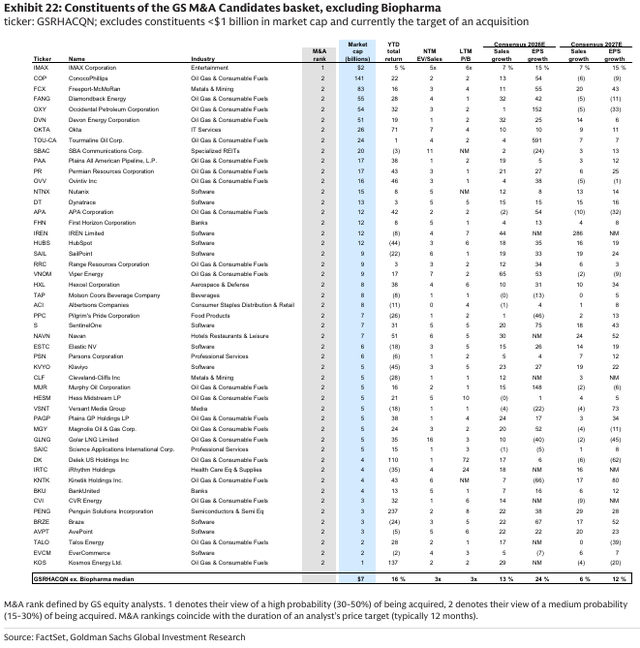
The above chart shows the 71 potential acquisition target companies in the US stock market selected by Goldman Sachs.
From chip frenzy to embracing cash flow: after the Philadelphia Semiconductor Index crashed into a bear market, global capital sought a second battleground other than AI
In the past two months, the investment strategy and style index for buying quality stocks performed best among the eight segments that Barclays Plc (Barclays Plc.) has tracked over time. As the risk of selling around AI computing power infrastructure and popular semiconductor stocks swept through global financial markets, neglected quantitative security transactions returned strongly. Recently, stock market investors' concerns about AI computational power-themed transactions have continued to increase, and investors have begun to seek refuge in a simpler corner of the stock market: companies with long-term stable financial conditions.
According to data compiled by Barclays, last year, Wall Street institutional investors obsessed with AI-themed transactions basically abandoned undervalued basic high-quality stocks with abundant cash flow, causing a valuation index to fall close to the lowest level in history. Today, as the market's concerns about overcrowded and leveraged AI positions and the Federal Reserve's interest rate path increase, this investment style is being revived.
AI computing power infrastructure transactions have moved from a one-sided momentum market to a stage of high volatility, de-crowding, and capital return verification. Portfolios need to reduce their dependence on the single factor of semiconductors and technology hardware. It is highly exposed to the multi-momentum factor of the AI computing power industry chain. The annualized volatility rate has risen to 36% in the past three months, reaching a rare level during the non-recession period; hedge fund holdings are still high, while hyperscale technology companies have increased their capital expenditure guidelines by about $100 billion in the previous quarter, and the probability of another increase on the same scale in this earnings season is limited. The correlation between stocks is at a very low level, so that the equal-weighted S&P 500 can still reach a new high. This also means that it is currently closer to internal clearance of AI crowded transactions and the expansion of market breadth, rather than the collapse of overall demand in the US stock market.
The Korean and US semiconductor markets revealed the microscopic mechanism of this round of adjustments: the Philadelphia Semiconductor Index has fallen by more than 20% from its peak in June and has entered a technical bear market; South Korea's KOSPI also fell more than 20% from a record high. The high index weight of Samsung Electronics and SK Hynix combined single-stock leveraged ETFs, guaranteed financing and trend capital concentrations, quickly turning fundamental profit questions into mechanical rebalancing, stop-loss, and closing and selling. As a result, South Korean regulators suspended the listing of related new products and raised the minimum deposit for retail investors to participate in single-share leveraged ETFs to 30 million won. It can be seen from this that global capital does not completely deny the demand for AI computing power, but rather reduces risk exposure with high leverage, high momentum, high valuation, and relies on capital expenditure to support continuous acceleration.
The three main alternative lines proposed by Goldman Sachs — experiential consumption, high-quality compound interest, and mergers and acquisitions alpha — essentially shift the pricing anchor from “computing power capital expenditure beta” to “real demand, cash flow compounding, and event-driven alpha”, reducing the correlation between consumption, discounted high-quality stocks and M&A candidates — the next stage will no longer be “AI related”, but profits and cash flow can also be realized without continuing to increase leverage.