
Nvidia Turns to a Japanese Giant to Solve the Power Botteneck. What That Means for NVDA Stock.
Nvidia (NVDA) is reportedly in early talks with Mitsubishi Heavy Industries (MHVIY) to supply cooling systems and energy management equipment for artificial intelligence (AI) data centers. This might sound like a minor supply agreement, but it could lead to a major positive shift for Nvidia.
Currently, Nvidia chips run so hot and draw so much power that data centers are struggling to cool them off. The company's latest Rubin chips are designed to run entirely on liquid cooling, needing large, dedicated cooling systems around them to work. Without that setup, the chips cannot perform. If the Nvidia-Mitsubishi collaboration takes place, the Japanese group would provide a system that ties high-efficiency cooling, air conditioning, and emergency power together to cool down both the chips and accompanying infrastructure.
That is why the partnership matters for Nvidia. The potential deal would help the high-performance GPU market leader to further improve its GPU performance for AI data centers. Nvidia intends to roll out its next-generation data centers called AI factories with partners around the world. In Japan, it is already working with South Korea’s SK Group — the parent company of SK Hynix (SKHY) — on an AI factory due by 2028 or 2029. Mitsubishi Heavy fits the same plan. For Nvidia, locking in partners who can handle the heat and power problem is now just as important as making the chips themselves.
About Nvidia Stock
Nvidia is a technology company best-known for designing GPUs and AI accelerators used in data centers, gaming, and automotive systems. The company also develops networking hardware and the CUDA software platform that powers much of the AI industry. Founded in 1993, the company is headquartered in Santa Clara, California, and led by CEO Jensen Huang.
Over the last 12 months, NVDA stock is up 18%, notably underperforming the iShares Semiconductor ETF (SOXX), which as more than doubled over the same period. The underperformance is striking for a company widely seen as the backbone of the AI boom.
Nvidia stock recovered well from the $165 mark in late March to a 52-week high of $236.54 in mid-May. Although NVDA stock has recently seen a slight dip on concerns over reported delays for its next-generation chips, demand for its products remains strong.
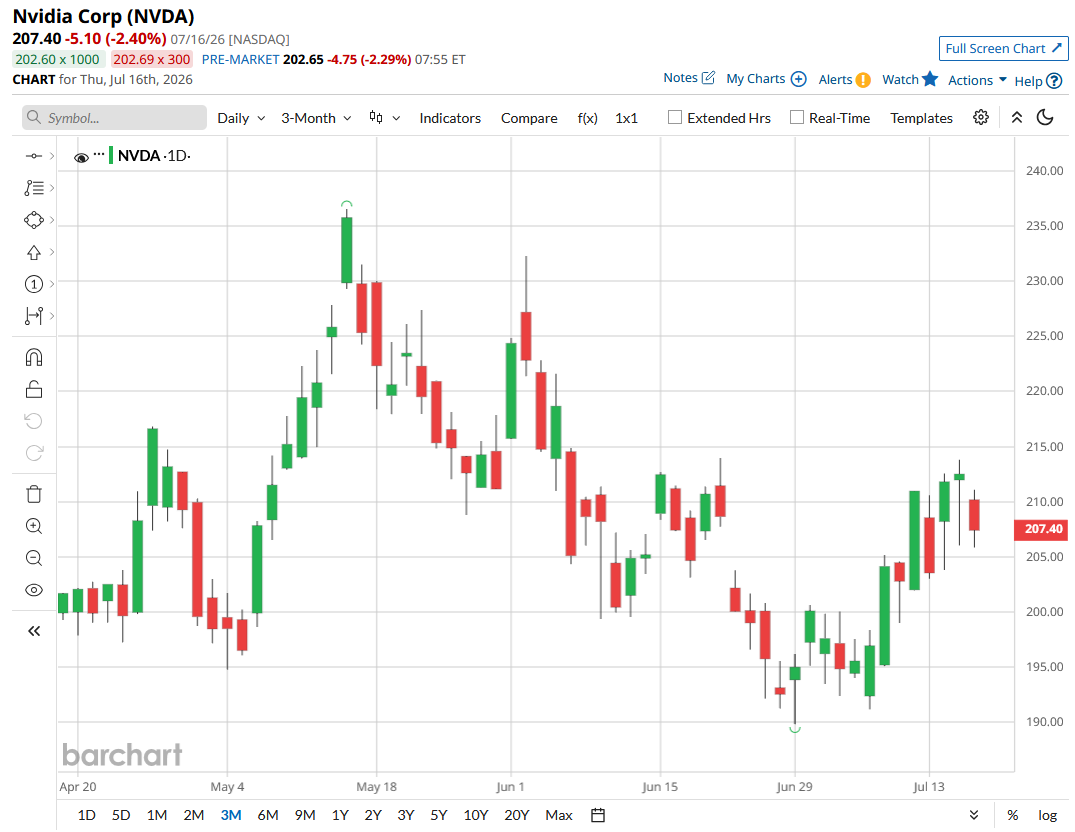
The valuation is perhaps the strongest argument against recent delay concerns. The forward price-to-earnings (P/E) ratio of 23.5 times is well below the company’s own five-year average of 45 times. Meanwhile, the forward price-to-sales (P/S) ratio of 23.2 times is roughly in-line with the five-year average. NVDA stock is now relatively cheaper than it has historically been, even as its business continues to grow rapidly. This is important because, with shares already trading at a discount, there is less room for the delay concerns to push the stock much lower.
The EPS growth trajectory makes Nvidia's valuation look even more attractive, with 92% growth expected in fiscal 2027, followed by an estimated 38% increase in fiscal 2028. The balance sheet should also strengthen investor confidence, with the company being net cash positive by more than $40 billion.
Overall, Nvidia's valuation, rapid growth, and clean balance sheet suggest that the market might be overreacting to chip delay concerns.
Nvidia Reports 85% YOY Revenue Growth
Nvidia announced its first-quarter fiscal 2027 earnings on May 20. The company reported revenue of $81.6 billion, up 85% year-over-year (YOY), beating the consensus estimate of $79 billion. EPS came in at $1.87, surpassing market expectations of $1.77 and resulting in an almost 6% earnings surprise.
Nvidia noted significant growth across its major business segments, particularly in data centers and AI infrastructure, with a GAAP gross margin of 74.9%. Additionally, the firm saw record free cash flow of $48.6 billion, up from $34.9 billion in the previous quarter. Nvidia raised its quarterly dividend from $0.01 to $0.24.
For Q2, Nvidia expects revenue of $91 billion, while gross margin is anticipated to be a healthy 75%. For full-year fiscal 2027, the company expects operating expenses growth to be somewhere in the upper 40% range on a YOY basis.
What Are Analysts Saying About Nvidia Stock?
On July 10, Morgan Stanley analyst Joseph Moore reiterated a “Buy” rating on Nvidia. The analyst also assigned a price target of $288 to NVDA stock. Overall, the AI tailwind has driven a bullish view among analysts, with other experts also assigning positive ratings. Similar to Morgan Stanley, Bank of America Securities has a “Buy” rating and a price target of $350.
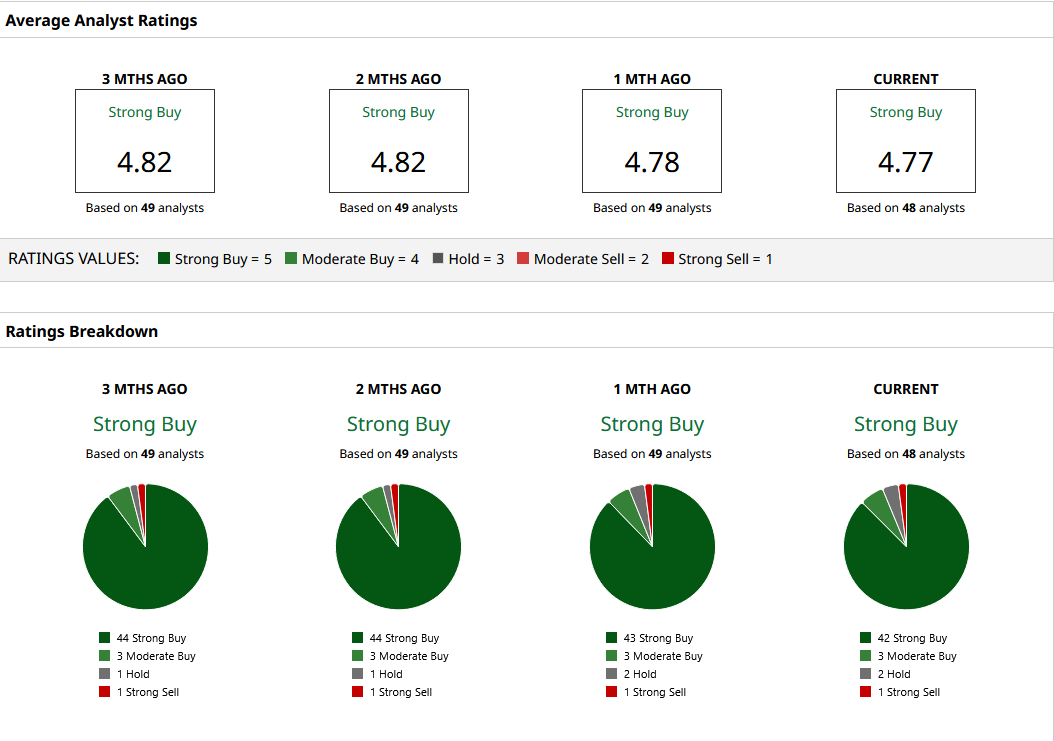
Based on 48 Wall Street analysts with coverage, NVDA stock holds a consensus “Strong Buy” rating. Out of those analysts, 42 have a “Strong Buy” rating, three have a “Moderate Buy,” two analysts have a “Hold” rating, and one has a "Strong Sell' rating. The mean price target of $303.05 implies potential upside of 49% from current levels, reflecting strong confidence in Nvidia’s long-term growth prospects.
On the date of publication, Jabran Kundi did not have (either directly or indirectly) positions in any of the securities mentioned in this article. All information and data in this article is solely for informational purposes. For more information please view the Barchart Disclosure Policy here.