
Market Correction: This ETF Could Be a No-Brainer Buy if a Bear Market Is Coming
Key Points
The Vanguard S&P 500 ETF has delivered 15% annualized returns for almost 16 years.
The fund tracks the S&P 500 and could offer better protection against a downturn in AI-related tech stocks.
One of the biggest debates in the investment world so far in 2026: "Is the artificial intelligence (AI) trade overpriced?" Major tech companies have been spending hundreds of billions of dollars on AI data centers and other capex, but some investors are worried that the spending won't pay off, and that AI stocks are overvalued.
On Friday, the tech-heavy Nasdaq-100 index dropped by 1.5%, driven largely by declines in semiconductor stocks. A Chinese AI start-up called Moonshot recently released a new AI model that could potentially compete with America's leading AI start-ups. As a result of these uncertainties, investors seem to be selling off chip stocks and AI stocks and rotating money into other assets.
Missed Nvidia in 2009? This Rare Signal Is Flashing Again. In 2009, a "Double Down" signal flashed for a little-known chipmaker called Nvidia. For the first time in years, that same "Total Conviction" signal is flashing for a company 1/100th the size of Nvidia. Continue »
It's too soon to say that a bear market is coming for the Nasdaq-100, let alone the wider U.S. stock market. But if you're concerned about high valuations of tech stocks, the Vanguard S&P 500 ETF (NYSEMKT: VOO) might be a good buy. This is one of the most popular exchange-traded funds (ETFs) in the world. No matter what happens next with AI stocks or the overall stock market, buying this S&P 500 ETF is generally a good move for long-term investors.
Let's look at the Vanguard S&P 500 ETF and see if it's a good choice for your portfolio.

Image source: Getty Images.
Vanguard S&P 500 ETF: 506 stocks, nearly 16 years of 15% annualized returns
The Vanguard S&P 500 ETF ranks as one of the best ways to buy the entire S&P 500 index. This fund holds 506 stocks and charges an ultra-low expense ratio of 0.03%. The ETF is up 9.6% year to date. It has delivered average annual returns (by net asset value) of about 22.3% over the past year, 20.6% for the past three years, and 13.4% for the past five years.
In the past nearly 16 years since the VOO fund's inception in September 2010, it has delivered average annual returns of 15.03%. That's an impressive run, considering that the S&P 500's long-term average return is about 10% per year.
Why buy VOO in case of a bear market?
No one knows what's going to happen next with any sector of the economy or stock. But if the AI boom turns out to be an overheated bubble, it's likely that the Nasdaq-100 index would go through a larger downturn. The S&P 500 might also decline if AI stocks enter a bear market, but the downturn would likely be less severe.
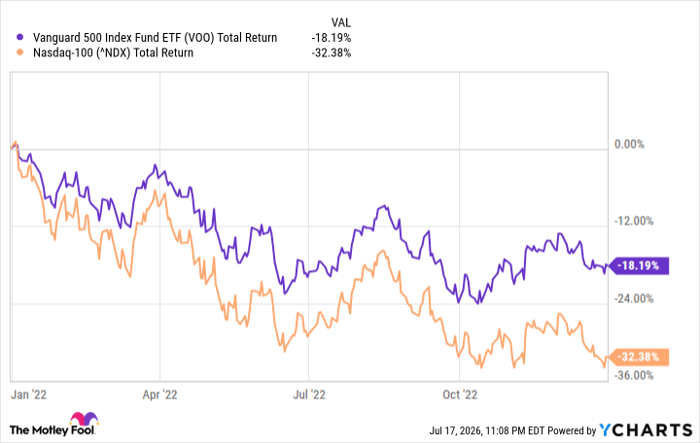
We saw this happen during the most recent bear market in 2022. The Nasdaq-100 lost 32.4% of its value that year, while VOO (which tracks the S&P 500) declined by 18.2%:
VOO Total Return Level data by YCharts
Over time, the S&P 500 index adds or drops stocks from its listing based on which companies are growing and gaining value. Today's losing stocks get replaced by tomorrow's winning stocks automatically. That's a big reason why buying the Vanguard S&P 500 ETF is often a smart move for long-term investors -- it puts the 500 largest U.S. companies into your portfolio at a low price, with automatic diversification.
Investing in the Vanguard S&P 500 ETF is almost always a winning proposition in the long run, even if the stock market goes down in the next year or so.
Ben Gran has no position in any of the stocks mentioned. The Motley Fool has positions in and recommends Vanguard S&P 500 ETF. The Motley Fool has a disclosure policy.