
When Will Bonds Break Free of the Long-Term Consolidation?
I asked if negative sentiment in bonds was a reason to buy in a May 14, 2026, Barchart article, when I concluded with the following:
I favor a long position in TLT as sentiment in the U.S. government bond market remains overly bearish. At $84.73 per share, the risk-reward ratio of the trading range favors the upside by nearly 1:12 based on the range since 2024. A short squeeze in the U.S. long-term bond market could create a profitable environment for long TLT positions at $84.73 per share.
In mid-May 2026, I favor a long position in TLT with a stop below $82 and, if the U.S. long bond futures fall below the 107 level. The path of interest rates over the coming weeks and months will impact commodity prices as financing production and inventories depend on rates. Moreover, higher rates tend to impede economic growth, while lower rates support it.
The long bond futures were at the 112 level on May 13, with the TLT ETF trading at $84.73 per share. On July 20, the bonds were lower at 110-25, with the TLT trading at $83.98. TLT fell to a low of $82.77 per share on May 19 but did not fall below the stop level. I remain cautiously bullish on bonds and TLT in July 2026.
The range trading continues in the long bond futures
After the 44.1% decline from the March 2020 high of 191-22 to the October 2023 low of 107-04, the U.S. 30-year Treasury Bond futures have traded in a narrow range.
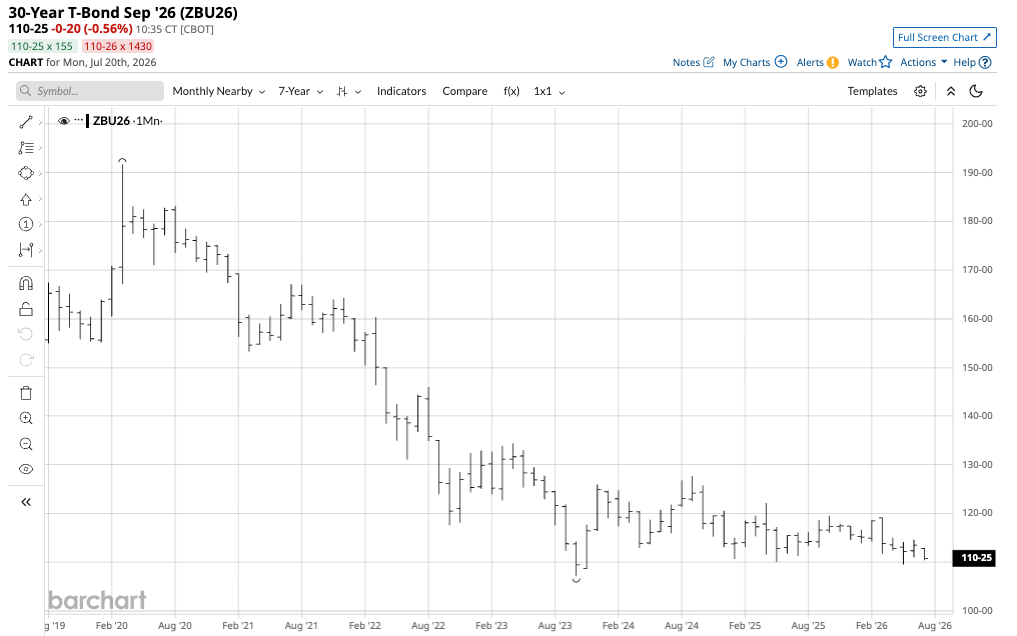
The 7-year monthly chart shows that the long bond futures settled into a 108-17 to 127-22 trading range since November 2023. At 110-25 on July 10, 2026, the bond futures were not far above the low end of the range.
TLT’s trading range mirrors the bonds
After the 54.1% decline from the March 2020 high of $179.70 to the October 2023 low of $82.42, the iShares 20+ Year Treasury Bond ETF (TLT) traded in a narrow range.
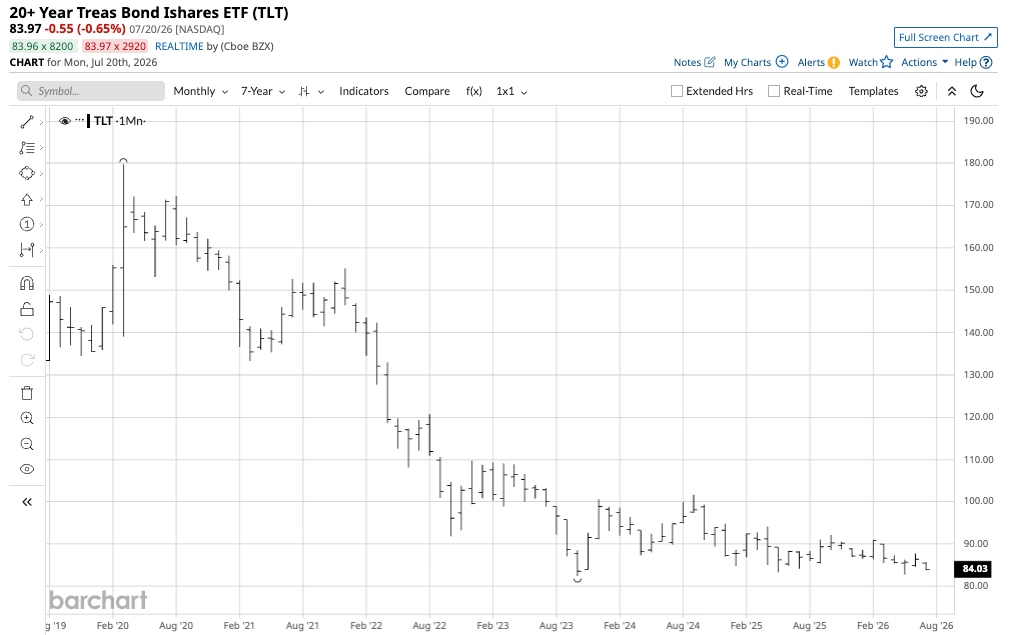
The 7-year monthly chart shows that the TLT ETF has settled into an $84.02 to $101.64 trading range since November 2023. At $83.97 on July 20, 2026, the TLT was below the low end of the range and just above support at the October 2023 low of $82.42 per share.
The case for lower rates over the coming months
The case for lower interest rates over the coming months includes:
- WTI crude oil prices have declined from nearly $120 to below $82 per barrel, which could lead to lower inflationary data over the coming months.
- The Fed has left short-term interest rates unchanged throughout 2026, but Chairman Kevin Warsh could change the Fed’s monetary policy approach, which favors the Trump administration’s desire for lower rates.
- The long bond futures and TLT have remained above their October 2023 lows, which are the critical technical support levels.
- Lower rates would expand affordability for home buyers.
- Homeowners locked into fixed-rate high-interest loans could refinance, leading to lower monthly payments.
- Financing costs for the nearly $40 trillion U.S. debt will decline as interest rates fall.
- Lower rates will stimulate corporate growth and the employment market by reducing business funding costs, accelerating technology innovation, and protecting employment.
- The turbulent geopolitical landscape could trigger sudden market volatility, prompting market participants to buy U.S. government debt securities, which tend to rise during risk-off periods.
These factors favor lower short, medium, and long-term interest rates over the coming months.
The risks that could send rates higher and the bonds and TLT lower
The issues that can send bonds and TLT lower and interest rates higher include:
- The U.S. debt, at nearly $40 trillion, threatens the full faith and credit of the U.S. government and could cause credit downgrades.
- De-dollarization and the bifurcation of the world’s nuclear powers could reduce the dollar’s purchasing power, leading to higher interest rates.
- The Middle East remains highly volatile. Sudden spikes in crude oil and oil product prices that increase inflationary pressures could send interest rates higher.
- The upcoming U.S. midterm elections could cause significant policy shifts, increase uncertainty, and lead to higher interest rates.
- The rise of socialist candidates that support government ownership of the means of production could cause economic upheaval, leading to higher interest rates.
These factors favor continued elevated interest rates and the potential for higher rates over the coming months.
Risk-reward favors the upside for bonds and TLT
As an optimist, I believe that the bullish case for bonds and TLT outweighs the bearish case in July 2026. However, unless there are dramatic surprises, I do not see the bonds or TLT breaking through the bottom or top end of the trading range in place since late 2023.
The odds favor a bounce from near the low end of the trading range to the top end. While the trend is skewed lower, the first technical resistance level for TLT is at the February 2026 high of $90.86, 8.2% above the current level. The first technical resistance level in the long bond futures is at 119-06, 7.6% above the current level.
I do not see the bonds or TLT breaking substantially below the low or above the high end of the trading range since late 2023 in 2026. However, there are likely trading opportunities on the horizon as the markets move within their respective ranges. Meanwhile, interest rates significantly impact raw material prices as they determine the costs of financing production and carrying inventories. Lower rates tend to support higher raw material prices, while high rates can put pressure on prices.
On the date of publication, Andrew Hecht did not have (either directly or indirectly) positions in any of the securities mentioned in this article. All information and data in this article is solely for informational purposes. For more information please view the Barchart Disclosure Policy here.