
The surge in AI electricity orders is difficult to withstand the headwinds! GE Vernova (GEV.US) Q2 profit falls short of expectations, tariff costs and wind power losses suppress prospects
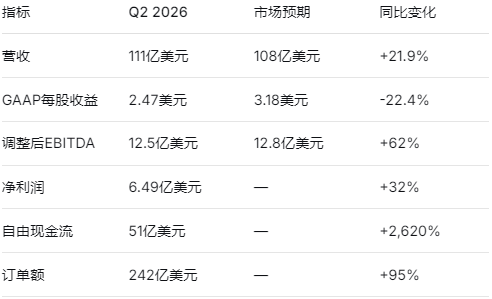
The Zhitong Finance App learned that GE Vernova (GEV.US) announced its second-quarter earnings report before the market on Wednesday. The energy giant, which was spun off from General Electric, soared to US$11.1 billion in revenue for the quarter at a year-on-year growth rate of 21.9%, easily exceeding market expectations of US$10.8 billion. However, GAAP earnings per share were only $2.47, which was a significant decrease of 22.4% from analysts' unanimous expectations of $3.18. What worries the market even more is that the company warns that 2026 global tariffs will bring additional costs of about 100 million to 200 million US dollars, compounded by continued deep losses in the wind power business. The stock price once fell more than 8% during pre-market trading. As of press release, the decline had narrowed to 5.6%.
Core financial data: revenue exceeds expectations, profit indicators are poor
According to financial reports, GE Vernova's adjusted core profit for the second quarter was US$1.25 billion, lower than the average analysts' expectations of US$1.28 billion in LSEG statistics. The company made it clear that global tariffs will increase costs by about 100 million to 200 million US dollars in 2026. Although part of the cost can be offset through contract protection and cost recovery measures, this pressure highlights the general difficulties faced by manufacturers as global trade barriers increase.
In terms of profit quality, the company's net profit for the quarter was 600 million US dollars, with a net profit margin of 5.8%; the adjusted EBITDA profit margin increased sharply by 340 basis points year-on-year to 11.3%. GE Vernova CEO Scott Strazik said, “Global demand for our products and solutions continues to grow, and the company's momentum is growing.”
Orders surged 88%, and AI data centers became the core engine
GE Vernova's brightest performance indicator for the quarter was orders. The company reported second-quarter order volume of US$24.2 billion, almost double that of US$12.4 billion in the same period last year, and an organic increase of 88%. By the end of the quarter, the company's backlog of orders had reached US$176 billion, an increase of US$13 billion over the previous quarter.
The core driver of the surge in orders is the power demand for AI data centers. The company's electrification division's core profit for the quarter reached US$671 million, a year-on-year increase of more than double. The department's second-quarter orders organically increased 66% to US$6.3 billion. Year-to-date data center orders have exceeded US$5 billion, more than double the total volume for the full year of 2025. The AI boom continues to spread from computing power layers such as chips and servers to the “physical layer” of power infrastructure.
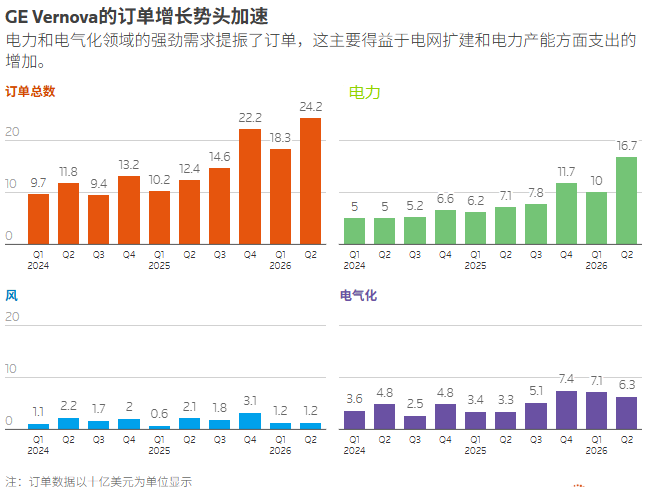
The electricity sector also performed strongly, with core profit of $1.03 billion, up about 31.3% year over year. The department signed a new contract for 20 gigawatts of gas turbine equipment, increasing the backlog of gas equipment orders from 100 gigawatts to 116 gigawatts. The company expects to reach at least 125 gigawatts by the end of 2026. Currently, about 20% of gas power generation business orders come from data centers and AI-related projects, and the company's orders have been scheduled for 2030 or even 2031.
The three major business segments: electrification and electric power are booming, and wind power is the only “bleeding point”
The electrification sector is a well-deserved growth champion. The division's core profit jumped from US$314 million in the same period last year to US$671 million, and data center orders have surpassed US$5 billion since the beginning of the year, which is more than double the total for the full year of 2025. The demand for power grid upgrades brought about by the expansion of AI computing power continues to inject strong momentum into this sector.
The electricity sector also performed well, with core profit of US$1.03 billion, an increase of 31.3% over the previous year. Orders for gas turbine equipment continue to be strong, and the company has now drastically raised the gas equipment contract forecast for the end of 2026 from at least 100 gigawatts to 125 gigawatts.
The wind power sector was the only “bleeding point” in the financial report. Wind power revenue fell by about 10% during the quarter to US$2.03 billion, and core losses widened to approximately US$275 million. Onshore equipment delivery continues to weaken, and the problem of historical contract cost inversion for offshore wind power is still fermenting. Previously, losses in the wind power sector in the first quarter had increased from US$146 million in the same period last year to US$382 million. Continued deterioration in the second quarter showed that the sector's plight was far from over.
The shadow of tariffs: 2026 cost impact of 100 million to 200 million US dollars
While AI-driven electricity demand is bringing dividends to electrification and the electricity sector, global trade barriers are becoming a cost pressure that cannot be ignored.
GE Vernova made it clear on Wednesday that 2026 global tariffs will increase its costs by about $100 million to $200 million. The company previously estimated the annual tariff impact to be between 250 million and 350 million US dollars in earlier guidelines. This time, the figure was further clarified in the range of 100 million to 200 million US dollars. Although it has narrowed, it still constitutes a continuous erosion of profitability.
The impact of tariffs on the wind power business is particularly significant. The decline in onshore equipment deliveries has been partly due to the impact of tariffs, while offshore wind power projects are already facing cost overspending pressure, and the compounding effects of tariffs have further exacerbated the sector's losses.
Significant increase in 2026 guidance: free cash flow target nearly doubles
Despite the double pressure of tariff headwinds and wind power losses, GE Vernova drastically raised its financial guidance for the full year 2026 based on strong order reserves and cash generation capacity:
Revenue guidance: increased from $44.5 billion to 45.5 billion US dollars to 45.5 billion US dollars to 46.5 billion US dollars;
Free cash flow guidelines: A sharp increase from the previous 6.5 billion to 7.5 billion US dollars to 11.5 billion US dollars, almost doubling;
Adjusted EBITDA margin: remained unchanged at 12% to 14%;
The near doubling of free cash flow guidance is the biggest highlight of this increase. Free cash flow for the second quarter reached US$5.1 billion in a single quarter, more than the total for the full year of 2025. The company's cash balance at the end of the period reached US$13.1 billion, and the capital of US$3.9 billion has been returned to shareholders since the beginning of the year.
CFO Ken Parks said, “Based on our strong financial performance, we have raised our full-year revenue and free cash flow expectations.”
Market Reaction: Heavy Pre-Market Setbacks Reveal Market “Selective Pricing”
Despite many highlights in the financial report — revenue exceeding expectations, doubling orders, surging free cash flow, and a sharp increase in full-year guidance — the market gave a decline of nearly 8% in pre-market trading.
This seemingly contradictory response reveals the current market's “selective pricing” logic for GE Vernova:
First, the differentiation of profit quality. GAAP earnings of $2.47 per share were 22.4% lower than expected, and the adjusted EBITDA of $1.25 billion was also lower than the forecast of $1.28 billion. While revenue exceeded expectations, profit indicators were generally poor, indicating that cost pressure is eroding profit margins.
Second, the “bleeding” effect of the wind power business. The continued deterioration of the wind power sector has evolved from a “short-term disturbance” to a “structural drag.” If the trend of loss of 382 million US dollars in the first quarter and another loss of 275 million US dollars in the second quarter continues, wind power losses for the whole year may be close to 1 billion US dollars.
Third, the long-term uncertainty of tariffs. Although the increase in tariff costs of 100 million to 200 million US dollars is definitely not significant, in the current context where global trade frictions continue to escalate, the market is concerned that this figure may only be the beginning.
Fourth, there is little room for fault tolerance in high valuations. Prior to the release of the financial report, GE Vernova's stock price had accumulated a cumulative increase of about 62% during the year, with an increase of 100% over the past 12 months. The company's current forward price-earnings ratio is about 30 times, which is already high for a company considered a utility-related enterprise. In an overvalued environment, any “miss” is likely to be amplified.
Outlook: Focus on whether the structural dividend of AI power demand can hedge against multiple headwinds
GE Vernova is at a crossroads where structural growth and structural headwinds coexist. On the growth side, the explosive growth in electricity demand driven by AI data centers is an undisputed long-term trend. The electrification sector's data center orders have surpassed $5 billion, and the electricity sector's gas equipment contract is expected to rise to 125 gigawatts — behind these figures is a real and irreversible wave of investment in energy infrastructure.
Looking at the headwind side, continued losses in the wind power business, uncertainty about tariff costs, and the disconnect between profit indicators and revenue growth constitute a triple resistance to suppressing valuations. The company has previously warned that the wind power sector will lose about 400 million US dollars a year in 2025 and 2026, but the actual situation may be even more serious.
However, Wall Street as a whole remains positive about GE Vernova. According to the data, all 30 analysts covering the stock gave a “buy” rating, none “sell”, and the consensus target price was around $1,221.48. TipRanks' earnings conference call sentiment analysis also showed that the overall tone was “positive” — positive factors such as strong order growth, backlog expansion, improved profit margins, and higher guidance significantly exceeded negative impacts such as wind power losses and tariffs.
Despite this, this “ice and fire” financial report shows that the path to this target price is by no means an easy one. What the market needs is not only a grand narrative of AI power demand, but also a clear path for wind power to turn losses into profits and effective hedging against tariff headwinds. These require companies to provide a clearer signal.