
How 5 Giant Stocks Are Causing a Potentially Nuclear Debt Headache for the U.S. Stock Market
Five of the biggest U.S. stocks are amassing off-balance sheet commitments that add up to an estimated $1.65 trillion. That’s with a T!
A study by Nikkei analyzing recent financial disclosures reveals that off-balance-sheet commitments across five major U.S. technology companies— Alphabet (GOOGL), Microsoft (MSFT), Amazon (AMZN), Meta Platforms (META), and Oracle (ORCL) have surged to $1.65 trillion. This figure represents an eightfold increase over roughly four years and now exceeds the $1.35 trillion in explicit debt recorded on their balance sheets.
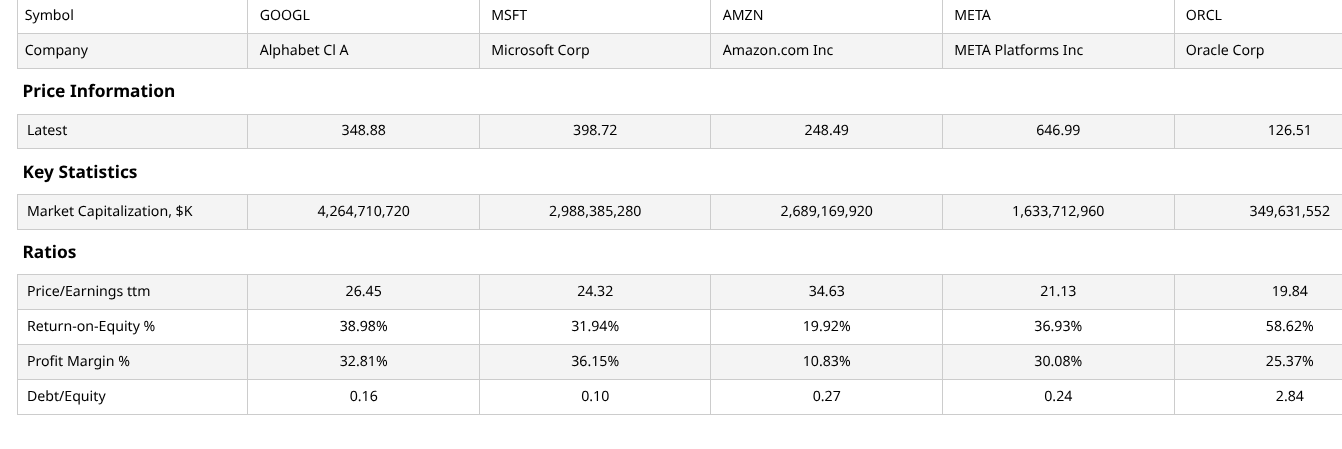
As we can see above, the stocks are at different valuation levels, but all fairly reasonable at 20x-25x trailing earnings, with the exception of AMZN at 35x. The concern going forward is that profit margin row and the debt/equity row below it. These companies quickly went from cash cows to “all in” on AI spend. That might work out.
But it completely changes the way we look at them.
These unrecorded financial obligations consist primarily of long-term data center leases, multi-year semiconductor supply agreements, and joint-venture guarantees designed to secure hardware and facilities for artificial intelligence workloads.
The Mechanics of Off-Balance-Sheet AI Financing
To construct the physical infrastructure required for large-scale computing without instantly expanding reported debt ratios, tech firms utilize deferred accounting mechanisms allowed under current financial standards. Costs associated with long-term facility leases or server purchase orders are detailed in footnotes rather than recognized as primary balance-sheet liabilities until facilities become fully operational or equipment is delivered.
The specific concentration of these commitments varies by company:
- META: Off-balance-sheet liabilities reached approximately $420 billion, roughly 2.8 times its recorded balance-sheet debt.
- ORCL: Unrecorded commitments expanded to $273 billion — a 30-fold increase over four years — driven largely by long-term capacity agreements for computing projects including the Stargate data center initiative linked to OpenAI.
- GOOGL, MSFT, and AMZN: This Magnificent Seven subset holds substantial long-term power purchase agreements, server acquisition commitments, and facility leases alongside reported cloud services backlogs.
The expansion of off-balance-sheet obligations shifts the risk profile of major technology firms from capital-light software models to asset-heavy infrastructure operations. Why does this matter to investors? Because the main financial risk it creates is due to a duration mismatch between hardware obsolescence and long-term lease terms.
Specifically, graphics processing units (GPUs) and specialized server hardware typically experience replacement cycles of 18-36 months due to rapid technological iteration. In contrast, data center leases and facility commitments run on 5-20-year horizons.
If end-user demand for computing capacity falls short of current projections, companies remain legally obligated to service these multi-year lease payments while holding hardware that depreciates rapidly. Credit rating agencies have already noted this, as “shadow borrowing” obscures the true level of financial leverage carried across the sector.
If you ask tech executives, they’ll explain that these forward commitments are backed by contracted future demand. As of the first quarter, the combined cloud business order backlog for Microsoft, Amazon, and Alphabet stood at $1.45 trillion. Not bad. But the question is how sustainable it is. AI adoption is still a wildcard. Not that it won’t change our lives, but how much will people and companies pay for it?
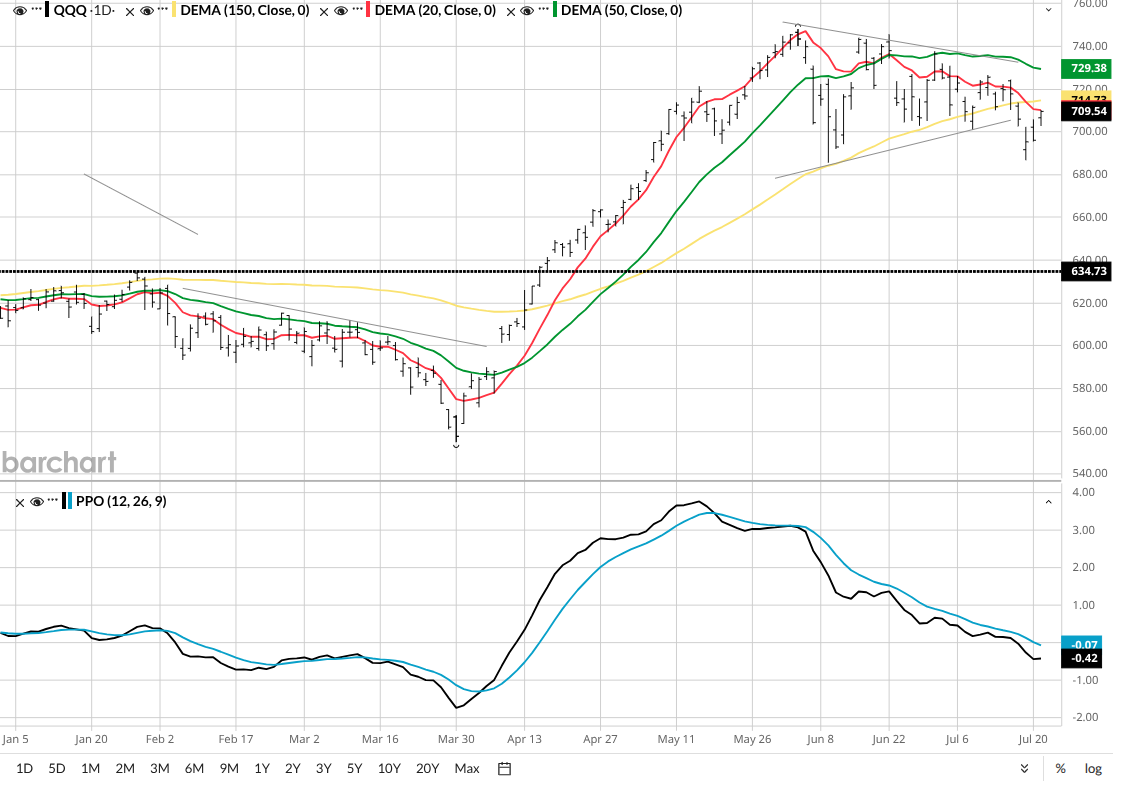
I think the Invesco QQQ ETF (QQQ) chart above tells us all we need to know about the market’s growing concerns. To me, the bottom line is that this is a specter that will likely limit upside for a while, beyond the obligatory strong bounces around earnings and other corporate news. But until the cash return is clearer, these five stocks are essentially walking around with a target on their back.
Rob Isbitts is a semi-retired CIO, former fiduciary investment advisor, and Barchart columnist. Check out his other work at ETFYourself.com (featuring the Fresh Charts weekly trading post), and ROAR.PiTrade.com, helping investors to better-manage their own portfolios.
On the date of publication, Rob Isbitts did not have (either directly or indirectly) positions in any of the securities mentioned in this article. All information and data in this article is solely for informational purposes. For more information please view the Barchart Disclosure Policy here.