
Policy uncertainty rose after Walsh took charge of the Federal Reserve, and the market is divided over whether to raise interest rates in July
The Zhitong Finance App learned that as the Federal Reserve's July interest rate meeting approaches, uncertainty about the Fed's policy path has clearly increased under the leadership of the new Chairman Walsh. There are only a few days left until the meeting, and the market still has major differences over whether the Federal Reserve will raise interest rates this month. This situation is rare in recent years.
According to the interest rate swap market, traders currently expect the probability that the Federal Reserve will announce an interest rate hike of 25 basis points on July 29 is about 30%, and the probability of keeping interest rates unchanged is about 70%.
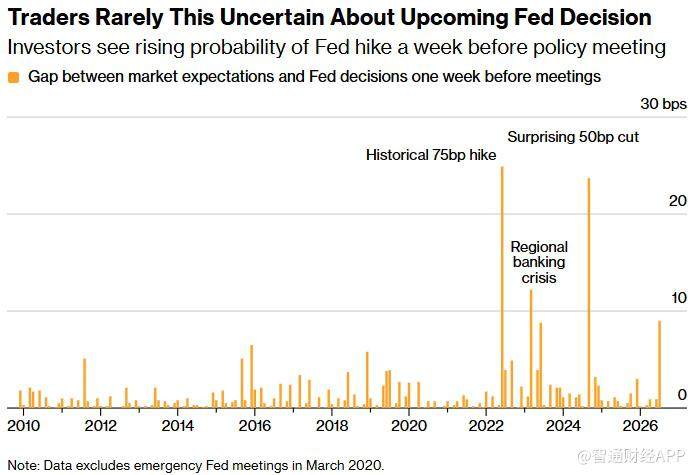
Market participants believe that there is still such a clear division of expectations on the eve of the interest rate meeting, and the future may become the new normal in the Walsh era.
Jim Bianco, president and macro strategist at Bianco Research, said that the cancellation of forward-looking guidance means that the market will often see 20%, 30%, or even 40% probability of interest rate hikes or interest rate cuts in the future, which reflects that investors are adapting to the Federal Reserve's new communication methods.
The last time the market had such big differences over the results of the Federal Reserve meeting was in September 2024. At the time, investors had mixed opinions on whether the Federal Reserve would cut interest rates by 25 basis points or 50 basis points. In the end, then-Chairman Powell chose to cut interest rates by 50 basis points to deal with the weak US labor market.
Since becoming the chairman of the Federal Reserve in May of this year, Walsh has stated many times that he hopes to abolish the Federal Reserve's long-standing practice of hinting at interest rate paths in advance through forward-looking guidelines. He believes that in the context of rapid changes in the economic environment, early release of policy signals may limit the flexibility of decision makers.
For financial markets, this means that the risks and benefits of betting on the direction of the Federal Reserve's policy have increased. Investors who make correct judgments can expect higher returns, while those who make mistakes will also face greater losses.
However, Walsh has always stressed that US inflation has always been higher than the Fed's 2% target since the COVID-19 pandemic, so the market generally expects that the Fed will continue to raise interest rates during the year. Currently, the biggest doubt is only when to act.
Compared to traders, economists are more consistent in their judgment. According to the survey, all 76 economists surveyed expect that the Federal Reserve will keep the federal funds rate target range unchanged at 3.5% to 3.75% during the July 28-29 meeting.
In fact, data released last week showed that the US consumer price index (CPI) fell for the first time in six years in June, which once prompted the bond market to bet that the Federal Reserve would stay on hold.
However, with the recent escalation of the US-Iran conflict, international oil prices have risen again, and market concerns about rising inflationary pressure have once again heated up, which has also boosted expectations of interest rate hikes.
Currently, the interest rate swap market is fully calculated that the Federal Reserve will raise interest rates by 25 basis points in September, and the cumulative rate hike is expected to exceed 50 basis points by March next year, which means that the market still expects two or more interest rate hikes in the future.
John Brady, managing director of RJ O'Brien, said he personally still doesn't think the Federal Reserve will raise interest rates next week, but market pricing shows that the policy choices at this meeting will be closer than he had previously anticipated, and there is still some doubt about the results.