
“Fifteenth Five-Year Plan for Renewable Energy Development”: Total renewable energy consumption will reach about 1.8 billion tons of standard coal in 2030
The Zhitong Finance App learned that recently, the National Development and Reform Commission and the National Energy Administration issued a notice on the “15th Five-Year Plan” for renewable energy development. Among them, it was mentioned that by 2030, the total consumption of renewable energy will reach about 1.8 billion tons of standard coal. The goal of generating electricity. In 2030, the total installed capacity of renewable energy power generation will reach about 3.5 billion kilowatt-hours, and the annual power generation capacity will reach about 6 trillion kilowatt-hours; the total installed capacity of wind power and solar power will reach more than 2.8 billion kilowatt-hours, accounting for more than 50% of the installed capacity, and an annual power generation capacity of more than 4 trillion kilowatt-hours, accounting for 30% of the power generation. Non-electricity utilization goals. In 2030, the total scale of non-electricity use of renewable energy will increase 1.5 times compared to 2025, equivalent to 150 million tons of standard coal.
In terms of guiding the renewable energy industry to high-end and intelligent upgrading and cultivating new productivity in the energy sector, the “Plan” focuses on accelerating the cultivation of new productivity in the energy sector, guided by scientific and technological innovation, supported by industrial upgrading, and breakthroughs in market-based operations.
The first is to strengthen research on technological innovation. Strengthen the professional layout of new energy and renewable energy related disciplines. Focus on reliable replacement of renewable energy, and promote research and large-scale application of advanced technology and equipment such as 100% green power transmission, grid construction, and multi-time scale power prediction in large bases. Strengthen research on cutting-edge technology and high-end equipment such as giant impact hydroelectric power units in the kilometer waterhead section and space-facing solar power generation. Continue to promote innovation and application of engineering technology such as the “Shagowang” base and offshore wind power, accelerate the application of artificial intelligence technology, and promote the iterative upgrading of the industry.
The second is to promote the upgrading of the entire industry chain. Relying on the large market size and rich application scenarios, we will continue to strengthen the optimal allocation of resources and promote the high-end and intelligent development of the industry. Focus on key technical equipment in the field of renewable energy and strengthen R&D and application of domestically produced equipment. Increase large-scale application of advanced technology and equipment in large-scale renewable energy bases. Cultivate the recycling industry chain for decommissioned new energy equipment. Improve the renewable energy industry standards and certification system, and speed up the formulation of standards such as system-friendly new energy power plants.
The third is to improve market-based operation capabilities. Improve the supply level and power forecast accuracy of new energy weather forecasting, and enhance the ability to fulfill electricity market transactions. Apply artificial intelligence and other technologies to enhance the ability of new energy sources to participate in intelligent decision-making in the electricity market. Support the integrated centralized control operation and maintenance of regional new energy plant clusters to enhance the operating revenue of the electricity market. Accelerate the cultivation of operators specialized in new energy power generation.
The original text is as follows:
“Fifteenth Five-Year Plan for Renewable Energy Development” answers reporters' questions
Recently, the National Development and Reform Commission and the National Energy Administration jointly issued the “15th Five-Year Plan for Renewable Energy Development” (hereinafter referred to as the “Plan”). What arrangements does the “Plan” make to promote high-quality development of renewable energy during the “15th Five-Year Plan” period? The reporter interviewed relevant responsible comrades from the National Development and Reform Commission and the National Energy Administration.
Question 1: What new situations did China face in renewable energy development during the “15th Five-Year Plan” period? The “Plan” suggests that during the “15th Five-Year Plan” period, “expansion and quality improvement, reliable replacement” should be the main line. How should we accurately grasp the profound connotation of this main line?
A: Since the 14th Five-Year Plan, China has built the world's largest and fastest growing renewable energy system, forming the world's largest and most complete new energy industry chain. By the end of 2025, the total installed capacity of renewable energy power generation in the country had exceeded 60%, and the installed scale of wind power and photovoltaics reached 1.84 billion kilowatts, historically surpassing thermal power. The supply capacity of clean electricity was greatly enhanced, and the contribution to the green transformation was even more prominent.
The “15th Five-Year Plan” and the period ahead is an accelerated period of global energy transition to low carbon and zero carbon. China will ensure that the carbon peak target is achieved as scheduled, and a new journey to combat climate change will begin. The main supporting role of renewable energy in the overall green transformation of economic and social development is even more prominent. From an international perspective, the recent international energy security situation has become more complex and serious. Geographical conflicts such as the US-Israel war have continued to disrupt the global oil and gas supply chain this year, and uncertainty about energy channel safety has risen markedly, forcing countries to speed up the process of replacing fossil energy with renewable energy. At the same time, a new round of technological revolution and industrial transformation has accelerated breakthroughs, the technological paths and application scenarios of artificial intelligence to enable energy transformation continue to expand, and the global renewable energy development space has become wider. From a domestic perspective, renewable energy development opportunities and challenges coexist, and there is a long way to go for further high-quality development. China's energy and electricity consumption demand will maintain a relatively rapid growth trend. Combined with increased fluctuations in the international oil and gas and key mineral supply chains, the risk of essential energy security will continue to be highlighted, and the task of coordinating energy security and green and low-carbon transformation is arduous. At the same time, renewable energy technology, costs, and industrial advantages continue to increase, but it is also facing problems such as factor supply, consumption pressure, market benefits, and the achievement of green value. There is an urgent need to innovate development methods and improve the quality of development.
In the face of the new situation and new requirements, renewable energy should be further “expanded in volume and quality and replaced reliably” during the “15th Five-Year Plan” period on the basis of the “14th Five-Year Plan” high-quality leap forward development. “Expanding quantity and improving quality” means comprehensively considering the safe supply of energy and the need for green and low-carbon transformation. On the one hand, maintain a reasonable scale and pace of development, continue to increase the share of renewable energy supply, and establish a solid foundation for the country to reach carbon peak as scheduled; on the other hand, continuously improve the overall efficiency of renewable energy development, transmission and utilization to improve the quality of industry development and enhance the market competitiveness and development efficiency of renewable energy. “Reliable substitution” is to insist on first, then break down and break down, further promote the speedy “establishment” and “reliability” of renewable energy, gradually achieve a safe and reliable replacement of traditional energy, in particular, accelerate the system-friendly performance of new energy generation, gradually promote the transformation of renewable energy into a main power source with electricity supply, capacity support and system adjustment capabilities, and consolidate green energy support for building a clean, low-carbon, safe and efficient new energy system.
Question 2: To reach the carbon peak, energy is the main battleground, and renewable energy is the main force. In terms of coordinating energy security and low-carbon transformation, the “Plan” sets out what new goals, what new requirements are put forward, and what new tasks are deployed?
Answer: To anchor China's carbon peak target, in order to help speed up the construction of a new energy system, the “Plan” sets four main goals: the first is the total target. By 2030, the total consumption of renewable energy will reach about 1.8 billion tons of standard coal. The second is the power generation target. By 2030, the total installed capacity of renewable energy will reach about 3.5 billion kilowatts, and the annual power generation capacity will reach about 6 trillion kilowatt-hours; the total installed capacity of wind power and solar power will reach more than 2.8 billion kilowatts, accounting for more than 50% of the installed capacity, and the annual power generation capacity will reach more than 4 trillion kilowatt-hours, accounting for 30% of the power generation. The third is the non-electricity utilization target. By 2030, the total scale of non-electricity use of renewable energy will increase 1.5 times compared to 2025, equivalent to 150 million tons of standard coal. The fourth is a reliable replacement target. By 2030, the average confidence output of wind power photovoltaics in the country will reach 8%, peak wind power photovoltaic power accounts for more than 20% during the peak summer and winter evenings, and more than 300 million kilowatts of reliable peak power generation capacity will be added during the “15th Five-Year Plan” period.
To implement these goals, the “Plan” thoroughly implements the new energy security strategy and focuses on grasping the three principles. The first is to insist on integration, promote multi-energy complementary integration among different types of renewable energy, renewable energy and other energy sources, integration of renewable energy production and consumption, integrated upstream and downstream of the renewable energy industry chain, promote the overall development of renewable energy and other industries, and enhance the autonomy of renewable energy development. The second is to insist on diversified collaboration, strengthen target collaboration, power source collaboration, and factor collaboration, coordinate the relationships between high-quality renewable energy development and traditional energy back-up guarantees, power grid regulation support, and land use and marine factor guarantees, strengthen planning guidance and policy coordination, and promote the formation of strong synergy. The third is to adhere to efficiency and order, place efficiency and efficiency in a more important position, strengthen cost control and lean management throughout the life cycle of the project, enhance the endogenous dynamics and comparative advantage of new energy sources in market competition, promote the formation of reasonable electricity revenue and electricity revenue, and promote the sustainable and healthy development of renewable energy.
In order to further promote the high-quality development of renewable energy, the “Plan” lays out seven key tasks: one is to actively expand the supply of renewable energy power, optimize the “Three North” wind power photovoltaic bases, offshore wind power, water and landscape integration and distributed new energy layout, and actively promote the development of biomass, photothermal and marine energy power generation; the second is to accelerate the improvement of reliable electricity replacement capabilities, promote the construction of system-friendly wind and photovoltaic power generation, and promote the construction of system-friendly wind power plants, energy multi-energy integration and pumped storage to raise the level of collaborative operation between load and new energy sources; the third is to promote breakthroughs in the non-electric use of renewable energy and actively develop green hydroammonia alcohol and wind energy Heating, promoting diversified and efficient use of biomass energy and geothermal energy heating (cooling) according to local conditions; the fourth is to comprehensively raise the level of renewable energy consumption, implement the minimum share of renewable energy consumption, and implement renewable energy replacement actions; the fifth is to consolidate and expand renewable energy technology and industrial advantages, strengthen technological innovation research and industrial chain supply chain construction, and enhance the market-based operation capacity of new energy power plants; the sixth is to improve the policy system and long-term mechanism to ensure the high-quality development of the industry, and continuously improve laws and regulations, market transactions, price formation, green power, and factor guarantees; 7 is to deepen renewable energy High level of international cooperation in the fields of projects, industries, standards and certification.
Question 3: In order to achieve the goal of reaching a total installed capacity of about 3.5 billion kilowatts of renewable energy power generation by 2030, what are the key arrangements for the national renewable energy power development layout in the “Plan”? How to reflect the combination of centralization and distribution?
Answer: The “Plan” is based on resource endowments, load distribution, power grid conditions and industrial infrastructure in different regions, insists on combining centralization and distribution, placing equal emphasis on land and sea, and focuses on optimizing the renewable energy power development layout, and continuously enhancing renewable energy power supply capacity.
In terms of centralized development, the first is to speed up the construction of the “Three North” wind power photovoltaic base, focus on the “Shagowang” new energy base, further promote the construction of wind power photovoltaic bases in Xinjiang, the upper reaches of the Yellow River, the Hexi Corridor, the “few curves” of the Yellow River, northern Hebei, and Songliao, scientifically promote photovoltaic sand control, and promote 100% green power transmission base pilots that mainly support power regulation. During the “15th Five-Year Plan” period, the “Three North” wind power photovoltaic base added more than 370 million kilowatts of installed capacity. The second is to promote the standardized and orderly construction of offshore wind power, face the four major seas of the Bohai Sea, the Yellow Sea, the East China Sea and the South China Sea, continue to accelerate offshore wind power construction, vigorously promote the layout and construction of offshore offshore wind power bases, and encourage the integrated development of offshore wind power with offshore photovoltaics, marine energy, offshore oil and gas, and undersea computing power. During the “15th Five-Year Plan” period, an additional 100 million kilowatts of offshore wind power were started nationwide, and the cumulative installed capacity reached more than 100 million kilowatts in 2030. The third is to promote hydropower development and construction with a focus on hydropower integration, coordinate hydropower development and ecological protection, take into account the needs of water conservancy, shipping, etc., actively and steadily promote the development and construction of major hydropower projects in the lower reaches of the Brahmaputra River, carry out scientific and orderly upgrading and transformation of hydropower stocks, and accelerate the planning and construction of integrated hydropower bases in the watershed. By 2030, the country's conventional hydropower installations will reach about 410 million kilowatts. Fourth, develop centralized new energy sources in various regions according to local conditions, and support the rational development and construction of centralized new energy projects in various regions in combination with the green transformation of traditional industries, the transfer of high-capacity industries, and the development of emerging industries.
In terms of distributed development, the “Plan” clearly focuses on regions such as the Middle East and the southern region, targeting four key areas, including industry, transportation, construction, and agriculture, to promote multi-scenario diversified development and space-intensive composite use of distributed new energy sources. During the “15th Five-Year Plan” period, distributed new energy sources were added to the country by more than 300 million kilowatts of installed capacity. The first is to promote the integrated development of distributed new energy and industry and commerce, actively promote the development of distributed photovoltaics and decentralized wind power in industrial and commercial agglomeration areas such as industrial parks and economic development zones, and accelerate the construction of industrial green microgrids. The second is to promote the integration of distributed new energy sources and multiple transportation scenarios, encourage the integrated development and construction of distributed new energy sources and surrounding energy facilities along transportation infrastructure, build a number of “zero carbon highways”, and actively expand the space for the development and utilization of distributed new energy sources integrated with communication energy. The third is to strengthen the integrated development and comprehensive utilization of distributed photovoltaics in the construction sector, launch integrated photovoltaic pilot projects for newly built public buildings, combine distributed energy storage and charging piles to raise the level of photovoltaic self-consumption in buildings, and raise the level of photovoltaic safety and appearance in buildings. Fourth, accelerate the integrated development of distributed new energy sources and agriculture, strengthen the diversified development and utilization of rural renewable energy, further promote the “Thousand Villages and Thousand Villages Control Campaign” and the “Thousand Households Bathing Campaign”, and build village-level photovoltaic support power plants according to local conditions.
Question 4: The proportion of installed renewable energy power generation in China has reached 60%, and the total installed capacity of wind power and photovoltaic power generation has historically surpassed thermal power. What specific measures are put in place in the “Plan” to promote the “15th Five-Year Plan” renewable energy to achieve a larger scale and higher proportion of development while better serving the safe, reliable and cost-effective operation of the power system?
A: The safe and stable operation of the power system requires sufficient electricity, as well as uninterrupted reliable electricity. The “Plan” further enhances renewable energy's support for power systems in terms of both electricity volume and electricity.
In terms of electricity volume, the “Plan” proposes that by 2030, China's annual renewable energy generation capacity will reach about 6 trillion kilowatt-hours, and the annual power generation capacity of wind power and solar power will reach 4 trillion kilowatt-hours or more. At that time, China's power generation structure will show the characteristics of “half non-fossil, nearly half renewable, and 30% new energy.” In terms of electricity, the “Plan” proposes for the first time the goals and tasks of improving the reliable replacement capacity of renewable energy power, focusing on key scenarios for power insurance and supply, setting targets such as average confidence output for wind power photovoltaics, adding reliable peak power generation capacity from renewable energy, and the share of wind power photovoltaic power during peak summer and winter, and deploying 4 tasks and measures.
The first is to improve the friendly performance of wind and power plant systems. Accelerate the construction of system-friendly wind and power stations, focus on enhancing the reliable peak power generation capacity of power plants, improving grid-related performance and active support for the safe and stable operation of the system according to local conditions. For new construction projects, technical requirements will be raised, and the application of advanced technology and equipment such as network type, high-precision power prediction, and integrated scheduling will be increased. By 2030, in principle, the confidence output of a new centralized wind and power station should not be less than 10%, and eligible projects are encouraged to exceed 20%. For existing projects, in conjunction with the upgrading of old wind and photovoltaic power stations, we encourage collaboration to improve power generation efficiency and system-friendly performance through renovation and expansion, and rationally increase energy storage, etc., and promote grid-related performance transformation in a steady and orderly manner.
The second is to promote the integrated development of new energy sources and multiple energy sources. The “Plan” proposes three integrated models: First, scientifically promote the construction of wind power and photovoltaic power generation on the same site or nearby, share transmission and transformation facilities inside and outside the site, and implement joint power prediction, forecasting and integrated operation. Second, promote the collaborative construction and operation of photothermal power generation and wind power photovoltaics, and build a number of “photothermal+wind power photovoltaic” integrated projects in regions with good photothermal resources, such as the northwest and southwest. Third, promote the integrated development of biomass power generation and wind power photovoltaics, and explore nearby layouts and construction and centralized bundling into power systems in regions rich in scenery and biomass resources, such as Northeast China.
The third is to promote high-quality development of pumped energy storage. The “Plan” clarifies measures in two areas. First, carry out large-scale demonstration studies on the demand for pumped energy storage for service power systems, actively promote the construction and operation of projects under construction, and strive to add about 100 million kilowatts of pumped energy storage projects for service power systems to be put into operation during the “15th Five-Year Plan” period. Second, rely on the southwest integrated water and landscape base, the “Three North” wind power photovoltaic base, coastal nuclear power base, etc., to scientifically plan and build pumped storage power plants to serve specific power sources.
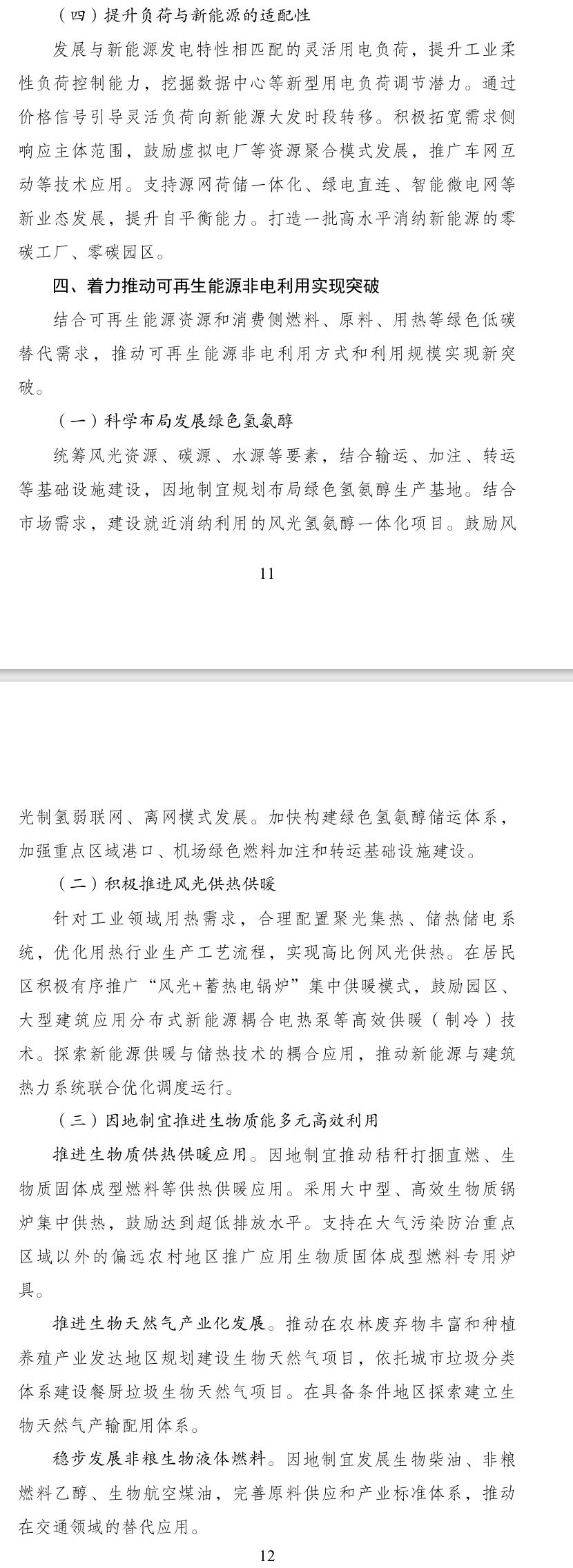
Fourth, improve the compatibility between loads and new energy sources. To promote reliable replacement, it is necessary not only to enhance source-side adjustment support, but also to improve load-side adaptability. Develop flexible electricity loads that match the characteristics of new energy generation, guide the transfer of flexible loads to new energy generation periods through price signals, encourage the development of resource aggregation models such as virtual power plants, support new energy consumption formats such as integrated source networks, direct green power connections, and smart microgrids, and build a number of zero-carbon factories and zero-carbon parks that consume new energy at a high level.
Question 5: The “Plan” positions non-electricity use of renewable energy as a “breakthrough” during the “15th Five-Year Plan” period. To achieve this transformation, what are the key arrangements for non-electricity use during the “15th Five-Year Plan” period?
A: Using electricity as the core and breaking through with non-electricity is the path for high-quality development of renewable energy during the “15th Five-Year Plan” period. Considering challenges such as limited local load growth in regions rich in scenic resources and increased restrictions on large-scale long-distance delivery, expanding non-electricity utilization channels is a need to break through bottlenecks in energy consumption from new energy sources. It is also an intrinsic requirement for expanding the depth and breadth of alternative energy from new energy sources to traditional fossil energy.
After years of cultivation, China's green hydrogen ammonia alcohol and other industries have developed rapidly. By the end of 2025, China had built green hydrogen, green ammonia, and green methanol production capacity of about 250,000 tons, 650,000 tons, and 380,000 tons respectively, all accounting for more than half of the global production capacity. The industrial base is gradually being consolidated, and the foundation for large-scale development and utilization is initially in place. At the same time, we also see that currently non-electricity use of renewable energy accounts for only about 1% of China's energy consumption. Compared with the demand for deep decarbonization of fuel, raw materials, and heat in key industries such as industry, transportation, and construction, there is still a lot of room. Compared with similar traditional fossil energy products, price competitiveness also needs to be further improved, and large-scale development needs to be accelerated.
The first is the scientific layout for the development of green hydroammonia alcohol. Combining the layout of new energy bases such as “Shagahuang” to promote the construction of a comprehensive green hydrogen ammonia alcohol industrial base, the scale of hydrogen production from renewable energy sources nationwide will reach 2 million tons by 2030. Large-scale production bases for green hydroammonia alcohol are planned to be built in the Northeast region; in regions such as the “few bends” of the Yellow River, northern China, and the northern foothills of Tianshan Mountain, it is planned to build a comprehensive green hydroammonia alcohol industrial base that is mainly used nearby.
The second is to actively promote wind and solar heating. In response to the heat needs of industrial fields such as steel, cement, chemicals, textiles, pharmaceuticals, paper, food processing, etc., concentrated heat collection, heat storage and electricity storage systems are rationally arranged to achieve a high ratio of wind and solar heating. In response to urban and rural heating needs, heating (cooling) technologies such as “scenery+regenerative electric boilers” and distributed new energy coupling electric heat pumps are applied according to local conditions to expand clean heating channels for residents.
The third is to promote diversified and efficient use of biomass energy according to local conditions. Steadily promote biomass heating applications and biogas industrialization, actively develop non-food biological liquid fuels such as biodiesel, non-food fuel ethanol, bioaviation kerosene, etc., and develop in collaboration with the resource utilization of agricultural and rural organic waste, urban and rural domestic waste, etc.
Fourth, promote geothermal heating (cooling) according to local conditions. Launch pilot projects for high-quality development and utilization of geothermal energy. Build pilot projects for clustered utilization of shallow geothermal energy in urban areas with conditions for laying large areas of underground pipes, carry out pilot projects for shallow geothermal energy heating according to local conditions in pilot areas of the rural energy revolution, and carry out pilot projects for high-quality development and utilization of geothermal energy in areas rich in medium- to deep geothermal resources such as Beijing's urban sub-center, Xiong'an New Area, and Xianyang.
Question 6: An overall increase in renewable energy consumption levels is an important gripper for achieving the “dual carbon” goal. What specific measures are proposed in the “Plan” to increase renewable energy consumption in key areas such as industry, transportation, construction, and data centers?
A: The “Plan” insists on combining mandatory and voluntary measures, and focuses on increasing the level of renewable energy consumption in the whole society. In terms of compulsory consumption, the minimum share target system for renewable energy consumption will be fully implemented, and the scope of the compulsory consumption of renewable energy electricity industry will be gradually expanded. Accelerate the establishment of a monitoring, statistics and accounting system for non-electricity use of renewable energy. In terms of voluntary consumption, on the basis of rich renewable energy consumption services, public institutions are encouraged to prioritize the use of renewable energy, support key energy industries to further increase the share of renewable energy consumption, and encourage large-scale events to consume 100% renewable energy.
In response to key areas, the “Plan” proposes vigorous implementation of renewable energy replacement actions, and specific measures are proposed in each field. In the industrial sector, promote the upgrading and transformation of production processes and energy technology in key energy industries, guide the increase in the application ratio of electric furnaces in an orderly manner, and expand the application of green electricity in the industrial field. Accelerate the replacement of energy with renewable energy in coal and oil and gas exploration and development, and promote the “greening (manufacturing) of the renewable energy equipment” industry. Expand renewable energy industrial heating scenarios and promote large-scale application of green hydroammonia alcohol in the industrial field. Build zero-carbon factories according to local conditions and jointly promote the construction and application of industrial green microgrids.
In the field of transportation, promote the construction of energy supplementation infrastructure such as charging (exchanging) electricity for vehicles and ships, accelerate the large-scale use of new energy heavy trucks, and promote “green car charging” for new energy vehicles. Expand the application of green hydroammonia alcohol, sustainable aviation fuel, etc. in the transportation field.
In the field of construction, it is necessary to include priority use of renewable energy in urban planning, construction, renewal and transformation, promote the full electrification of energy used in newly built public buildings according to local conditions, and promote the application of solar energy, geothermal energy, environmental thermal energy, etc. in building heating (cooling).
In the field of digital infrastructure, guide the collaborative planning and layout of newly built data centers and renewable energy power generation, classify and explore the potential for air conditioning savings during computing power loads, innovate methods such as direct green power connection and integrated source network load storage, and steadily raise the level of green electricity consumption in digital infrastructure.
In the rural sector, explore the integrated development model of “green energy+characteristic industries”, guide the consumption of renewable energy, promote the replacement of loose coal, and promote the quality and efficiency of rural characteristic industries.
Question 7: The “15th Five-Year Plan” is a critical period for promoting self-reliance and self-improvement in energy technology. What are the key arrangements in the “Plan” in guiding the renewable energy industry to high-end and intelligent upgrading and cultivating new productivity in the energy sector?
Answer: Facing the major needs of renewable energy development, the “Plan” focuses on accelerating the cultivation of new quality productivity in the energy sector, guided by scientific and technological innovation, supported by industrial upgrading, and market-based operations as breakthroughs.
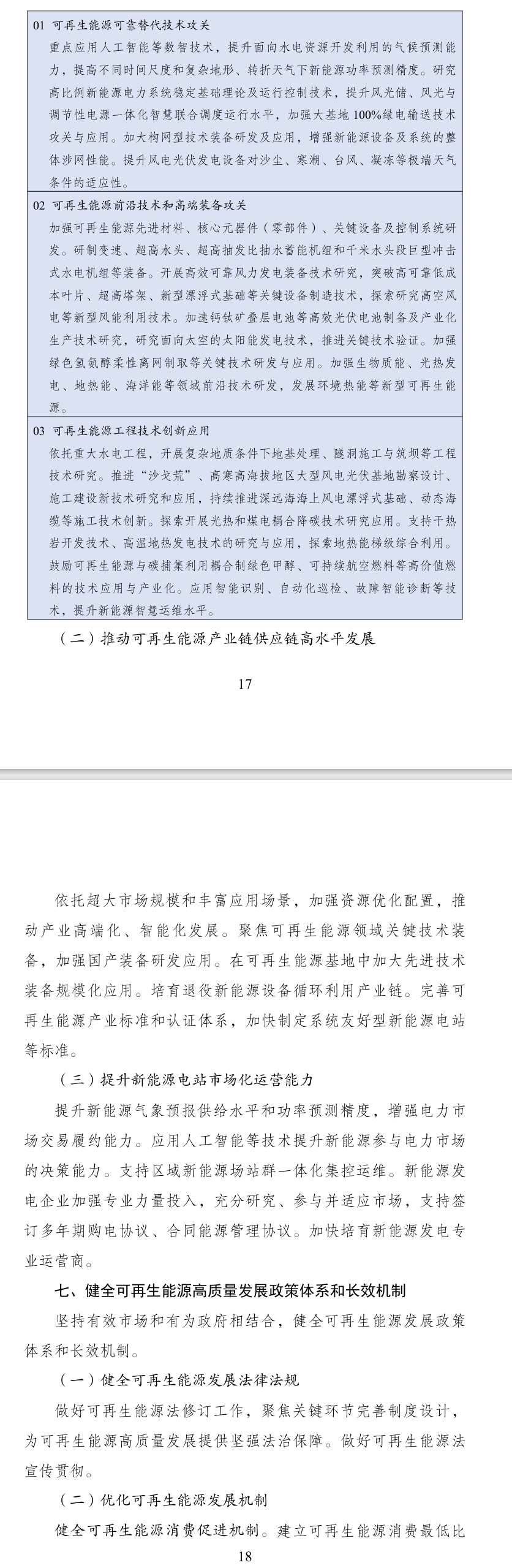
The first is to strengthen research on technological innovation. Strengthen the professional layout of new energy and renewable energy related disciplines. Focus on reliable replacement of renewable energy, and promote research and large-scale application of advanced technology and equipment such as 100% green power transmission, grid construction, and multi-time scale power prediction in large bases. Strengthen research on cutting-edge technology and high-end equipment such as giant impact hydroelectric power units in the kilometer waterhead section and space-facing solar power generation. Continue to promote innovation and application of engineering technology such as the “Shagowang” base and offshore wind power, accelerate the application of artificial intelligence technology, and promote the iterative upgrading of the industry.
The second is to promote the upgrading of the entire industry chain. Relying on the large market size and rich application scenarios, we will continue to strengthen the optimal allocation of resources and promote the high-end and intelligent development of the industry. Focus on key technical equipment in the field of renewable energy and strengthen R&D and application of domestically produced equipment. Increase large-scale application of advanced technology and equipment in large-scale renewable energy bases. Cultivate the recycling industry chain for decommissioned new energy equipment. Improve the renewable energy industry standards and certification system, and speed up the formulation of standards such as system-friendly new energy power plants.
The third is to improve market-based operation capabilities. Improve the supply level and power forecast accuracy of new energy weather forecasting, and enhance the ability to fulfill electricity market transactions. Apply artificial intelligence and other technologies to enhance the ability of new energy sources to participate in intelligent decision-making in the electricity market. Support the integrated centralized control operation and maintenance of regional new energy plant clusters to enhance the operating revenue of the electricity market. Promote new energy power generation enterprises to increase professional investment, fully research, participate and adapt to the market, and support the signing of multi-year power purchase agreements and contract energy management agreements. Accelerate the cultivation of operators specialized in new energy power generation.
Question 8: In order to support the implementation of the goals and tasks of the “Plan”, what are the key arrangements in terms of institutional mechanism reform and policy guarantees?
Answer: In order to ensure the implementation of various goals and tasks, the “Plan” adheres to the combination of an effective market and a promising government to improve the policy system and long-term mechanism for the high-quality development of renewable energy in terms of laws and regulations, development mechanisms, market mechanisms, and factor guarantee mechanisms.
The first is to improve renewable energy development laws and regulations. Promote the speedy revision of the Renewable Energy Law to further forge consensus, break down institutional barriers, improve the important institutional design for the high-quality development of renewable energy under the new stage of full marketization, publicize and implement the Renewable Energy Law, and provide strong legal guarantees for the high-quality development of renewable energy during the “15th Five-Year Plan” and beyond.
The second is to optimize renewable energy development mechanisms. Improve renewable energy consumption promotion mechanisms and implement the minimum share target for renewable energy consumption. Improve the mechanism for coordinated development of renewable energy, strengthen the renewable energy power consumption responsibility and weight system, and better promote network source collaboration. Improve the management mechanism for renewable energy development and construction, and enhance the supply of policies such as integrated innovation and development of deep-sea offshore wind power and water scenery. Strengthen supervision of renewable energy planning and construction, grid-connected consumption, and transaction scheduling.
The third is to improve the market-based development mechanism for renewable energy. Continue to improve the electricity market rules system adapted to the large-scale and high-proportion development of new energy sources and full entry into the market, promote the overall participation of large bases in electricity market transactions, optimize centralized new energy quotation methods, and encourage distributed new energy aggregation transactions. Improve the price settlement mechanism for sustainable development of new energy sources, study the cost guidance mechanism for offshore wind power transmission projects, improve the electricity price mechanism for adjustable resource capacity such as pumped energy storage and new energy storage, establish reliable capacity compensation mechanisms in an orderly manner, and improve the green certification green power transaction mechanism.
Fourth, strengthen the guarantee of renewable energy development factors. In terms of resource space, a national survey of wind power and photovoltaic resources will be carried out on a pilot basis, the construction of an observation network and a database of developable resources will be promoted, and policies for the mixed use of space adapted to the characteristics of new energy sources will be studied and formulated. In terms of finance, promote innovation in green finance products and services, and broaden direct financing channels. In terms of power system support and security, power grid infrastructure is being built moderately ahead of schedule, promoting the integrated development of distribution grids, smart microgrids and backbone grids, strengthening the planning, construction and scientific utilization of various types of regulatory resources, and strengthening the power system's ability to accept, allocate and control new energy sources.
Notice of the National Development and Reform Commission and the National Energy Administration on Issuing the “Fifteenth Five-Year Plan” for Renewable Energy Development
All provinces, autonomous regions, municipalities directly under the Central Government, departments in charge of development, reform and energy of the Xinjiang Production and Construction Corps, agencies dispatched by the National Energy Administration, and relevant central enterprises:
In order to thoroughly implement the spirit of the 20th National Congress and the 20th Plenary Session of the CPC Central Committee, earnestly implement the arrangements of the Fourth Plenary Session, thoroughly implement the “Four Revolutions, One Cooperation” new energy security strategy, anchor the carbon peak carbon neutrality goal, and promote the high-quality development of renewable energy, we have organized and prepared the “Fifteenth Five-Year Plan for Renewable Energy Development” in accordance with the relevant requirements of the “Outline of the 15th Five-Year Plan for National Economic and Social Development of the People's Republic of China” and the “Fifteenth Five-Year Plan” for the Construction of New Energy Systems. It is now being issued to you, please follow the instructions.




This article was selected from the official website of the “National Development and Reform Commission”. Zhitong Finance Editor: Jiang Yuanhua.