
IPO outlook | Daqin Digital's Hong Kong IPO: V-shaped performance reversal, overseas markets become a “good medicine” for energy storage?
When the traditional big storage and household storage price war had reached its extreme, the energy storage industry was visible to the naked eye. Scenes such as severe homogenization, overcapacity, and continued price decline have gradually become the most common situation in the energy storage industry today. Whether it is large-scale power grid energy storage, industrial and commercial energy storage, or overseas household storage markets, the products of mainstream domestic battery manufacturers are highly convergent, and the core competition is cost and production capacity.
Even so, there are “brave men” who are putting olive branches out to the capital market to seek expansion opportunities. Recently, Daqin Digital Energy Technology Co., Ltd. submitted a prospectus to the Hong Kong Stock Exchange, and Guotai Junan International acted as the sole sponsor.
Gross margin fluctuated greatly, and 2025 ushered in performance recovery
The Zhitong Finance App learned that Daqin Digital Energy was founded in 2017, and this company, which has been in operation for less than 10 years, is one of the earliest companies in China's distributed energy storage system (ESS) industry to focus on overseas markets. Its business covers two major product lines: household ESS and industrial ESS. Among them, household ESS products include ESS batteries and integrated ESS, while industrial and commercial ESS products are aimed at industrial parks and commercial complexes.
By the end of 2025, the company's products had been deployed in more than 100 countries and regions, and the cumulative shipment volume of ESS batteries exceeded 1 million units. According to Frost & Sullivan data, in terms of 2025 shipments, Daqin is the fifth largest household energy storage system provider in the world, with a shipment volume of 2.5 GWh and a market share of 6.5%.
In terms of shipment volume, Daqin Digital Energy has gained a foothold on the global household storage circuit. However, the company's financial data showed an extremely dramatic reversal. Judging from the past three years, the company's profit trajectory shows a V-shaped curve. Its revenue increased slightly from 723 million yuan in 2023 to 734 million yuan in 2024, then jumped to 2,525 million yuan in 2025, a year-on-year increase of 244.3%; gross margin showed extremely fluctuating 2.7%, -19.9%, and 23.2%.
Further scrutinizing the reason, the loss in 2024 was mainly due to the one-time clearance of old inventory: in order to clear the old inventory in 2023 and 2024, the company offered price concessions, which reduced revenue by about $50.5 million and deducted the unsold inventory. The high-voltage battery alone caused gross loss of 95.56 million yuan, and the gross loss rate was as high as 80.6%.
This is greatly related to industry fluctuations at the time: the price of lithium carbonate was still at an all-time high in early 2023, and battery-grade lithium carbonate was still above 500,000 yuan per ton. The company purchased a large number of batteries at this price level to produce ESS batteries for household use, and produced a total of about 284,000 units. The market in 2023, however, underwent drastic changes. The price of lithium carbonate plummeted all the way, from 500,000 per ton to 100,000 per ton at the end of the year. LFP batteries fell by about 40%-50% year on year for two consecutive years in 2023 and 2024. In the end, this batch of high-cost products was only able to “break the arm” at a low price.
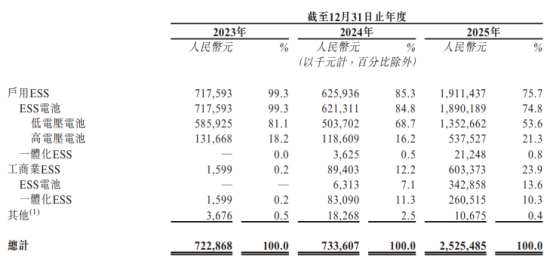
However, when this “burden” was cleared in 2025, Daqin's profitability quickly returned — gross profit for low-voltage batteries changed from 62.5 million yuan in 2024 to gross profit of 280 million yuan in 2025, and gross margin rose from -12.4% to 20.7%; gross profit of high-voltage batteries changed from 95.6 million yuan to gross profit of 102 million yuan, and gross margin rose from -80.6% to 18.9%.
Judging from the revenue structure, household ESS has always been the company's core revenue source. In 2023-2025, household ESS revenue accounted for 99.3%, 85.3%, and 75.7%, respectively. Although the share declined year by year, the scale soared from 718 million yuan to 1,911 million yuan. Among household ESS, revenue from low-voltage batteries increased from 586 million yuan to 1,353 million yuan, high-voltage batteries increased from 132 million yuan to 538 million yuan, and the product structure is being upgraded towards higher value high-voltage systems.
What is more noteworthy is the rapid rise of the industrial and commercial ESS business: in 2023, the business revenue was only 1.6 million yuan, accounting for about 0.2% of total revenue; in 2024, it increased to 89.4 million yuan, accounting for 12.2%; in 2025, it further jumped to 603 million yuan, accounting for 23.9%. The share of revenue from the industrial and commercial ESS business went from zero to nearly one-quarter in just two years, showing that the company's market expansion capabilities in the industrial and commercial scene are being unleashed at an accelerated pace.
The cash flow situation also improved significantly in 2025. In 2023 and 2024, net cash used in operating activities was $214 million and $377 million, respectively, with a continuous net outflow; in 2025, it turned into net cash from operating income of $81.3 million. Cash and cash equivalents increased from $114 million at the end of 2023 to $283 million at the end of 2025.
The business landscape expanded to industry and commerce, and “going overseas” became a “good medicine”?
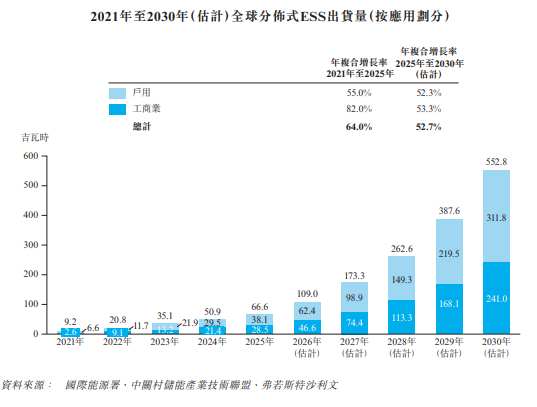
With the acceleration of global energy transformation, the recovery in demand for household energy storage in Europe, and industry dividends from the explosion of AI computing power, the energy storage industry has ushered in a new explosive growth cycle. According to Frost & Sullivan, global household ESS shipments are expected to grow at a compound annual growth rate of 52.3% between 2025 and 2030, which means the market is expected to expand several times over the next five years.
The Zhitong Finance App has observed that for Daqin ShuNeng, the structural growth of the global market has undoubtedly become the best dividend time. Judging from the geographical distribution, the company's revenue sources are highly concentrated in overseas markets. In 2025, 95.1% of the company's revenue came from overseas regions, with the European market contributing 61.0% of revenue, the Middle East accounting for 12.7%, Africa accounting for 10.4%, and Asia Pacific (excluding mainland China) accounting for 9.2%. This geographical structure was quite different in 2023 — at that time, mainland China accounted for 56.9% of revenue, while Europe only accounted for 19.9%.
This also means that within three years, the company has completed a “export” strategy transformation from focusing on domestic sales to a “export” strategy centered around Europe and blossoming in many places around the world. The explosive growth of the European market is benefiting from the region's favorable energy policies, high electricity price environment, and growing recognition by household users of the economic benefits of energy storage systems. However, the heavy reliance on a single regional market also indicates that the company's performance will face significant fluctuations if European energy policies shift or market demand slows down.
On the other hand, the global ESS market is fiercely competitive, technology continues to iterate, and customer and regulatory requirements continue to evolve. The company's main competitors include global giants such as Tesla (Powerwall), LG Energy Solution, BYD, and Sunshine Power. According to household ESS shipments in 2025, the company ranked fifth in the world, but the top four companies undoubtedly occupy a larger market share and have stronger brand awareness and financial strength. In the field of household ESS, brand trust, channel coverage, and localized service capabilities are essential; in the field of industrial and commercial ESS, project experience, system integration capabilities, and customer relationships are key competitive factors, and it is difficult to say that Daqin Shu can excel in these areas.
Furthermore, the cost of raw materials is the biggest cost item and risk exposure of the Qin Shu. In 2023-2025, raw material costs accounted for 86.0%, 82.4%, and 90.9% of the company's sales costs, respectively, with LFP (lithium iron phosphate) cells accounting for most of the raw material costs. The price of LFP cells is closely related to the price of lithium carbonate, and the price of lithium carbonate has fluctuated greatly in the past due to changes in global supply and demand dynamics. This high sensitivity to a single raw material means that the company's profitability is largely dependent on the stability of the upstream battery supply chain.
At this point, Daqin Shuenergy's current listing will mainly be used to expand production capacity, strengthen R&D, deepen the global distribution network, and supplement working capital. If the company can maintain a high revenue growth rate while maintaining and increasing the level of gross margin and reducing its dependence on a single raw material, it is expected that its fifth-largest market position in the world will be further consolidated. However, if LFP cell prices fluctuate sharply again, demand in the European market slows down, or industry competition intensifies, leading to a price war, the stability and sustainability of the company's profits may once again be tested.