
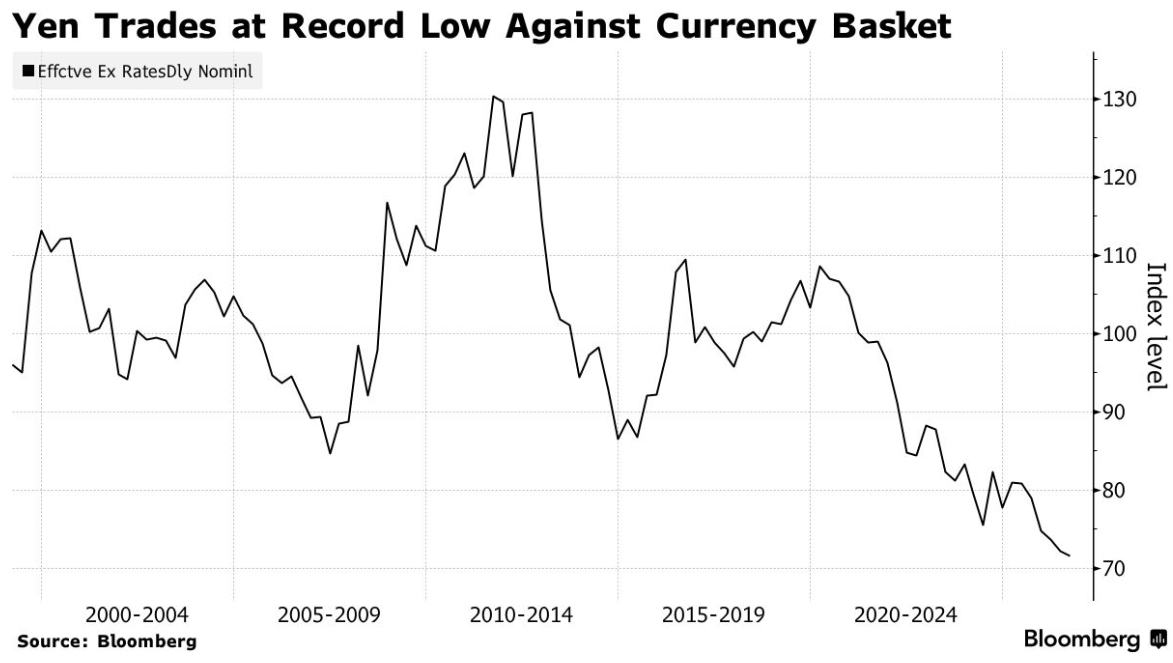
Total failure! The effective exchange rate of the yen hit another record low, and the wave of depreciation spread from the US dollar to the global currency basket
The overall financial app notes that although the yen exchange rate fell to a 40-year low and dominated headlines, a broader measure of the strength of the yen was sending an equally worrying signal to Japan.
The Bank of Japan's Nominal Effective Exchange Rate Index — which measures the performance of the yen against a basket of trade-weighted currencies — continued its downward trend and hit a record low this year, reflecting an overall weakening of the yen against the euro, the British pound, and several similar Asian currencies.
On Wednesday, the exchange rate of the yen rose from 163.13 yen to the dollar to 162.69 yen per dollar. Meanwhile, the yield on Japan's 2-year treasury bonds rose to the highest level since 1995, and the yield on 5-year treasury bonds rose to 1.995%.
This decline highlights that the yen's weakness has gone far beyond the dollar, heightening concerns about import inflation and the erosion of Japan's purchasing power. The weakening of the trade-weighted yen has boosted import costs from a wider range of trading partners, complicating the Bank of Japan's efforts to normalize monetary policy without harming economic recovery.
Ugo Ranchioni, senior portfolio manager at Neuberger, said, “The real value of the yen is not only falling against the US dollar, but it is also showing an overall downward trend against a basket of currencies. This may become a source of official concern. Stronger interventions, combined with other means, may be needed in the future to achieve full results.”
Central bank officials are open to raising interest rates faster than economists' consensus, as the continued weakness of the yen exacerbates the risk of rising inflation. Markets generally expect the Bank of Japan to stand still at the upcoming July 31 meeting, and the next rate hike is expected in December. Policymakers raised the benchmark interest rate to 1% last month, a 31-year high.
Driven by huge spreads, high oil prices, and concerns about Japan's fiscal outlook, the yen has fallen below the 163 mark against the US dollar, the lowest level since 1986. Officials interfered with the foreign exchange market with 11.73 trillion yen ($71.9 billion) between April 28 and May 27, but failed to stop the yen from falling to a new low in 40 years.