
Still bullish 170% after plummeting 40%: Why is Wall Street “dead set” on Strategy (MSTR.US)?
The Zhitong Finance App learned that currently, Strategy Inc. (MSTR.US), headed by Michael Saylor, is facing an almost total collapse of confidence — Wall Street analysts are the only ones standing still.
Although analysts have lowered their target price as Strategy's common stock and preferred shares have plummeted along with Bitcoin, they still believe that the stock has more room to rise than any other NASDAQ 100 component stock. Even Elon Musk's SpaceX (SPCX.US) is no exception — the stock has now fallen below the IPO price after a record debut.
According to compiled data, 17 analysts gave Strategy a “buy” or equivalent rating, including TD Cowen, Citigroup, and B. Analyst at Riley Securities. In contrast, there are 3 “hold” ratings and only 1 “sell” rating.
This optimistic expectation comes at a time when Strategy completely changes the business model on which it is famous. Saylor transformed the company from an unknown enterprise software manufacturer to the publicly traded company that holds the most Bitcoin in the world. After years of urging investors to buy cryptocurrencies, the company began selling part of its holdings to raise cash. By the end of June, Strategy had moved away from a “buy and hold” strategy to actively manage its liquidity and balance sheet. These changes are aimed at increasing its ability to meet future debts, but they have failed to restore market confidence. The company's securities have yet to recover lost ground.
Even so, Wall Street analysts have generally maintained bullish recommendations. Their predictions are based in part on the expectation that Saylor's financing machine will continue to raise capital, and that Bitcoin's rebound will allow the stock to regain the premium that investors once gave.
TD Cowen analyst Lance Vitanza said that his opinion on Strategy depends on his judgment on Bitcoin's trend in the next few years.
In an interview, he said, “I'm very confident that in two or five years, Bitcoin will reach hundreds of thousands of dollars — but it won't be a straight, smooth, and smooth line.”
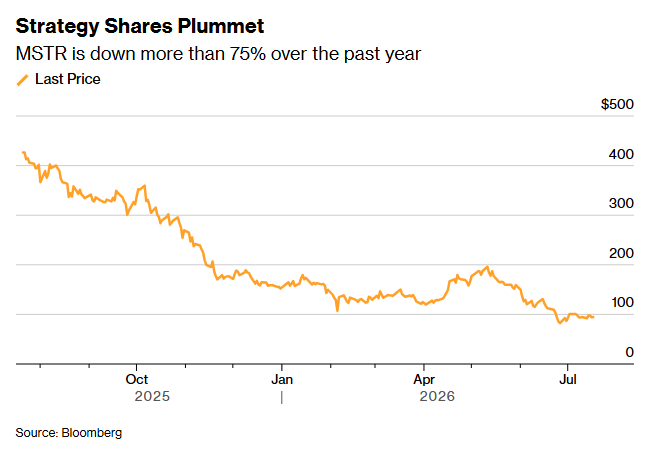
Bitcoin traded at around $66,000 on Thursday, down nearly half from its all-time high at the end of last year. Strategy's stock price closed at around $100 on Wednesday.
Strategy did not respond to requests for comment.
The market unanimously expects a one-year target price of around $275, which means an increase of about 170% from current levels. This is almost double the expected increase of SpaceX, which is the second-most bullish target stock in the Nasdaq 100 index, according to compiled data. This huge implied upside has raised questions.
Adam McCarthy, head of research at the cryptocurrency liquidity and market data company LO:TECH, said that this surge in expectations “is far from reality and seems extremely unreasonable.”
This overall target price figure comes with an important caveat. The consensus target price includes suggestions given at different stages of Strategy's decline. According to the data, several companies have updated their views in recent weeks, while others have not adjusted their ratings or price targets for months, and some of these ratings even date back to the end of 2025.
Such a huge implied increase may also reflect to some extent how fast Strategy is declining. Its stock price fell by more than 40% over the past three months, making it the worst performing constituent stock in the Nasdaq 100 Index. Since analysts usually adjust price targets less frequently than share price repricing, a sudden sell-off may cause a huge gap between market prices and consensus expectations.
However, analysts have lowered their expectations. Compiled data shows that the average target price has fallen from above $460 at the beginning of the year as many companies lowered their predictions and valuation assumptions for Bitcoin. But most analysts are still reluctant to give up a “buy” or equivalent rating.
Recent research reports remain generally positive. According to the data, out of 11 analysts who have updated their views, 9 gave Strategy a “buy” or equivalent rating, 1 held a “neutral” position, and 1 suggested shorting the stock. Although recent buy ratings conceal huge differences in valuations—the target price ranges from $130 to over $500, these ratings all point to unanimous optimism.
Some of the agencies that cover Strategy analysts also have commercial relationships with the company, including underwriting securities issuance, market their securities, and acting as authorized agents for their on-market expansion projects.
Earlier this year, Saylor said that about 80% of Stretch's preferred shares have been sold to retail investors through an on-market promotion program. He has expressed his hope that these securities will become Strategy's main source of financing. If retail investors remain major buyers, Strategy's ability to continue to finance through the project will largely depend on retail investors' willingness to continue to buy these preferred shares.
McCarthy said, “If you set prices like bank analysts, you might think that retail investors' capital flows are resilient, and if interest rates fall next year, Bitcoin may make a comeback.”