
Is cooling inflation just an illusion? The ECB is expected to stand still tonight, but hawkish blades may be hidden behind it
The Zhitong Finance App learned that after the ECB raised interest rates by 25 basis points in June, there is almost no suspense at tonight's (July) monetary policy meeting — the ECB will press the “pause button” to raise interest rates to keep deposit interest rates at 2.25%.
However, what really affects market nerves is not the current standstill, but rather how much room the ECB will open up for further policy tightening in September and beyond. As the geographical conflict in the Middle East intensifies again and oil prices return above $90 per barrel, market expectations for further policy tightening are heating up again.
Interest rates suspended but options retained
Since the interest rate hike last month and hinted that there is still follow-up, a series of positive data in the Eurozone — including lower-than-expected inflation, moderate wage increases, and falling price expectations — has markedly reduced the urgency of continuing interest rate hikes. However, the renewed conflict between the US and Iran is rapidly rewriting the economic script.
Oliver Rakau (Oliver Rakau), an economist at the Oxford Institute of Economics, characterized the resolution as a “hawkish suspension,” arguing that the current data is slightly inclined to support further policy tightening in the future. This is generally in line with the ECB's June forecast and market pricing.
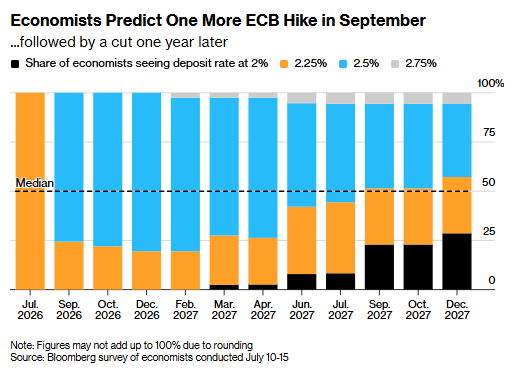
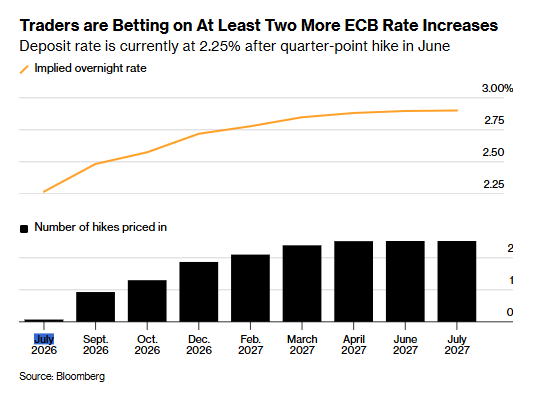
Currently, the financial market has set prices ahead of schedule. Traders expect that the ECB will complete the remaining rate hikes by February next year at the latest, while the probability of raising interest rates again in the middle of next year is as high as 60%.
According to estimates by Morgan Stanley economist Jens Eisenschmidt (Jens Eisenschmidt), if deposit interest rates rise to 2.5%, it already forms a “moderate restrictive level”. At that time, once inflation approaches the target, it is easy to find a reason to start cutting interest rates. Therefore, in his view, based on the benchmark forecast that inflation will just hit the target next year and fall slightly below the target thereafter, “there is no reason to raise interest rates more than twice.”
However, if Lagarde reaffirms at the press conference that there is a “general consensus” on the policy direction, or reminds the outside world that the June forecast is based on the assumption that interest rates will be raised three times in total, then the market's bet on the September rate hike will be further confirmed.
The secondary effects of inflation have yet to be seen, and food risks may be brewing
The biggest encouragement that allows the ECB to wait and see for a while is that the “secondary effect” that has long been feared by various circles has not yet occurred.
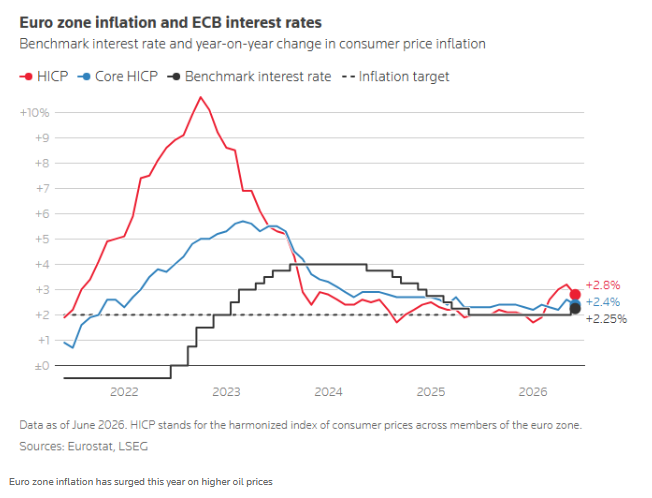
Higher energy costs are usually transmitted to all kinds of goods and services, which in turn drives up wages and creates a price-wage spiral, but this is not shown in the data. Eurozone inflation slowed to 2.8% in June, and price pressure on services and core inflation excluding energy and food also cooled. Wage growth continues to moderate, and the overall labor market is weak, particularly in Germany, the largest economy in the Eurozone; consumer expectations for future prices have also declined markedly.
Despite this, according to a survey, about 10% of economists have found evidence that inflation expectations are beginning to unanchor, and almost all respondents have at least some concerns about the secondary effects. ECB policymakers also believe that even if the secondary effect is more delayed and less intense, it will still arrive, and the central bank needs to be ready to act at any time.
What's more complicated is that the extreme heat and El Niño phenomenon that swept through many European countries this summer may have damaged crops and boosted future food prices. Low water levels in key waterways such as the Rhine may also cause shipping bottlenecks. Barclays Bank warned in a report that although food inflation has generally declined in recent months, abnormally hot weather may once again put upward pressure on food prices.
Changes in the Middle East disrupt the risk balance: How Lagarde can walk a tightrope
In the period after the interest rate meeting in June, there was a cease-fire between the US and Iran. Coupled with the decline in inflation data exceeding expectations, the worst phase that once made the market expect is over. However, as fighting reignited and oil prices once again stabilized above $90/bbl, expectations of austerity made a comeback. This allows the ECB not only to answer “how much is enough to raise interest rates,” but also to clarify its judgment on risk balance.
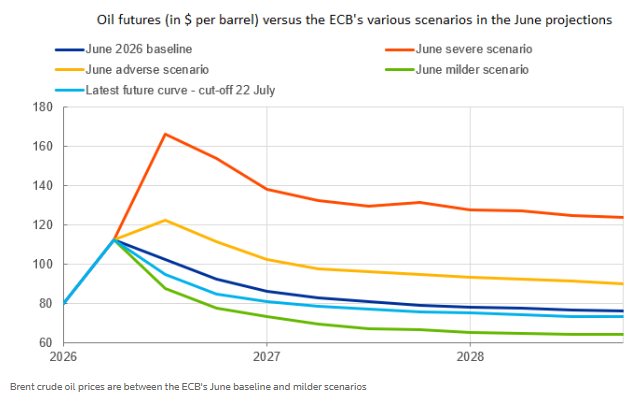
Lagarde will inevitably be asked how the Eurozone's economic performance compares to the baseline scenario set in June and the more pessimistic scenario. Despite the recent rise in oil prices, when considering the futures curve, the level is still close to a more moderate path for inflation to fall more quickly; in contrast, gas prices are closer to an unfavorable scenario.
Previously, thanks to a brief cease-fire, Lagarde described in early July that the risk of inflation was “more balanced” than when interest rates were raised in June; now that war has resumed, whether this statement will be adjusted again will become a key detail for the market to capture policy trends. At the same time, the ECB must also face medium- to long-term headwinds — ongoing trade tensions, high energy costs, and China's continued expansion in some of Europe's key export markets mean that Eurozone industry will continue to be pressured over the next few years, thereby curbing labor demand, which in turn will cause downward traction on wages and prices.
More than monetary policy: Lagarde's personal whereabouts add variables
In addition to the economic and interest rate path, Lagarde's press conference was also inevitably questioned about her personal future. This
The French governor continues to spark speculation — she may step down early before her term expires in October next year. Lagarde herself recently admitted that as early as February of this year, when the inflation target was close to the 2% target, she had considered leaving early, but since then, the US launched an attack on Iran to keep her in office.
Recently, she also announced plans to participate in the French election campaign in some capacity to raise the visibility of European issues, while at the same time saying that she would not personally seek public office. Meanwhile, there are endless rumors that she will be the permanent head of the World Economic Forum in Davos. Personnel uncertainty has added an additional sensitive dimension to the ECB's follow-up policy communication.