
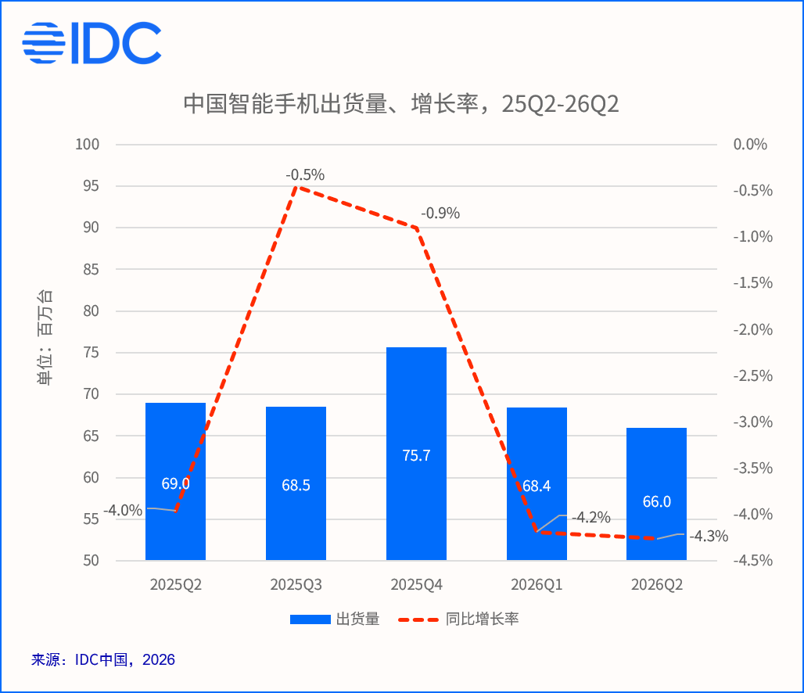
IDC: Shipments in the Chinese smartphone market in the second quarter were about 66.1 million units, down 4.3% year on year. There was a year-on-year decline for five consecutive quarters
The Zhitong Finance App learned that the latest quarterly mobile phone tracking report from the International Data Corporation (IDC) shows that in the second quarter of 2026, the Chinese smartphone market shipped about 66.01 million units, a year-on-year decrease of 4.3%. There has been a year-on-year decline for five consecutive quarters. Since late March, due to the continuous rise in the cost of core components such as storage, Android manufacturers have been forced to raise product prices or adjust configuration plans one after another, clearly suppressing consumers' desire to switch devices. At the same time, the demand-driving effect of the “national subsidy” policy is gradually weakening. Affected by this, during the “618” promotion this year, overall smartphone sales in China fell nearly 15% compared to the same period last year, showing short-term demand-side fatigue.
In the first half of 2026, the cumulative shipment volume of the Chinese smartphone market was about 134 million units, a year-on-year decrease of 4.2%. Despite the sharp rise in storage costs and the price of other materials remaining high, the impact on the market was not fully felt in the first half of the year. Judging from the manufacturer pattern, Huawei and Apple are firmly in the first tier of the market; OPPO and Vivo form the second tier; Xiaomi and Honor follow.
Leading manufacturers performed even better in the second quarter of 2026. Against the backdrop of the overall market downturn, leading manufacturers Huawei and Apple performed outstanding. The year-on-year increase in shipments in the second quarter reached 19.4% and 24.4%, respectively, making them the highlights in the market and ranked in the top two places. On the one hand, the two major brands continue to attract consumers with their strong brand strength; on the other hand, against the backdrop of widespread price increases from Android manufacturers, Huawei and Apple not only did not raise sales prices, but instead introduced targeted preferential promotion strategies, further strengthening their market competitiveness. In addition, Huawei continues to enrich its product line layout, improving the user experience through the Hongmeng system to cover a wider range of user needs; Apple, by releasing price increases for new products in the second half of the year ahead of schedule, prompted some consumers to make pre-purchase decisions and buy the iPhone 17 series in advance, further boosting current season shipments.
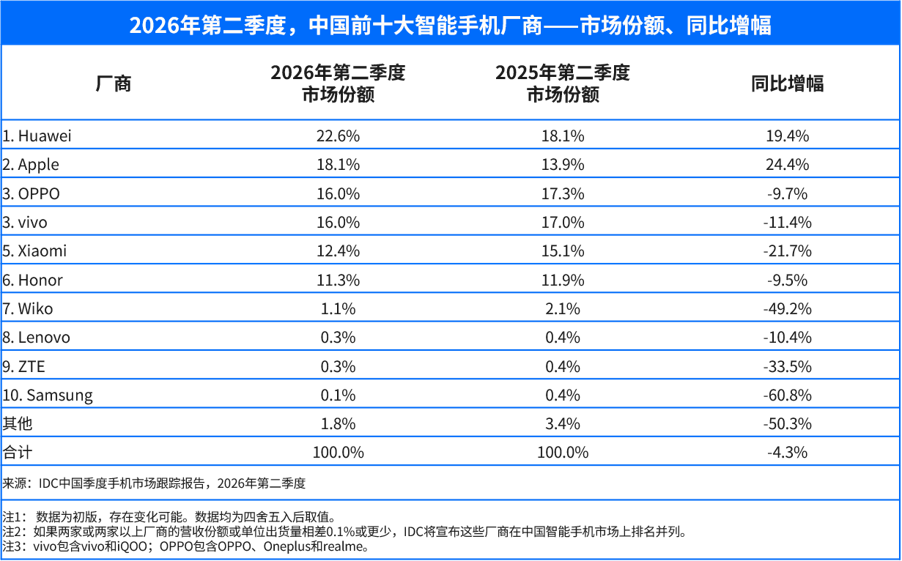
OPPO is in the top three in the industry, and its overall development is steady against the cycle. The brand's high-end results were outstanding, and the average quarterly price rose to $395, continuing to lead leading Android vendors. The mid-range Reno series firmly occupies the leading position in the 400-600 US dollar Android middle and high-end market, establishing a basic sales market; the high-end Find X9 series and the crease-free folding flagship Find N6 are booming, helping OPPO's shipments in the $600 and above price segment to achieve three-digit year-on-year growth for two consecutive quarters. The sub-brand OnePlus performed well and was the only brand in the Android camp that maintained year-on-year growth. Relying on a product layout that stabilizes the market in the mid-range, continues to break through at the high-end, and accurately reaches young consumers, OPPO has shown strong operational resilience and market competitiveness in an environment where industry costs are under pressure and demand is weak.
Vivo relies on two-wheel drive in the mid-range and high-end markets to maintain stable market performance. The brand is at the top of the market in the price range below $400, consolidating the sales base with inclusive models; the high-end market continues to gain strength, the X300 series continues to consolidate its professional video benchmark advantage, and the iQOO 15 series is deeply involved in the e-sports performance circuit to accurately absorb young consumers. Thanks to the combined efforts of multiple products, vivo leads the Android camp in the high-end market above $600, and its leading edge continues to expand. The market popularity of the new folding flagship X Fold6 is rising, and the weekly sales volume of the first sales week has increased significantly compared to the same period of the previous generation. The balanced layout of the full price segment and the differentiation of image and performance have broken through, so that vivo can better cope with fluctuations in the industry cycle.
Honor's steady performance among leading mainstream manufacturers has been outstanding, and its business resilience is outstanding. The X80 Pro Max series quickly climbed to the top of the Android best-selling model list after its launch; the Power series relied on ultra-long battery life to create differentiated advantages and accurately cover users in need of battery life; the Win series continued to set a benchmark in the performance model industry through low-level in-depth performance adjustments. Honor's performance on the folding screen circuit is also stable, and the popularity of the new Magic V6 market is increasing, helping Honor stabilize its second place in the domestic folding screen market. The differentiated collaboration of multiple product lines supports Honor's smooth operation during the industry adjustment period.
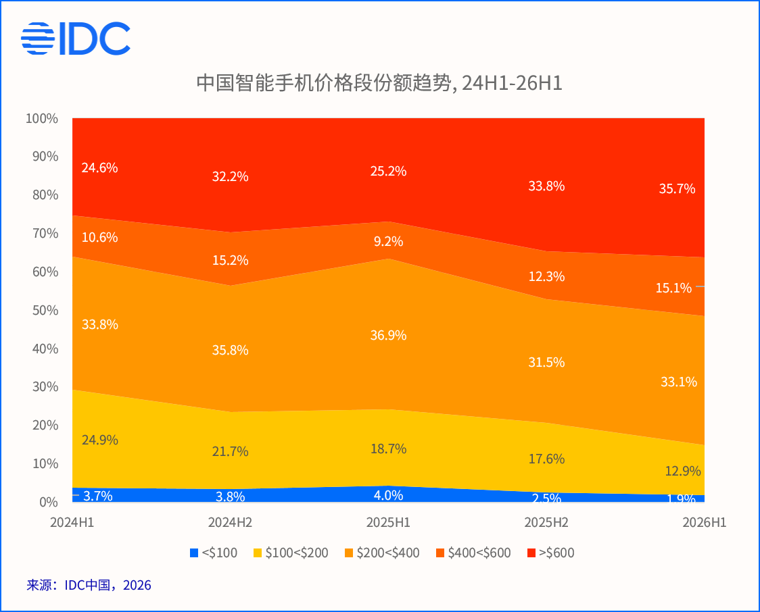
Under cost pressure, China's low- and middle-end smartphone market share has shrunk significantly
In the first half of 2026, the price of memory chips continued to rise, compounding the overall rise in the cost of various upstream components. The domestic smartphone industry was clearly under pressure, and the market price structure ushered in significant differentiation. Affected by the cost squeeze, the profit margin for mid-range and low-end models under $400 continued to narrow, and major brands took the initiative to reduce the production capacity and launch pace of low-end models. The market share in this price segment declined sharply by 11.8 percentage points over the same period last year. Manufacturers are concentrating R&D and production capacity resources on middle and high-end products with more profit margins, and the market focus is rapidly shifting upward: the share of the high-end price segment of $400-600 increased by 5.9 percentage points over the same period last year, and the high-end market share of $600 or more expanded by 10.4 percentage points, and the trend of high-end transformation of the industry is becoming more and more clear.
Guo Tianxiang, research manager at IDC China, pointed out that as the low-cost inventory materials purchased by various manufacturers in the early stages are gradually exhausted, cost pressure will be released centrally in the second half of the year. It is expected that the year-on-year decline in China's smartphone market shipments may expand to around 20% in the second half of 2026. Looking ahead to 2027, it is difficult for storage prices to fall significantly, and the overall market will still face serious challenges. But there's no need to be overly pessimistic — consumers' demand for mobile phone use is not going away; it's just a delay in release. As an indispensable terminal device for everyone, the central position of a mobile phone will not waver. It is expected that from 2028 to 2029, with the arrival of a new rotation cycle, the market is expected to recover.
AI has become an important variable affecting the development of the mobile phone industry in the future
An important variable in the mobile phone industry in the future is that the deep participation or even direct entry of more software developers and big model companies is expected to reshape the competitive landscape of the mobile phone industry. The “AI Agent” mobile phone concept is expected to become a key direction for the industry to break the game. However, it should be pointed out that the actual implementation of AI is inseparable from the collaborative integration of the four major elements of hardware, system, ecology, and big models, all of which are indispensable. Only the deep integration of the four can drive AI from concept to practical application, bring users a real leap forward in experience, and thus stimulate the demand for a new round of switching.