
Are US bonds ushered in the best entry window in 20 years? BlackRock bucked the trend and sang a lot: fearless to raise interest rates and build an “anti-decline buffer” with high yields
The Zhitong Finance App learned that BlackRock, the world's largest asset management company, released a fixed income outlook report for the third quarter on Thursday, clearly stating that against the backdrop of continued high US bond yields, US Treasury bonds are providing investors with the strongest “anti-fall protection” in recent years. According to the report, the fixed income market is ushering in “richer investment opportunities” as inflation and economic growth gradually slow down from their highs in the first half of the year, compounded by AI-driven structural economic changes.
This judgment coincides with a sharp sell-off in the US bond market — the 10-year yield is close to a two-month high of 4.66%, and the 30-year period has been above 5% for many consecutive days — BlackRock's reverse layout signals are worth the market's attention.
Yield “safety cushion”: a 10-year increase of 70 basis points will lead to loss
Chi Chen, a senior portfolio manager at BlackRock and co-managing BlackRock's $18 billion total return fund, wrote in the report that the current yield level provides a “substantial buffer” for further sell-off in the interest rate market. The yield on US Treasury bonds up to 10 years is far above 4%, and the yield on longer-term treasury bonds is higher than 5%, which means that the compensation investors receive for holding bonds has increased significantly, and market valuations are “becoming more attractive.”
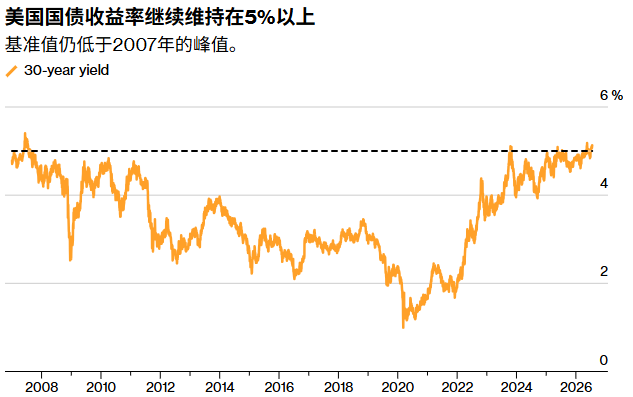
BlackRock estimates that the 10-year US Treasury yield will need to rise by about 70 basis points from the current level before the total one-year return becomes negative. This “safety pad” thickness has been extremely rare in the fixed income market for the past 20 years. Rick Rieder, BlackRock's chief investment officer for global fixed income, said in an interview: “We are in an environment where real interest rates are much higher than in the past 20 years. “While enjoying the rewards of higher real interest rates and higher returns, I think interest rate volatility will remain low.”
Declining Inflation and Growth Divergence: BlackRock's Core Macro Judgment
BlackRock's macroeconomic judgments formed the basis for its well-earned optimism. The report predicts that US inflation and economic growth will slow from the first half of this year. This judgment is in line with the latest data — the overall US CPI fell 0.4% month-on-month in June, the biggest monthly decline since April 2020. The year-on-year increase fell back to 3.5%, a significant drop from 4.2% in May.
However, Rieder also pointed out that the driving force for US economic growth is becoming “more concentrated.” AI investment is the main engine of economic resilience — capital expenditure of hyperscale cloud service providers soared nearly 80% year over year, helping to offset the weakness of interest-sensitive industries such as housing. But he also warned that the employment growth brought about by AI was uneven: the three-month annualized employment growth in the medium AI exposure industry was 1.63%, the low-exposure industry was 1.55%, while high-exposure industries (such as insurance) had turned negative growth (-0.29%).
This macro-picture of “centralized growth” means that future fixed income returns will rely less on broad market exposure and more on active industry allocation, strict securities selection, and diversified revenue sources.
Interest rate hike expectations are divided: BlackRock's “hawkish pricing” dispute with the market
Currently, the most significant difference between the market and BlackRock is the expectation of the Federal Reserve's policy. The report bluntly stated: “The market is pricing the Fed's policy path more hawkish than we expected.”
According to the swap agreement, traders have fully set the interest rate hike in October, and monetary policy is expected to be tightened by about 43 basis points by the end of the year. According to the CME Federal Reserve observation tool, as of July 23, the probability that the Fed will raise interest rates by 25 basis points in September is 54.6%. Driven by further tension in the US and Iran, US bond yields have been rising for three consecutive days, and the probability that the Federal Reserve will raise interest rates by 25 basis points in July has risen to 37.9%.
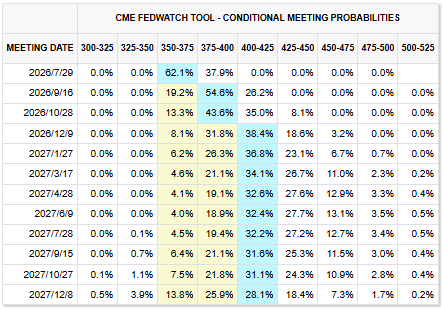
Rieder's basic expectation is that the Federal Reserve will stay on hold for at least July and September, not raise interest rates this year, and possibly shift to easing in 2027. He believes that the Federal Reserve under the new Chairman Walsh will reduce its reliance on forward-looking guidance and make more use of broader policy tools such as balance sheets, liquidity conditions, and money supply dynamics.
This disagreement is directly reflected in BlackRock's four potential return scenarios for the Bloomberg US Treasury Index:

Even under the most unfavorable 100 basis point rate hike scenario, treasury bond returns were positive — this is a quantitative confirmation of BlackRock's “anti-fall protection” logic.
A New Paradigm of Policy in the Walsh Era: Shorter Statements, Fewer Guidelines, More Tools
BlackRock sees Walsh's presidency of the Federal Reserve as the beginning of a “real new era.” According to the report, Walsh has reduced the FOMC statement from an average of more than 200 words to less than 100 words, and made it clear that the shorter format “only gives you facts.” This approach has been described by Walsh himself as deliberately moving away from forward-looking guidance — he believes this tool is “inappropriate for the current policy crisis situation.”
On the issue of inflation, Walsh reiterated the Fed's commitment to the 2% target, even though inflation has been above that level for more than five years. BlackRock's price pressure tracking through alternative data sources such as web scraping pricing and retail gasoline costs shows that inflation may have eased from recent highs.
BlackRock Fund Manager said, “Ultimately, these statements need to be supported by action, or confirmed by easing inflation.” This means that the credibility of Walsh era policies will ultimately be defined by actual inflation data rather than rhetoric.
Investment strategy: profit first, interest is king, intensive cultivation
Based on the above judgment, BlackRock's fixed income investment strategy can be summarized into four core principles:
First, profit is prioritized rather than directional long-term bets. The report tends to “adopt a revenue-first strategy rather than establish a larger directional long-term position before the data more clearly verifies the market shift.” Rieder summed it up as “dynamic patience” — making sure you're getting ticket interest and finding the best opportunities.
Second, the credit market is centered on coupon income. The report argues that credit “still supports arbitrage transactions,” and that relatively low risk means “future returns may depend less on narrowing interest spreads and more on the growth of profits and compound interest income over time.”
Third, securitized assets are superior to corporate credit. Rieder made it clear: “The securitization market still provides value compared to the investment-grade credit market. The US investment-grade credit market is heavily supplied by data centers and hyperscale cloud service providers. I don't think American investment-grade credit is attractive at all.” Specific areas he is currently optimistic about include non-institutional mortgages, commercial mortgage-backed securities, and institutional mortgage-backed securities — the latter having lower interest rate volatility than investment-grade corporate bonds.
Fourth, global dispersion and tactical allocation. Rieder is diversifying its investment in the European credit market — European data centers are in short supply, and the market has taken into account the ECB's expectations of three rate hikes. At the same time, he is making tactical allocations in emerging markets such as Mexico, but remains cautious about dollar fluctuations. He also increased profits by selling interest rate volatility through options strategies.
The “revenue window” of the US bond market once every 20 years?
BlackRock's $15.3 trillion management scale makes every quarterly outlook a “weather vane” for global capital markets. In the current context where the US bond market is experiencing drastic fluctuations, BlackRock's core message is clear and firm: a long-term yield of 5% provides a sufficiently thick “safety cushion” to enable bondholders to receive positive returns even in the face of the impact of interest rate hikes.
This judgment is based on three pillars: the gradual decline of inflation from a high level, the drive for economic growth is concentrated but has not stalled, and the restructuring of the Federal Reserve's policy framework in the Walsh era may reduce interest rate volatility. For investors, BlackRock's proposed path is also clear: stop trying to predict the timing of every change in interest rates, focus on getting coupon income, and work hard in securitized assets and global credit markets.
“In the field of fixed income, I call it dynamic patience — it means making sure you're getting interest and finding the best opportunities,” Rieder said. After experiencing the most intense interest rate cycle in decades, the bond market is finally once again a place to “make money on interest” — and for BlackRock, this is probably the best entry window in 20 years.