
NextEra Energy Stock Faces Rising Rate Pressure As Oil And Yields Climb
Oil above $100 a barrel and US Treasury yields above 4.7% on the 10-year and 5.18% on the 30-year are not just headlines; they directly influence company costs, financing, and valuations. Some stocks can potentially benefit when rates rise or energy prices spike, while others may face pressure from higher fuel bills or more expensive debt. This article walks through three stocks exposed to these twin shocks, explaining one case where the backdrop could be a tailwind and two where it may be a clear risk to monitor before committing fresh capital.
Bank of Southside Virginia Corporation The (BSSC)
Overview: Bank of Southside Virginia Corporation The is a regional financial services company that, through its community bank in Virginia, offers everyday banking products, personal and commercial loans, and a broad range of insurance and wealth services to households, farms, small businesses, and local organizations.
Market Cap: US$130.8 million
Bank of Southside Virginia Corporation The stands out as a small, locally focused lender that could be sensitive to higher interest rates, with the potential for wider net interest margins when yields move up, while its funding and liquidity profile call for closer attention. The bank has outperformed the broader US market and US banks sector over the past year. However, the absence of reported financials, limited trading history, and a board with no independent directors raise important questions around transparency, governance, and risk that investors should weigh carefully. For those willing to do the extra homework on a thinly covered stock, the mix of recent share price strength, rate exposure, and information gaps may present an unusual opportunity that is not fully appreciated by the wider market.
Bank of Southside Virginia Corporation The’s share price strength and rate sensitivity hint at a story investors may be underestimating, but the real tension sits in its governance and transparency, highlighted in the 3 warning signs (2 are major!)

NextEra Energy (NEE)
Overview: NextEra Energy is a large US utility that generates and sells electricity through Florida Power & Light and its NextEra Energy Resources arm, using a mix of wind, solar, nuclear, natural gas, battery storage, and other clean energy assets to serve about 6 million customer accounts in Florida and wholesale customers across North America.
Operations: NextEra Energy generates most of its revenue from Florida Power & Light at about US$18.5b, with a further US$8.9b from NextEra Energy Resources and US$0.4b from corporate and other activities.
Market Cap: US$183.4b
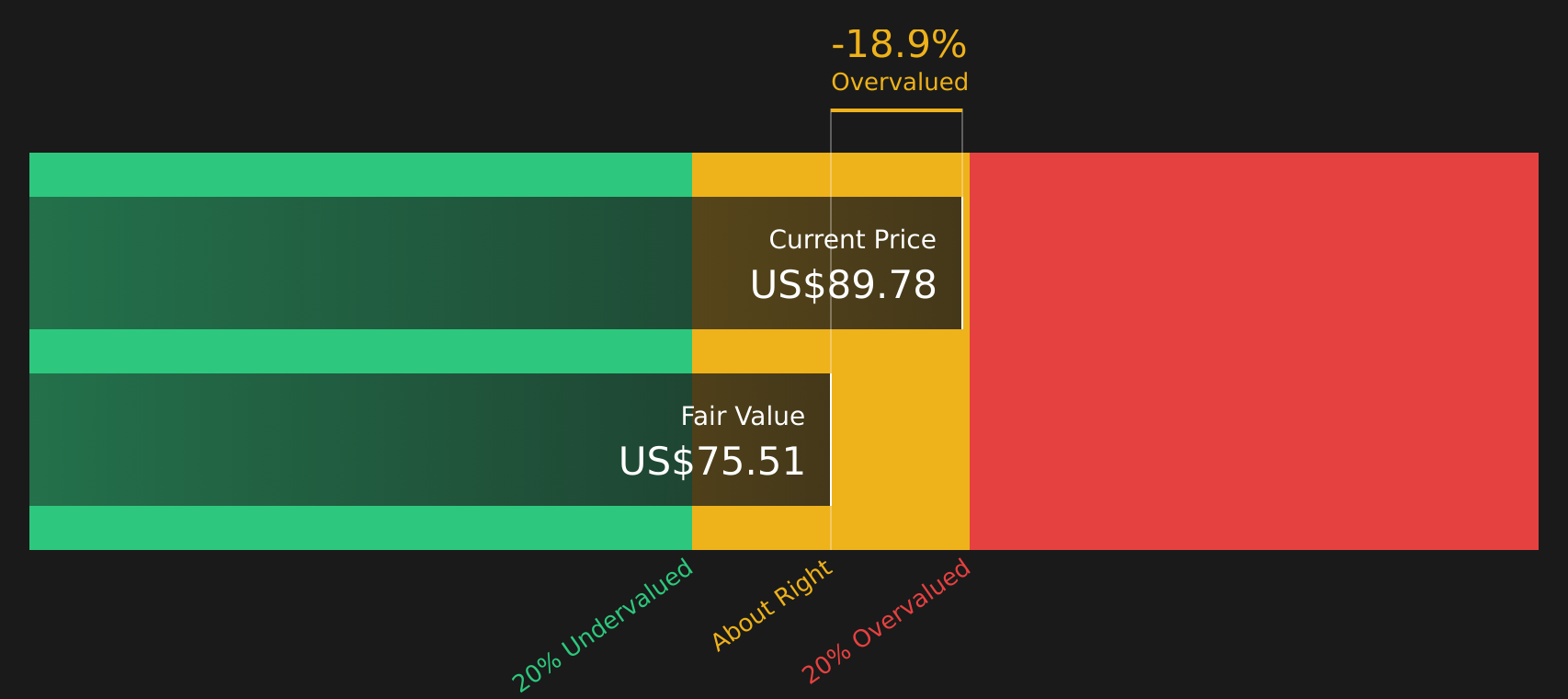
Investors looking at NextEra Energy should weigh its exposure to rising bond yields against the appeal of its scale in renewables, AI driven data center power demand, and a large regulated utility base. The company is planning heavy capital spending and potential acquisitions, which depend on affordable financing and supportive regulators at a time when long term yields are higher and funding costs matter more. Valuation already sits near peers on P/E and above a cash flow based estimate, while dividends are not well covered by free cash flow, leaving limited room for error if financing or regulatory conditions tighten. The risk is that you are paying up for growth just as the cost of delivering that growth is becoming more expensive.
NextEra Energy’s growth story may be masking how exposed it is to higher long term yields, heavy capex, and thin free cash flow cover. Before assuming the market has priced that in, check the 2 key rewards and 2 important warning signs (1 is major!)
American Airlines Group (AAL)
Overview: American Airlines Group is a major US network airline that carries passengers and cargo across the United States, Latin America, the Atlantic, and the Pacific through a broad hub system and partnerships with global carriers.
Operations: American Airlines Group generates about US$56.0b from air transportation, with around US$36.1b coming from the United States and the rest spread across Latin America, the Atlantic, and the Pacific.
Market Cap: US$9.8b
American Airlines Group looks interesting in this oil and yield shock context because it sits at the crossroads of robust traffic and very tight financial flexibility. Revenue is growing, yet recent results show a sharp margin squeeze, with net income of just US$71m in Q2 2026 and a loss over the first half, while fuel and labor costs stay heavy and the balance sheet carries high debt and negative equity. Surging oil above US$100 and higher borrowing costs directly threaten already thin margins and interest coverage, just as analysts are counting on high future earnings growth and a richer loyalty and premium offering to do the heavy lifting. The real question is whether this fragile setup can withstand a prolonged period of expensive fuel and funding.
American Airlines Group’s thin margins, heavy debt, and negative equity suggest investors may be missing how fragile this setup really is in a world of expensive fuel and funding, so it is worth reading the 2 key rewards and 4 important warning signs (2 are major!)

Take Control of Your Investment Journey
If NextEra Energy or any of these companies have caught your attention, register for FREE with Simply Wall St and add your companies to a Watchlist to monitor the share price against the fair value and track any new developments as they happen. Once you've made your move, manage your holdings with our Portfolio Command Center that filters out the noise to deliver only the most critical, actionable updates. Throughout your journey, our Community allows you to filter the best ideas from thousands of investor perspectives. By uncovering hidden catalysts and risks early, you'll accelerate your decision-making and stay one step ahead of the market.
Seeking Fresh Alternatives Before Others Do?
Markets move fast, and the next breakout stories can be flying under the radar for now. To identify fresh momentum and potential entry points before the crowd, consider acting early and systematically.
- Target early price shifts and balance sheet strength with a curated set of resilient companies by scanning the 82 resilient stocks with low risk scores while conditions may still suit patient investors.
- Look for potential breakout leaders in AI infrastructure and robotics by reviewing the hand picked group of 54 AI infrastructure stocks before valuations draw broader attention.
- Explore under followed mineral trends by checking the focused basket of 29 best rare earth metal stocks while these producers remain relatively overlooked and prices may still be adjusting.
This article by Simply Wall St is general in nature. We provide commentary based on historical data and analyst forecasts only using an unbiased methodology and our articles are not intended to be financial advice. It does not constitute a recommendation to buy or sell any stock, and does not take account of your objectives, or your financial situation. We aim to bring you long-term focused analysis driven by fundamental data. Note that our analysis may not factor in the latest price-sensitive company announcements or qualitative material. Simply Wall St has no position in any stocks mentioned.
Have feedback on this article? Concerned about the content? Get in touch with us directly. Alternatively, email editorial-team@simplywallst.com